Can a Bulging Disc Become a Herniated Disc? – Mira Mesa, CA
My MRI Says "Bulging Disc." Is It Only Going to Get Worse?
When patients from Mira Mesa come into our office with a recent MRI, one concern comes up over and over again.
"My MRI says I have a bulging disc. Does that mean it's eventually going to become a herniated disc?"
It's a fair question.
Most people don't know the difference between a bulging disc, a protrusion, or a herniated disc until they're the ones living with the pain. By that point, they've often spent weeks—or even months—trying to figure out why their back hurts, why they're developing sciatica, or why their foot suddenly feels numb.
The MRI provides valuable information, but it doesn't always tell the whole story.
One of the biggest misconceptions is that every bulging disc eventually becomes a herniated disc.
Fortunately, that simply isn't true.
Some bulging discs remain stable for years. Others progress over time. The difference depends on several factors, including the health of the disc, everyday mechanical stress, genetics, previous injuries, and whether the injured disc begins irritating a nearby spinal nerve.
Understanding that difference is important because treatment decisions should never be based on one sentence in an MRI report.
Quick Answer
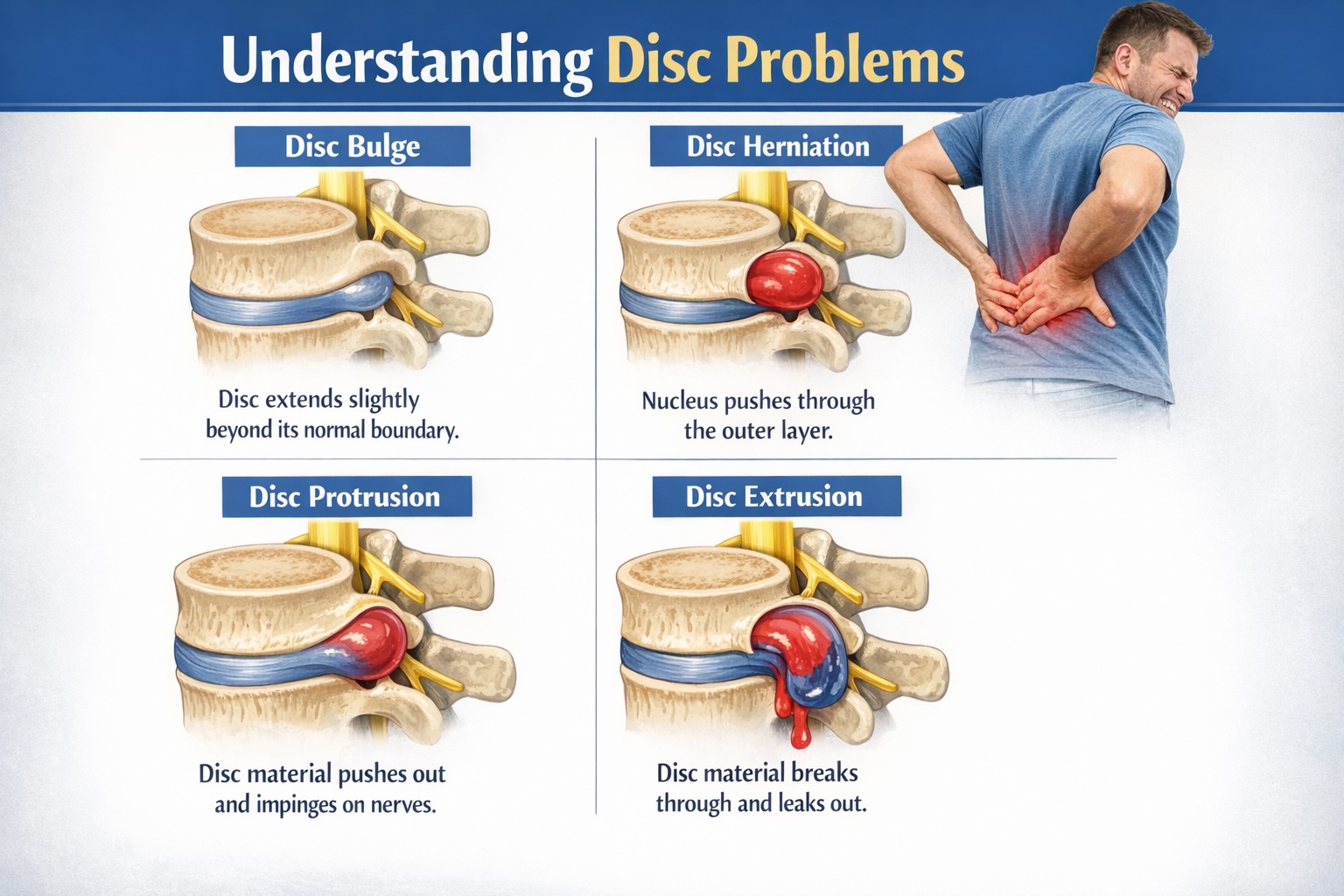
Yes, a bulging disc can become a herniated disc, but many never do. A bulging disc means the outer fibers of the disc have begun to extend beyond their normal boundaries while remaining intact. A herniated disc occurs when those outer fibers weaken enough to allow part of the inner disc material to move outward. Whether that happens depends on several factors, and many patients improve with conservative care without ever requiring surgery.
What this means for you:
An MRI is an important part of the evaluation, but it doesn't automatically determine whether your condition is serious or whether surgery will be necessary.
Wondering Whether You're a Candidate?
If you've recently been diagnosed with a bulging disc, herniated disc, sciatica, degenerative disc disease, or chronic neck or back pain, Dr. Cassidy James Boelk would be happy to help you better understand your diagnosis.
Schedule a No-Charge Consultation
During your visit we'll:
✔ Review your MRI (if you've already had one)
✔ Explain what your imaging actually means
✔ Perform a thorough examination
✔ Discuss whether you're an appropriate candidate for treatment
✔ Answer all of your questions honestly
If Dr. Boelk believes another treatment option is more appropriate, he'll tell you.
The Spinal Decompression & Chiropractic Center of San Diego
5095 Murphy Canyon Road, Suite 300
San Diego, CA 92123
☎ 619-298-0800
✔ 24-Hour Live Answering Service
✔ Hablamos Español
One Patient's Experience
Every patient arrives with a different story.
Some have lived with back pain for years.
Others develop severe symptoms almost overnight.
Anthony came to our office after dealing with a recurrent bulging disc that eventually irritated his sciatic nerve. Like many patients, he had already exhausted several treatment options before searching for a non-surgical alternative.
“I travel from the UK to see Dr Boelk and his wonderful team . I have 3 bulging disc and one is touching the nerve. I have the spinal decompression treatment and it really helps keep me in my active life . I will not go to anyone else for back treatment, this place is number one and they genuinely care about their patients.”
— Lisa S., United Kingdom
**“Last year, I spent three months constantly going back and forth between doctor’s appointments and urgent care. The pain was unbearable—I was taking medication regularly just to get through the day. Getting out of bed was excruciating, and walking or standing felt like torture. Every step filled me with dread.
In December, my doctor finally ordered an MRI. That’s when I learned I had an extruded disc pressing on my L5 nerve, which affects the leg and foot. My doctor scheduled two follow-up appointments: one for pain management (spinal injections), and another to evaluate me for surgery.
Then I discovered spinal decompression therapy. I was thrilled to find a non-invasive alternative. I never ended up needing either of those appointments.
Now, I’m walking regularly, standing up straight—something I couldn’t do before. When I first sought help, I was so hunched over that I had to use a cane just to move forward. Because of the pain, I hadn’t exercised in months. But now, I’m doing a program called 75 hard which requires not one but 2 45-minute workouts per day, and I've even gotten back to lifting weights!
I’m so thankful I found this place. It’s conveniently located near my work, which makes it easy to fit sessions into my lunch break. Dr. Boelk and the staff are incredibly friendly and polite—it’s always a pleasure to come in.
The environment is so relaxing that I look forward to each visit. I truly thank God for leading me to this alternative. It’s made such a difference in my life.”**
— Amanda, San Diego, CA
What's the Difference Between a Bulging Disc and a Herniated Disc?
These terms are often used interchangeably, but medically they describe different stages of a disc injury.
A bulging disc occurs when the outer portion of the disc begins pushing beyond its normal borders while remaining intact.
A herniated disc develops when the outer fibers weaken or tear, allowing some of the softer inner disc material to move farther outward.
That distinction matters.
Not because one name sounds worse than the other...
But because the location of the injured disc often determines whether a nearby nerve becomes irritated.
Some bulging discs cause significant symptoms.
Some herniated discs cause surprisingly little pain.
This is why your MRI should always be interpreted together with your symptoms and examination.
What this means for you:
Treat the patient—not just the MRI.
"I Was Fine Until I Bent Over."
One of the most common stories we hear goes something like this.
"I bent over to pick something up..."
Or...
"I reached into the washing machine..."
Or...
"I sneezed."
Then suddenly...
Back pain.
Sciatica.
Pain shooting down the leg.
Most people blame that one movement.
In reality, it's usually much more complicated.
Disc injuries often develop gradually. Years of repetitive bending, lifting, prolonged sitting, previous injuries, sports, or simply the normal aging process slowly change the structure of the disc.
Eventually, one ordinary movement becomes the moment the symptoms appear.
What this means for you:
Instead of asking, "What did I do wrong yesterday?", it's often more helpful to ask, "What has been happening to my spine over the past several years?"
That question usually leads to better long-term decisions.
Does Every Bulging Disc Become a Herniated Disc?
No.
Many never do.
Several factors influence whether a bulging disc progresses, including:
- Age
- Genetics
- Smoking
- Repetitive lifting
- Excess body weight
- Previous spinal injuries
- Long hours of sitting
- Overall disc health
Although no one can predict exactly what every disc will do over time, understanding these risk factors allows patients to make better decisions about protecting their spine.
What this means for you:
A bulging disc is not a guarantee that a herniated disc is in your future.
From Dr. Cassidy James Boelk
One of the things I enjoy most during a consultation is reviewing a patient's MRI together.
Many people arrive convinced the report contains terrible news because they don't fully understand the terminology.
Once we go through the images together, explain what they're actually seeing, and compare those findings with their symptoms, many patients tell me they finally understand what's happening.
Over the years, I've learned that the MRI often raises anxiety before it provides clarity.
That's why I believe patients deserve more than a written report.
They deserve someone willing to sit down, explain what the findings mean, answer their questions, and honestly discuss whether those MRI findings actually explain the symptoms they're experiencing.
Too often, that's the missing piece.
Can a Bulging Disc Heal?
One of the first questions patients ask is whether a bulging disc will eventually heal on its own.
The honest answer is—it depends.
Some people recover with little or no lasting symptoms. Others continue having flare-ups because the injured disc keeps irritating a nearby nerve.
One thing that's important to understand is that spinal discs heal differently than muscles or skin. Because they have a limited blood supply, recovery often takes longer than patients expect.
Here's the encouraging part.
Many people feel dramatically better even though their MRI still shows a bulging disc.
The goal isn't to create a perfect MRI.
The goal is helping you get back to work, sleep through the night, enjoy your family, and return to the activities you love.
Takeaway: Pain and function are often more important than the wording on an MRI report.
Why Does Sitting Make My Pain Worse?
This is one of the most common questions we hear.
Think about your typical day.
- Drive to work.
- Sit at your desk.
- Drive home.
- Eat dinner.
- Watch television.
Before you know it, you've spent 8–10 hours sitting.
For an injured lumbar disc, that's a lot of repetitive stress.
That's why many people say:
"Walking feels better than sitting."
Takeaway: If sitting consistently increases your symptoms, it's worth discussing with your doctor.
What Should You Do Next?
Every spine is different, but these habits often help reduce unnecessary stress on an injured disc.
✔ Walk frequently.
✔ Avoid prolonged sitting.
✔ Lift with proper mechanics.
✔ Change positions often.
✔ Stay active if tolerated.
✔ Get an accurate diagnosis.
Small changes performed consistently usually make a much bigger difference than one major change.
Common Myth
"Every Herniated Disc Requires Surgery."
Fortunately, that's simply not true.
Some patients recover with conservative treatment.
Others need surgery.
The difference isn't determined by one sentence on an MRI—it's determined by the complete clinical picture.
Takeaway: Treat the patient, not just the MRI.
Why Patients Choose Dr. Cassidy James Boelk, DC
Choosing the right provider isn't just about treatment—it's about getting the right diagnosis first.
✔ 22+ Years — Treating spinal disc injuries.
✔ Certified Spinal Decompression Doctor — Advanced disc care.
✔ Certified PPSC — Rehabilitation and biomechanics.
✔ Founder — Spinal Decompression Training Academy.
✔ 100,000+ Treatments — Extensive clinical experience.
✔ Personally Reviews Every MRI — Imaging matched to symptoms.
✔ 7 DRX9000® Systems — 4 lumbar • 3 cervical.
✔ Patients Travel Worldwide — Trusted by patients near and far.
✔ Honest Candidate Selection — If you're not a candidate, he'll tell you.
From Dr. Cassidy James Boelk DC
One of the biggest misconceptions I see is that patients become more worried about the MRI report than the condition itself.
I've reviewed thousands of MRI studies over the years, and one lesson continues to stand out.
The MRI is incredibly valuable—but it doesn't tell the whole story.
I've seen patients with large herniated discs who function surprisingly well, and I've seen patients with much smaller disc injuries who struggle to sit because of where the disc is pressing on a nerve.
That's why I never recommend treatment based on imaging alone.
My goal is to understand your symptoms, your examination, your MRI, and your goals before recommending a treatment plan.
Sometimes that means treatment in our office.
Sometimes it means recommending another option.
Either way, you'll receive my honest opinion.
Frequently Asked Questions
Can a bulging disc become a herniated disc?
Yes, but many never do.
Can a bulging disc heal?
Many patients improve without surgery.
Will I need surgery?
Not necessarily. Many patients recover conservatively.
Why does sitting make it worse?
Sitting places greater stress on lumbar discs.
Can walking help?
For many patients, yes—if it's comfortable.
“I highly recommend Dr. Cassidy Boelk, DC and the team at The Spinal Decompression and Chiropractic Center. I came in with severe sciatica and a herniated disc, and his treatments have made a world of difference. He and his staff are both professional and genuinely caring, creating a welcoming and supportive environment. The treatments were not only highly effective but also tailored to my specific needs. I’m grateful for the care I received and the significant improvement in my quality of life.”
— Brian Perrotta, San Diego, CA
Wondering If You're a Candidate?
If you'd like to find out whether you may be a candidate for treatment, we'd be happy to meet with you.
Schedule a No-Charge Consultation
✔ Honest Evaluation
✔ MRI Review
✔ No Obligation
✔ 24-Hour Live Answering Service
✔ Hablamos Español
The Spinal Decompression & Chiropractic Center of San Diego
📍 5095 Murphy Canyon Road, Suite 300
San Diego, CA 92123
☎ 619-298-0800