Can You Have Sciatica Without Back Pain? | Tierrasanta, CA
Yes. You can have sciatica without having much lower-back pain at all.
This is one of the things that confuses patients the most.
Someone may have burning pain through the buttock and down the leg, numbness in the foot or tingling in the toes, but their lower back feels relatively normal. Because their back doesn't hurt, they assume the problem must be in the hip, hamstring or leg.
Sometimes it is.
But sometimes the problem is actually coming from a nerve in the lower spine.
Dr. Cassidy James Boelk, DC has treated patients with disc injuries and sciatica for more than 22 years and has performed more than 100,000 spinal decompression treatments. He regularly sees patients whose main complaint isn't back pain at all.
It's the leg.
That's why one of the first things Dr. Boelk wants to know is exactly where your symptoms go.
Does the pain stop in the buttock? Does it run behind the thigh? Does it go below the knee? Is your calf burning? Is part of your foot numb?
Those details can tell us much more than simply asking, “Does your back hurt?”
⭐⭐⭐⭐⭐ Patient Experience
Toni H. had dealt with back pain and sciatica for years and had already tried several different approaches before coming to Dr. Boelk.
“For the first time in 10 years, I am completely pain-free. My sciatca is gone, and I no longer have back pain.
Before finding Dr. Boelk, I tried chiropractic care, acupuncture, pain medications, and several other therapies that simply didn't work. I was one step away from back surgery when I discovered spinal decompression treatment at The Spinal Decompression & Chiropractic Center of San Diego.
The results have been incredible. Every visit was comfortable, relaxing, and completely pain-free. Dr. Boelk and Patty always took the time to explain everything and made me feel genuinely cared for throughout the process.
They are warm, welcoming, and truly dedicated to helping their patients.
Thank you, Dr. Boelk and Patty!”
— Toni H., San Diego, CA
Toni had both back pain and sciatica, but that's not always the case.
Some patients have almost the opposite presentation. Their back barely bothers them, yet the pain in the buttock or leg can make sitting, driving, sleeping or walking miserable.
The amount of back pain doesn't necessarily tell Dr. Boelk how irritated a nerve may be.
Start With a No-Charge Consultation With Dr. Boelk
If you're in Tierrasanta and have persistent pain, burning, tingling or numbness down one leg, you don't have to diagnose yourself before making an appointment.
You can start with a No-Charge, No-Obligation Consultation personally with Dr. Cassidy James Boelk, DC.
The purpose is simple: find out what's going on and whether Dr. Boelk believes you're a candidate for the type of treatment provided at the office.
During your consultation, Dr. Boelk will:
-
Listen to how the problem started and how it has changed.
-
Go through exactly where your symptoms travel.
-
Discuss any pain, burning, numbness, tingling or weakness.
-
Review what makes the problem better or worse—sitting, standing, walking, driving, bending, coughing, sneezing or exercising.
-
Discuss treatments you've already tried and how you responded.
-
Review your actual MRI images and report, if available.
-
Compare what he sees on your MRI with what you're actually experiencing.
-
Discuss whether further examination or imaging may be appropriate.
-
Determine whether Non-Surgical Spinal Decompression may be an option.
-
Tell you if he doesn't believe you're a candidate.
-
Answer your questions and explain what he believes the next step should be.
Don't have an MRI? That's okay. You can still schedule the consultation.
There is no charge and no obligation to start treatment.
Why are the No-Charge Consultations limited?
Because Dr. Boelk personally performs them.
He reviews the patient's history and available imaging himself while continuing to care for the patients already undergoing treatment in the office.
That means there are only so many consultation appointments he can set aside during the clinic schedule.
If you've already spent weeks or months wondering whether the pain in your leg is actually sciatica, you don't have to wait for your lower back to start hurting before getting it checked.
Call 619-298-0800 and ask about the next available No-Charge Consultation with Dr. Cassidy James Boelk, DC.
How Can Sciatica Hurt Your Leg but Not Your Back?
Because the place where a nerve is irritated and the place where you feel the symptoms aren't always the same.
The nerve roots that contribute to the sciatic nerve originate in the lower spine.
When one of those nerves becomes irritated or compressed, symptoms can be felt farther along the nerve's pathway.
That's why someone may feel pain in the buttock, calf or foot even though the lower back itself doesn't particularly hurt.
It also explains something Dr. Boelk sees quite often.
A patient may spend weeks treating the area where the pain is located without realizing the problem may be coming from somewhere else.
The buttock hurts, so they massage the buttock.
The hamstring feels tight, so they stretch the hamstring.
The calf hurts, so they work on the calf.
Sometimes that's exactly what they need.
But if an irritated lumbar nerve is producing those symptoms, repeatedly treating the painful part of the leg may not address the source.
“My Hamstring Is So Tight I Can't Stretch It Enough”
This is another comment Dr. Boelk hears from patients with sciatica.
The back of the leg feels incredibly tight, so they stretch harder.
But nerve-related symptoms don't always behave like a tight muscle.
If you stretch your hamstring and feel a normal muscular pull that feels better afterward, that's one thing.
If stretching produces burning, tingling or causes pain to travel farther down the leg, pay attention to that.
The sensation you are interpreting as a tight hamstring may not be entirely muscular.
That's another reason getting the diagnosis right matters.
Where Does the Pain Go?
When Dr. Boelk evaluates someone with possible sciatica, he wants specifics.
For example:
-
Does the pain start in the lower back or buttock?
-
Does it travel through the back or outside of the thigh?
-
Does it go below the knee?
-
Is the calf painful or burning?
-
Is part of the foot numb?
-
Which toes are affected?
-
Is there tingling?
-
Does one leg feel weaker?
Different lumbar nerves are associated with different areas of sensation and muscle function.
Patients don't always follow a perfect textbook pattern, so Dr. Boelk doesn't diagnose someone based on a diagram alone.
But the pattern helps.
He then compares that information with what makes the symptoms better or worse, neurological findings and, when available, the MRI.
⭐⭐⭐⭐⭐ Patient Experience
Amanda came to the office after months of severe symptoms and an MRI showing an extruded disc pressing on her L5 nerve.
“Last year, I spent three months constantly going back and forth between doctor’s appointments and urgent care. The pain was unbearable—I was taking medication regularly just to get through the day. Getting out of bed was excruciating, and walking or standing felt like torture. Every step filled me with dread.
In December, my doctor finally ordered an MRI. That’s when I learned I had an extruded disc pressing on my L5 nerve, which affects the leg and foot. My doctor scheduled two follow-up appointments: one for pain management (spinal injections), and another to evaluate me for surgery.
Then I discovered spinal decompression therapy. I was thrilled to find a non-invasive alternative. I never ended up needing either of those appointments.
Now, I’m walking regularly, standing up straight—something I couldn’t do before. When I first sought help, I was so hunched over that I had to use a cane just to move forward. Because of the pain, I hadn’t exercised in months. But now, I’m doing a program called 75 hard which requires not one but 2 45-minute workouts per day, and I've even gotten back to lifting weights!
I’m so thankful I found this place. It’s conveniently located near my work, which makes it easy to fit sessions into my lunch break. Dr. Boelk and the staff are incredibly friendly and polite—it’s always a pleasure to come in.
The environment is so relaxing that I look forward to each visit. I truly thank God for leading me to this alternative. It’s made such a difference in my life.”
— Amanda, San Diego, CA
Amanda's case also shows why Dr. Boelk likes to see the actual MRI.
The words on the report are important, but they're only part of the picture.
Your MRI and Your Symptoms Should Make Sense Together
It's common for a lumbar MRI to show more than one abnormality.
There might be degeneration at L4-L5, a bulging disc at L5-S1, some narrowing around a nerve and other age-related changes.
Which one is actually causing the leg pain?
That's the question.
Dr. Boelk compares what appears on the MRI with where the patient hurts, where there is numbness or tingling, whether strength has changed and what movements or positions reproduce the symptoms.
Sometimes there's a very clear match.
Sometimes there isn't.
That's why Dr. Boelk prefers to review the actual MRI images, not just the written report.
The goal isn't to treat every abnormality on an MRI.
It's to determine whether there's a finding that actually makes sense with the patient's problem.
Don't Judge Sciatica Only by Your Pain Level
Dr. Boelk often asks patients what they've stopped doing because of the problem.
That's sometimes more revealing than asking for a number from zero to ten.
Maybe your pain is “only a five,” but:
-
You can't sit through dinner comfortably.
-
You've stopped going to the gym.
-
You aren't walking as far.
-
Driving has become miserable.
-
You're waking up at night.
-
You've stopped golfing, surfing, hiking or playing with your kids.
-
You're putting off a trip because you're worried about the flight.
People slowly adjust their lives around pain.
After a while, the new limitations start to feel normal.
That's why it's worth occasionally asking yourself:
What am I doing differently now because of my leg?
If the list keeps getting longer, the problem is costing you more than a pain score.
Numbness and Weakness Deserve Attention
Pain isn't the only thing Dr. Boelk watches.
If part of your foot is numb, tell him exactly where.
If one leg feels weaker, that's important.
If you're beginning to catch your toes when you walk or having difficulty lifting the front of your foot, don't ignore it.
A patient can sometimes report less pain while the neurological symptoms are actually becoming more concerning.
Most sciatica isn't an emergency. However, rapidly progressing weakness, new bowel or bladder dysfunction, difficulty urinating, or numbness involving the groin or saddle area requires prompt medical attention rather than waiting for a routine spinal decompression consultation.
Is Non-Surgical Spinal Decompression an Option?
It may be, depending on what's causing the sciatica.
Dr. Boelk evaluates patients with conditions including:
-
Lumbar disc bulges
-
Lumbar disc herniations
-
Degenerative disc disease
-
Disc-related sciatica
-
Foraminal narrowing
-
Selected cases of spinal stenosis
-
Chronic disc-related lower-back and leg pain
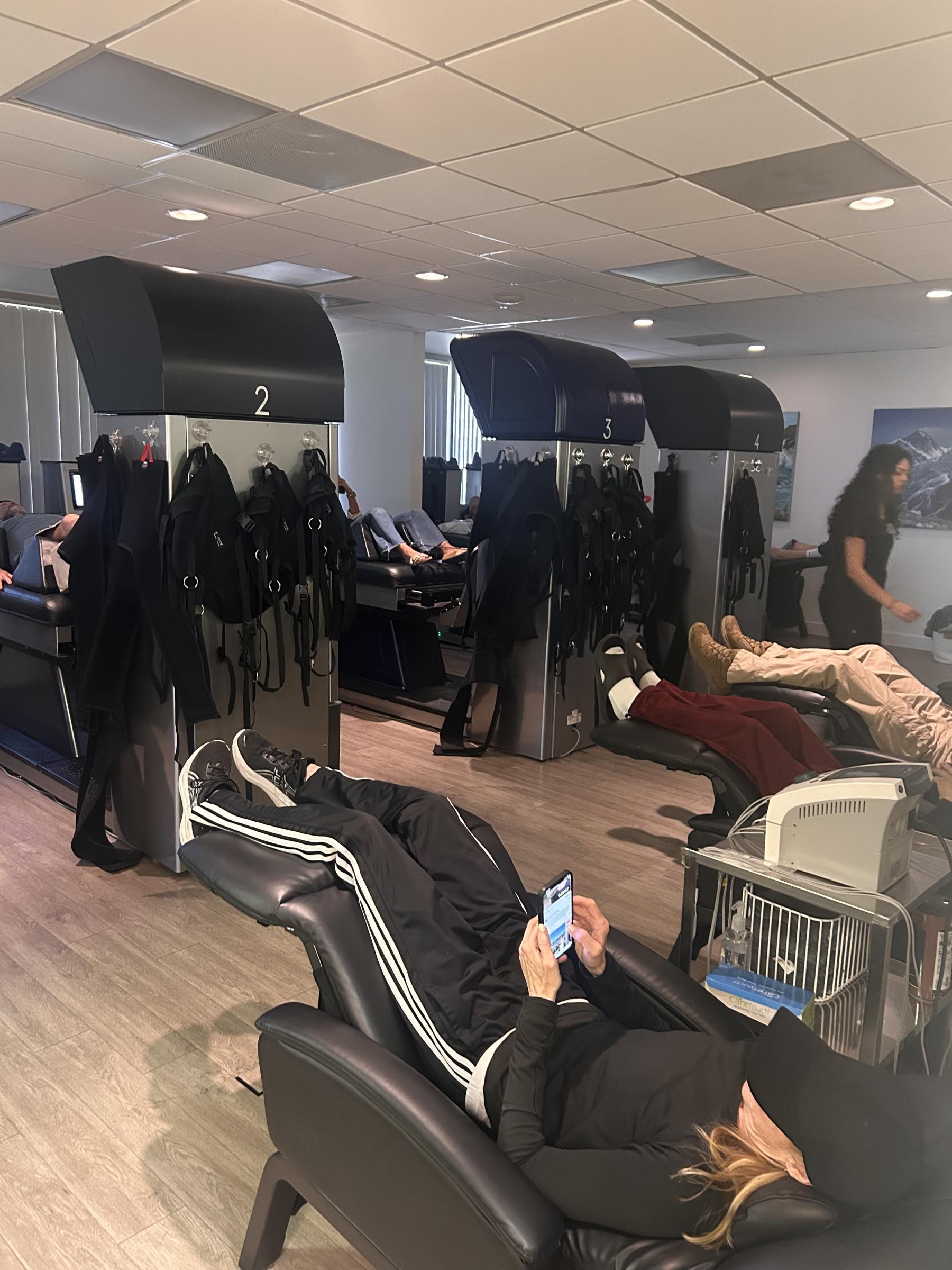
The Spinal Decompression & Chiropractic Center of San Diego uses the DRX9000 exclusively.
But having a disc problem on an MRI doesn't automatically make someone a candidate.
Dr. Boelk also considers spinal stability, neurological findings, bone health, previous surgery and the patient's overall medical history.
There are conditions where decompression may not be appropriate, including an unhealed fracture, significant osteoporosis, unstable spondylolisthesis, abdominal aortic aneurysm, pregnancy for lumbar decompression, certain malignancies and other medical or structural conditions.
Previous spinal surgery also needs to be evaluated carefully, particularly when fusion or metal hardware is present at the level that would need treatment.
★ Sometimes the Consultation Ends Without Treatment
Toni W. came to see Dr. Boelk hoping spinal decompression might be an option.
Because of the hardware in her back, it wasn't appropriate for her situation.
She wrote:
“Very nice Dr. and Honest ! I would definitely recommend anyone who hasn't had metal put in there back in a surgery to go to him and give his program a shot. I believe it would definitely help. Just not in my personal case. As I have a lot of hardware in my back. But I'm glad I took the time to meet with him. It was very informative all around.”
— Toni W., Lake Elsinore, CA
That's an important part of the way Dr. Boelk practices.
The goal isn't to turn every consultation into a treatment plan.
The goal is to determine whether the patient is actually a good candidate.
If the answer is no, the patient deserves to hear that.
Why Patients Choose Dr. Cassidy James Boelk, DC
Dr. Boelk has focused on Non-Surgical Spinal Decompression for more than two decades.
-
22+ years of Non-Surgical Spinal Decompression experience
-
100,000+ spinal decompression treatments
-
Certified Spinal Decompression Doctor
-
Certified Pain-Free Performance Specialist (PPSC)
-
Founder, Non-Surgical Spinal Decompression Training Academy
-
Trains other doctors in spinal decompression protocols and techniques
-
Founding Member, American Spinal Decompression Society
-
Member, International Disc Education Association
-
California X-Ray Radiation Supervisor & Operator
Dr. Boelk's experience with spinal injuries is personal too.
He suffered an L5 compression fracture at age 16 and later dealt with disc injuries and sciatica himself. Staying active—including surfing, hockey and exercise—has made understanding what patients want to get back to especially important to him.
Your Leg May Be Telling You Something Even When Your Back Isn't
If your back feels fine but you've had pain, burning, tingling or numbness running down one leg, don't assume that rules out your lower spine.
It doesn't mean the problem definitely is coming from your back either.
That's exactly why an evaluation matters.
Your No-Charge Consultation Includes:
-
A one-on-one consultation with Dr. Cassidy James Boelk, DC
-
Review of how your problem started and how it has changed
-
Discussion of exactly where the symptoms travel
-
Review of pain, numbness, tingling, burning or weakness
-
Discussion of what makes your symptoms better or worse
-
Review of treatments you've already tried
-
Review of your actual MRI images and report, if available
-
Comparison of the imaging with your symptoms
-
Discussion of whether further examination or imaging may be appropriate
-
An assessment of whether Non-Surgical Spinal Decompression may be an option
-
An honest answer if Dr. Boelk believes you're not a candidate
-
Time to ask questions and understand your options
No MRI is required to schedule.
No charge. No obligation to begin treatment.
And the reason availability is limited is straightforward: Dr. Boelk personally performs these consultations.
There are only so many he can set aside during the week while continuing to care for his existing patients. When those appointments are filled, the next available consultation moves to the next opening in his schedule.
If you've already spent weeks or months adjusting your life around the problem—walking less, sleeping differently, avoiding the gym, struggling through drives or putting off things you enjoy—there's no benefit in waiting for your back to start hurting too.
The first step isn't agreeing to treatment. It's finding out what's causing the problem and whether Dr. Boelk believes he can help.
Call 619-298-0800
Ask for the next available No-Charge Consultation with Dr. Cassidy James Boelk, DC.
Bring your MRI images and report if you have them. If you don't, that's okay.
Come in, let Dr. Boelk review what's going on, and find out whether you're a candidate.
The Spinal Decompression & Chiropractic Center of San Diego
5095 Murphy Canyon Road, Suite 300
San Diego, CA 92123
619-298-0800
SanDiegoBackCare.com
Live 24/7 Answering Service • Hablamos Español