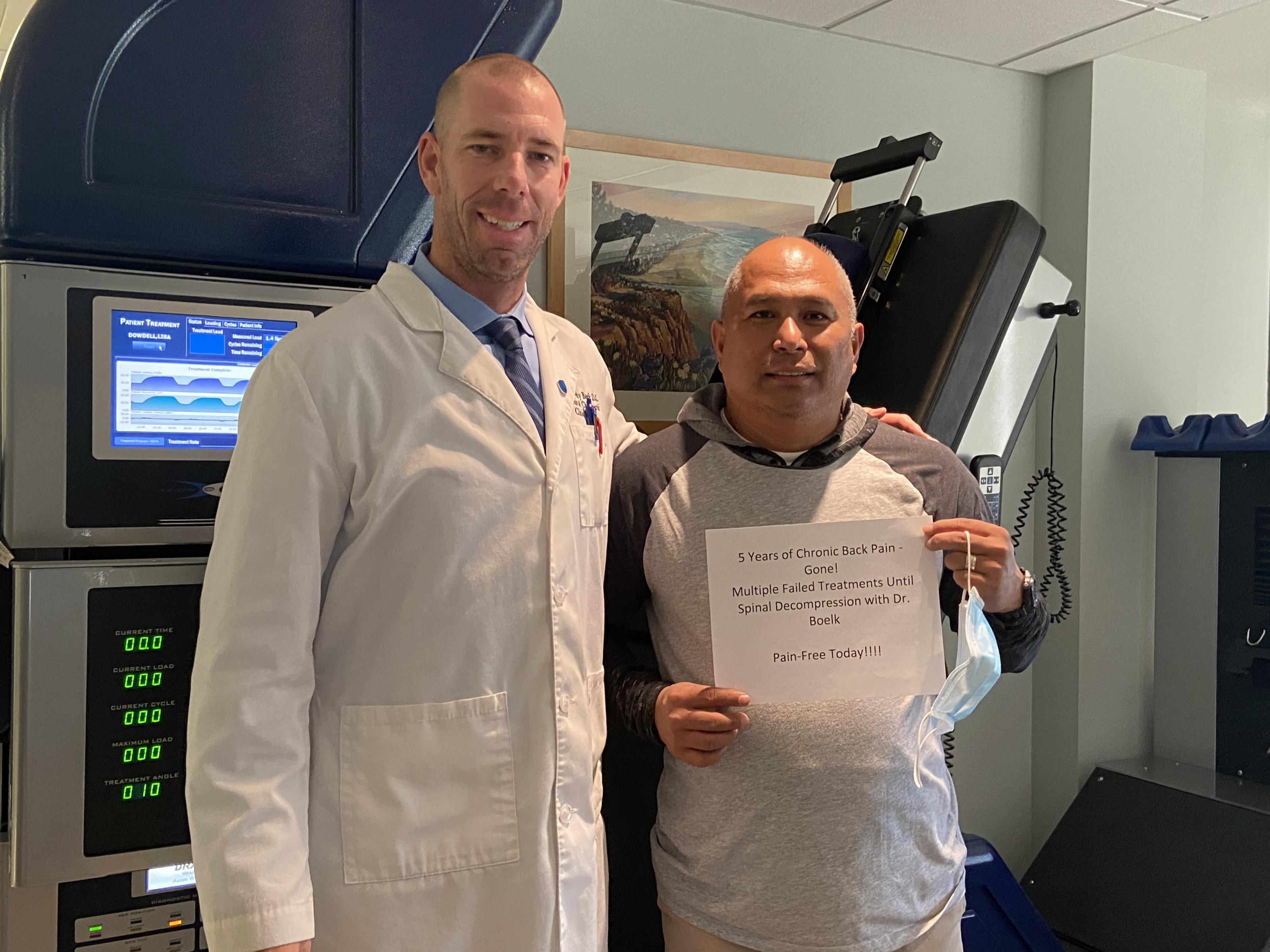
Can Spinal Decompression Help an L5-S1 Disc Herniation? | Kearny Mesa, CA
An L5-S1 disc herniation can make some of the simplest activities surprisingly difficult. Sitting at your desk, getting out of your car, bending over to put on your shoes, or even finding a comfortable sleeping position can become a daily challenge.
For some people, the pain stays in the lower back. For others, it travels through the buttock and down the leg, sometimes reaching the calf or foot.
If you've been diagnosed with an L5-S1 disc herniation, you may be wondering whether Non-Surgical Spinal Decompression could help relieve your symptoms without injections or surgery.
The answer is that spinal decompression may help certain patients with L5-S1 disc herniations, but the key is determining whether you're an appropriate candidate.
At The Spinal Decompression & Chiropractic Center of San Diego, located in Kearny Mesa, Dr. Cassidy James Boelk, DC, has spent more than 22 years evaluating and treating patients with complicated cervical and lumbar spine conditions.
As a Certified Spinal Decompression Doctor and Certified Pain-Free Performance Specialist, he emphasizes identifying the source of symptoms, evaluating spinal stability, and selecting treatment based on the individual patient's condition.
No-Charge Spinal Decompression Consultation in Kearny Mesa
If you're struggling with an L5-S1 herniated disc, persistent lower back pain, or sciatica, Dr. Boelk offers a limited number of No-Charge Consultations each week.
During your consultation, you can:
-
Discuss your back pain, sciatica, numbness, or tingling.
-
Learn how the DRX9000 Non-Surgical Spinal Decompression system works.
-
Find out what information is needed to determine whether you may be a candidate.
-
Discuss the next steps toward a comprehensive evaluation if appropriate.
Call 619-298-0800 to schedule your No-Charge Consultation.
The office is conveniently located at 5095 Murphy Canyon Road, Suite 300, San Diego, CA 92123, serving Kearny Mesa, Serra Mesa, Tierrasanta, Clairemont, Mission Valley, and surrounding communities.
What Patients With Herniated Discs Are Saying
Many patients who visit Dr. Boelk have already tried other treatments and are looking for a different approach.
Anthony K., a San Diego patient who previously underwent back surgery for a bulging disc, shared his experience after his disc symptoms returned.
⭐⭐⭐⭐⭐
“I have been dealing with back pain for several years. It got so bad that I had surgery 5 years ago for a bulging disc. About 5 months ago the disc bulged again hitting my sciatic nerve creating pain in my legs that made me want to cry it hurt so bad. After trying so many other options I was fortunate enough to find the spinal decompression and chiropractic center of San Diego. After just a few sessions I noticed a difference. Now after being there for the past few months I'm able to go about my normal life again.
What a blessing it was to find a Dr that genuinely cares and knows how to help people in my situation. Thank you Dr Boelk!”
— Anthony K., San Diego, CA
Why Is the L5-S1 Disc So Commonly Injured?
The L5-S1 disc sits at the junction between the lumbar spine and sacrum.
This region plays an important role in transferring forces between the upper body and pelvis. It also experiences considerable mechanical stress during bending, lifting, twisting, and prolonged sitting.
Over time, a disc may develop degenerative changes or sustain an injury that weakens its outer layers.
When disc material extends through the outer portion of the disc, it can form a herniation.
Depending on its location, the herniation may irritate or compress nearby nerve roots.
Common symptoms include:
-
Lower back pain, sometimes worse on one side.
-
Pain traveling into the buttock, thigh, calf, or foot.
-
Numbness or tingling in the leg or foot.
-
Burning, shooting, or electric-like sensations.
-
Weakness involving certain muscles of the leg or foot.
-
Increased discomfort during sitting, bending, or lifting.
However, an MRI finding alone does not determine how serious someone's symptoms will be.
Some patients have significant disc abnormalities without much pain. Others have smaller herniations that produce considerable nerve irritation.
Dr. Boelk evaluates how the MRI findings relate to the patient's actual symptoms before recommending treatment.
Can an L5-S1 Disc Herniation Cause Sciatica?
Yes. L5-S1 disc herniations are a common cause of sciatica.
At this spinal level, a herniated disc frequently affects the S1 nerve root, although certain herniation patterns can involve the L5 nerve root.
When the S1 nerve becomes irritated, symptoms may travel from the buttock down the back of the thigh and calf toward the outside of the foot.
Some patients also experience changes in sensation, reflexes, or weakness when attempting to rise onto their toes.
Other patients experience symptoms that are primarily aggravated by sitting or bending forward.
Because the location of nerve compression matters, Dr. Boelk evaluates muscle strength, sensation, reflexes, movement patterns, and MRI findings when determining the appropriate course of care.
How Does DRX9000 Spinal Decompression Work for L5-S1?
Non-Surgical Spinal Decompression uses controlled mechanical traction to apply specific forces to the spine.
The goal is to reduce mechanical loading on selected spinal structures and potentially decrease irritation associated with certain disc conditions.
At The Spinal Decompression & Chiropractic Center of San Diego, Dr. Boelk exclusively uses DRX9000 spinal decompression systems.
These motorized tables allow treatment parameters to be adjusted based on the patient's clinical presentation.
Some patients report improvements in lower back pain, leg pain, and daily function during treatment.
However, decompression does not guarantee that a herniated disc will retract, that nerve compression will resolve, or that surgery can be avoided. The clinical research remains mixed, and more high-quality evidence is needed to establish which patients benefit most.
For this reason, Dr. Boelk emphasizes proper patient selection and periodic reassessment rather than assuming decompression is appropriate for everyone.
What If Your L5-S1 Herniation Is Causing Severe Sciatica?
Some patients experience relatively mild back discomfort, while others develop intense pain that significantly interferes with walking, sleeping, and daily activities.
When leg pain becomes persistent, patients may find themselves avoiding exercise, missing work, or struggling with activities they previously enjoyed.
One San Diego patient, Yuri Fresia, described his experience with persistent sciatica and returning to an active lifestyle.
⭐⭐⭐⭐⭐
“When I first came here I was suffering from sciatica pain for several months non stop. I tried many different non invasive treatments, pain killers but relief was just temporary. I heard about Dr. Boelk on social media and after reading other people testimonials about him I decided to try. It felt better since my first session. After 12 I felt I was improving a lot but still had room to get better so we decided trying 12 more. After 36 sessions I felt I was back to normal. I could get back to surf, jiu jitsu and work after 6 months away. Doctor helped me through the whole process, leaving me free to decide the next step and being honest about expectations. I totally recommend for all my friends that suffer from sciatica pain. It’s worth 100%.”
— Yuri Fresia, San Diego, CA
Yuri's experience highlights the importance of monitoring progress and making treatment decisions based on how the patient responds.
Who May Be a Candidate for L5-S1 Spinal Decompression?
Dr. Boelk evaluates several factors before determining whether spinal decompression is appropriate.
1. The MRI and Symptoms Should Correlate
An L5-S1 herniation on MRI does not automatically explain every case of back or leg pain.
The location of the herniation, symptom distribution, neurological examination, and other findings must be considered together.
2. Spinal Stability Must Be Evaluated
Some patients have additional conditions, including degenerative disc disease, facet joint changes, or spondylolisthesis.
When spinal instability is suspected, standing lumbar X-rays, including flexion and extension views, may provide important information.
Significant instability may make decompression inappropriate.
3. Neurological Symptoms Require Careful Assessment
Numbness, tingling, muscle weakness, and changes in reflexes can indicate nerve involvement.
Significant or progressive weakness may require urgent medical or surgical evaluation rather than a course of decompression.
4. Previous Treatment History Matters
Patients may have already tried physical therapy, medications, chiropractic care, or epidural steroid injections.
Understanding which treatments helped, which aggravated symptoms, and whether the diagnosis remains consistent is important when considering another approach.
Who Is Not a Candidate for Non-Surgical Spinal Decompression?
One of the most important aspects of Dr. Boelk's clinical approach is recognizing when spinal decompression should not be performed.
Certain conditions may make treatment inappropriate, including:
-
Unstable or significant spondylolisthesis.
-
Certain spinal fractures or structural instability.
-
Spinal fusion hardware at the intended treatment level.
-
Certain serious spinal or medical conditions.
-
Progressive neurological deficits requiring urgent assessment.
-
Suspected cauda equina syndrome.
New bladder or bowel dysfunction, saddle anesthesia, or rapidly progressive leg weakness requires immediate emergency evaluation.
When Surgery Is the More Appropriate Option
Not every patient who contacts the office is accepted for spinal decompression.
Jeff J., a patient from Tucson, Arizona, shared his experience after an evaluation determined that surgery was the appropriate option for his condition.
⭐⭐⭐⭐⭐
“I found this terrific practice on social media. I followed up and did my own research so I decided to pay them a visit. The place is clean, well organized and run by a very efficient receptionist. I met with the doctor and after a honest and forthright conversation, we both determined that surgery was my only option to correct my back issues. I will return as a customer when the time is right.”
— Jeff J., Tucson, AZ
This reflects an important principle: the purpose of an evaluation is not to convince every patient to undergo spinal decompression. It is to help determine the most appropriate next step.
Can Spinal Decompression Help You Avoid L5-S1 Back Surgery?
Many lumbar disc herniations improve with conservative management, and some decrease in size naturally over time.
For patients without urgent neurological findings, non-surgical care is often considered before surgery.
Treatment options may include activity modification, appropriate exercise, physical therapy, medications, and other conservative approaches.
Non-Surgical Spinal Decompression may be considered for selected patients, but current evidence has not established that it reliably prevents surgery.
The decision should be based on symptoms, neurological findings, imaging, previous treatments, and overall clinical presentation.
Avoiding surgery is a reasonable goal when it can be done safely, but it should never come at the expense of appropriate medical care.
Patients Travel to Kearny Mesa for Spinal Decompression Treatment
Although Dr. Boelk's practice is located in Kearny Mesa, patients travel from throughout San Diego County, other states, and internationally to seek his expertise.
Some coordinate extended stays in San Diego to complete an evaluation and, if appropriate, a course of treatment.
Lisa S., a patient who travels from the United Kingdom, shared her experience:
⭐⭐⭐⭐⭐
“I travel from the UK to see Dr Boelk and his wonderful team . I have 3 bulging disc and one is touching the nerve. I have the spinal decompression treatment and it really helps keep me in my active life . I will not go to anyone else for back treatment, this place is number one and they genuinely care about their patients.”
— Lisa S., United Kingdom
For patients traveling from outside the San Diego area, the office can help explain the evaluation process, scheduling considerations, and what information may be helpful before arranging travel.
However, traveling to San Diego does not guarantee acceptance for treatment. A proper clinical evaluation is still necessary.
Why Choose Dr. Cassidy James Boelk, DC, in Kearny Mesa?
Dr. Boelk has devoted more than 22 years to evaluating and treating patients with complicated cervical and lumbar spine conditions.
He is a Certified Spinal Decompression Doctor and Certified Pain-Free Performance Specialist, with extensive experience in spinal rehabilitation and conservative management of disc-related conditions.
His interest in spinal rehabilitation is also personal.
After experiencing significant spinal injuries himself, including a lumbar compression fracture and spondylolisthesis, he spent thousands of hours studying spinal mechanics, rehabilitation, and non-surgical treatment approaches.
His Kearny Mesa practice features seven Non-Surgical Spinal Decompression tables and exclusively uses DRX9000 systems.
Dr. Boelk also founded the Non-Surgical Spinal Decompression Training Academy, where he provides training to other healthcare professionals in spinal decompression protocols and techniques.
His approach emphasizes careful evaluation, appropriate patient selection, individualized treatment planning, and ongoing reassessment.
How Long Does It Take to See Results With L5-S1 Spinal Decompression?
There is no universal timeline for improvement.
Some patients notice symptom changes relatively early, while others require a longer period of conservative care.
Some patients do not respond adequately to spinal decompression.
Factors that may influence progress include the duration of symptoms, neurological findings, physical activity, other spinal conditions, and response to treatment.
At Dr. Boelk's Kearny Mesa clinic, treatment plans are individualized, and progress is reassessed periodically.
Improvement is evaluated using more than pain intensity alone.
Changes in leg symptoms, walking tolerance, sleep, daily activities, and neurological findings may also be important.
Frequently Asked Questions About L5-S1 Disc Herniations
Can an L5-S1 disc herniation heal without surgery?
Yes. Many lumbar disc herniations improve without surgery, and some decrease in size over time. The appropriate treatment depends on symptoms, neurological findings, and the individual condition.
Is walking good for an L5-S1 herniated disc?
Walking is often beneficial when tolerated. However, patients should adjust the duration and intensity based on symptoms and avoid repeatedly aggravating significant leg pain or neurological symptoms.
Can spinal decompression help L5-S1 sciatica?
It may help selected patients, but results are not guaranteed. A proper evaluation is necessary to determine whether the L5-S1 disc is responsible for the symptoms and whether decompression is appropriate.
Can an L5-S1 herniated disc cause foot numbness?
Yes. Depending on which nerve root is affected, an L5-S1 herniation may contribute to numbness, tingling, or weakness involving portions of the foot.
Is L5-S1 disc surgery always necessary?
No. Many patients improve with conservative treatment. However, significant or progressive neurological deficits and certain other conditions may require prompt surgical evaluation.
Looking for L5-S1 Herniated Disc Treatment in Kearny Mesa?
If you've been diagnosed with an L5-S1 disc herniation and continue to experience lower back pain, sciatica, numbness, or tingling, understanding your treatment options is an important first step.
At The Spinal Decompression & Chiropractic Center of San Diego, Dr. Cassidy James Boelk, DC, helps patients determine whether Non-Surgical Spinal Decompression may be appropriate for their particular condition.
A limited number of No-Charge Consultations are available each week.
If you've already had an MRI or have been told that injections or surgery may be necessary, contact the office to discuss scheduling a consultation.
The Spinal Decompression & Chiropractic Center of San Diego
Dr. Cassidy James Boelk, DC
Certified Spinal Decompression Doctor
Certified Pain-Free Performance Specialist
5095 Murphy Canyon Road, Suite 300
San Diego, CA 92123
Phone: 619-298-0800
Website: www.SanDiegoBackCare.com
Serving Kearny Mesa, Serra Mesa, Tierrasanta, Clairemont, Mission Valley, Mira Mesa, and surrounding San Diego communities.