Can Spinal Decompression Help a Pinched Nerve? – Kearny Mesa, CA
When Pain Starts Traveling Into Your Arm or Leg
A pinched nerve can make everyday activities surprisingly difficult.
You may feel pain traveling from your neck into your shoulder and arm, or from your lower back into your buttock and leg. In some cases, pain is not the main symptom. Instead, the person notices numbness, tingling, weakness, burning, or an electrical sensation in the hand or foot.
Common symptoms include:
-
Pain traveling down one arm or leg
-
Numbness or tingling in the hand, foot, fingers, or toes
-
Burning or electrical sensations
-
Weakness in an arm or leg
-
Reduced grip strength
-
Difficulty sitting, driving, standing, or walking
-
Symptoms that return despite medication, stretching, or therapy
If these symptoms continue, the important question is not simply how to cover them up. It is:
What is irritating the nerve, and can that pressure be reduced without surgery?
When nerve irritation is connected to a bulging, herniated, protruding, or extruded spinal disc, non-surgical spinal decompression may be able to help.
Severe Sciatica and a Herniated Disc
⭐⭐⭐⭐⭐
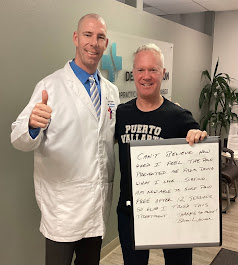
“I highly recommend Dr. Cassidy Boelk, DC and the team at The Spinal Decompression and Chiropractic Center.
I came in with severe sciatica and a herniated disc, and his treatments have made a world of difference.
He and his staff are both professional and genuinely caring, creating a welcoming and supportive environment.
The treatments were not only highly effective but also tailored to my specific needs.
I’m grateful for the care I received and the significant improvement in my quality of life.”
— Brian Perrotta, San Diego, CA
Brian’s experience is his own, and no treatment can guarantee the same result for every patient. His story demonstrates how a herniated disc can irritate a spinal nerve and create symptoms that extend far beyond the lower back.
Find Out What Is Irritating Your Nerve
If pain, numbness, tingling, or weakness is interfering with your sleep, work, exercise, driving, or daily activities, call 619-298-0800 to schedule a no-charge, no-obligation consultation with Dr. Cassidy Boelk, DC.
Bring your MRI or other recent imaging if available. Dr. Boelk will review your condition, answer your questions, and tell you directly whether you appear to be a candidate for non-surgical spinal decompression.
Call 619-298-0800 today to schedule your consultation. Hablamos Español.
A Pinched Nerve Is Not the Complete Diagnosis
“Pinched nerve” is a general description. It does not identify the condition responsible for the nerve irritation.
Possible causes include:
-
A bulging or herniated disc
-
A disc protrusion or extrusion
-
Degenerative disc changes
-
Loss of disc height
-
Inflammation surrounding a spinal nerve
-
Foraminal narrowing
-
Spinal instability
-
A recent injury or fracture
-
A condition outside the spine that imitates nerve pain
This distinction is important because two patients with similar symptoms may require very different treatment.
Spinal decompression is designed to address certain disc-related causes of nerve pressure. It will not correct every condition that causes pain, numbness, tingling, or weakness.
Pinched Nerves in the Lower Back
The nerves originating in the lumbar spine travel into the buttocks, legs, feet, and toes.
When a lumbar disc becomes damaged or compressed, it may begin to bulge or herniate toward one of these nerves. The resulting pressure and inflammation can produce:
-
Sciatica
-
Burning pain through the buttock or leg
-
Numbness in the calf, foot, or toes
-
Tingling or electrical sensations
-
Weakness in the leg or foot
-
Pain that becomes worse while sitting
-
Difficulty standing or walking comfortably
Some patients experience severe leg symptoms with very little lower-back pain. This can make it easy to assume that the problem is in the hip, knee, or leg when the nerve irritation is actually originating in the lumbar spine.
Pinched Nerves in the Neck
The nerves originating in the cervical spine travel into the shoulders, arms, hands, and fingers.
When a cervical disc bulges or herniates toward a nerve, symptoms may include:
-
Neck or shoulder-blade pain
-
Pain traveling down one arm
-
Numbness or tingling in the hand
-
Burning or electrical pain
-
Weakness in the arm or hand
-
Reduced grip strength
-
Symptoms that become worse with certain neck positions
The location of the symptoms can provide helpful clues about which nerve may be involved. However, the examination and imaging are needed to determine the actual cause.
How Non-Surgical Spinal Decompression May Help
Non-surgical spinal decompression uses computer-controlled pulling and releasing cycles to gently reduce pressure at a targeted area of the spine.
At The Spinal Decompression & Chiropractic Center of San Diego, lumbar and cervical conditions are treated on DRX9000 spinal decompression systems specifically configured for the area involved.
For an appropriate patient, decompression may help:
-
Reduce pressure affecting the spinal nerve
-
Decrease pain traveling into the arm or leg
-
Improve fluid and nutrient movement within the disc
-
Reduce protective muscle tightness
-
Improve comfort while sitting, standing, and walking
-
Improve tolerance for daily activities
-
Help the patient progress into appropriate rehabilitation exercises
Spinal decompression is not simply a forceful stretch of the entire spine. The treatment level, positioning, angle, force, and progression must be matched to the patient’s diagnosis, anatomy, symptoms, and response.
Why Numbness Can Continue After the Pain Improves
Pain and numbness do not always recover at the same speed.
Some patients notice that the sharp or burning pain improves first while numbness or tingling remains. Nerves can take time to recover after being irritated or compressed, especially when symptoms have been present for months.
Persistent numbness still needs to be monitored. Increasing numbness or weakness may indicate that the nerve remains under stress or that additional evaluation is needed.
The goal is not only to reduce pain. Dr. Boelk also monitors:
-
Changes in numbness and tingling
-
Muscle strength
-
Reflexes
-
Grip strength
-
Walking and balance
-
Sitting and standing tolerance
-
Whether symptoms are moving out of the arm or leg
These changes help determine whether the condition is responding appropriately.
Why Dr. Boelk Reviews the Actual Images
An MRI report may identify several abnormalities, but not every disc bulge or degenerative change is responsible for the symptoms.
Dr. Boelk reviews the available images and compares them with:
-
The exact location of the pain
-
The pattern of numbness or tingling
-
Muscle-strength changes
-
Reflex findings
-
Orthopedic and neurological examination results
-
Previous treatment and surgical history
-
Weight-bearing spinal alignment
-
Signs of instability
-
Positions and activities that aggravate the symptoms
When appropriate, weight-bearing and flexion-extension X-rays may also be taken. These images can reveal movement or instability that may not appear on an MRI performed while the patient is lying down.
The goal is to determine whether the imaging findings match the symptoms and whether decompression can be performed safely.
Not Every Patient Is a Candidate
⭐⭐⭐⭐⭐
“Very nice Dr. and honest! I would definitely recommend anyone who hasn't had metal put in their back in a surgery to go to him and give his program a shot.
I believe it would definitely help—just not in my personal case, as I have a lot of hardware in my back.
But I'm glad I took the time to meet with him. It was very informative all around.”
— Toni W., Lake Elsinore, CA
Dr. Boelk determined that Toni was not an appropriate candidate because of the amount of hardware in her spine. She was not encouraged to begin a treatment program that was unsuitable for her condition.
A patient may not qualify because of:
-
Spinal instability
-
Surgical hardware at the treatment level
-
A recent or unhealed fracture
-
Pregnancy when lumbar decompression is being considered
-
Certain advanced spinal conditions
-
Symptoms requiring urgent medical or surgical evaluation
The purpose of the consultation is to determine whether treatment makes sense before the patient commits time and money to a program.
If Dr. Boelk does not believe decompression is appropriate, he will explain why and recommend another direction when possible.
What Can You Do While Waiting to Be Evaluated?
Avoid repeatedly forcing movements that cause symptoms to travel farther into the arm or leg.
A few practical steps may help reduce repeated irritation:
-
Change positions regularly
-
Limit prolonged sitting when it increases symptoms
-
Avoid aggressive stretching of an irritated arm or leg
-
Stop exercises that increase numbness or tingling
-
Avoid repeated bending, twisting, or heavy lifting
-
Keep screens closer to eye level if neck position aggravates arm symptoms
-
Take short walks if walking is comfortable
-
Pay attention to whether symptoms are improving or spreading
The right exercise depends on the cause of the nerve irritation. A movement that helps one person may aggravate another.
When Nerve Symptoms Require Immediate Medical Attention
Seek urgent medical attention if symptoms include:
-
New loss of bladder or bowel control
-
Numbness in the groin or saddle region
-
Rapidly progressing weakness
-
Sudden loss of coordination
-
Severe symptoms following significant trauma
-
Fever or unexplained illness with severe spinal pain
Progressive weakness should not be ignored. A patient who is losing strength in an arm, hand, leg, or foot may require faster neurological or surgical evaluation.
Why Patients Seek Out Dr. Cassidy Boelk, DC
Patients from Kearny Mesa and throughout San Diego County seek out Dr. Boelk because his practice is focused on spinal decompression, disc injuries, sciatica, radiating arm pain, and difficult neck and back conditions.
His credentials and experience include:
-
Certified Spinal Decompression Doctor
-
Certified Pain-Free Performance Specialist
-
More than 21 years of clinical experience
-
Over 100,000 spinal decompression treatments performed
-
Founder of the Non-Surgical Spinal Decompression Training Academy
-
Trains other doctors in spinal decompression protocols and techniques
-
Founding Member of the American Spinal Decompression Society
-
Member of the International Disc Education Association
-
California-licensed doctor with X-ray radiography certification
-
Seven DRX9000 spinal decompression systems
-
Four lumbar and three cervical decompression systems
-
Extensive personal experience rehabilitating serious spinal and disc injuries
Dr. Boelk has spent thousands of hours rehabilitating his own neck and lower-back injuries while developing the decompression, rehabilitation, and spinal-stability protocols he uses with appropriate patients.
People travel to his San Diego office from throughout California, other states, Mexico, Spain, and the United Kingdom to seek his experience.
Do Not Wait for Numbness or Weakness to Become Your New Normal
Persistent nerve symptoms are your body’s way of indicating that something is irritated or compressed.
You do not have to commit to treatment to get an informed opinion.
Start with a no-charge, no-obligation consultation. Dr. Boelk will review your symptoms, examine your available imaging, and tell you honestly whether non-surgical spinal decompression may be appropriate.
Call Today to Find Out if You Are a Candidate
The Spinal Decompression & Chiropractic Center of San Diego
5095 Murphy Canyon Road, Suite 300
San Diego, CA 92123
Call: 619-298-0800
Website: www.SanDiegoBackCare.com
Hablamos Español
Call 619-298-0800 today to schedule your no-charge, no-obligation consultation. Find out what is irritating your nerve and whether non-surgical spinal decompression is an appropriate next step.