Can Spinal Decompression Help a Herniated Disc? – San Diego, CA
What Are Your Options When a Herniated Disc Is Not Getting Better?
A herniated disc can affect much more than the lower back.
Depending on the location of the disc injury and whether a nerve is involved, patients may experience lower-back pain, sciatica, burning into the leg, numbness, tingling, weakness, or difficulty sitting, standing, walking, exercising, or sleeping.
Some disc injuries improve with time and conservative treatment. Others continue to cause problems despite medications, physical therapy, chiropractic care, injections, rest, or changes in activity.
When symptoms have continued for weeks or months, many patients start wondering whether surgery is their only remaining option.
For appropriately selected patients, Non-Surgical Spinal Decompression can be an effective treatment option for lumbar disc herniations, bulging discs, disc protrusions, extrusions, degenerative disc conditions, and associated nerve irritation.
Dr. Cassidy James Boelk, DC has spent more than 22 years helping patients with difficult disc-related spinal conditions at The Spinal Decompression & Chiropractic Center of San Diego.
The important first step is determining what is actually causing the symptoms and whether the patient's particular disc condition can be treated safely with Non-Surgical Spinal Decompression.
Severe Sciatica and a Herniated Disc
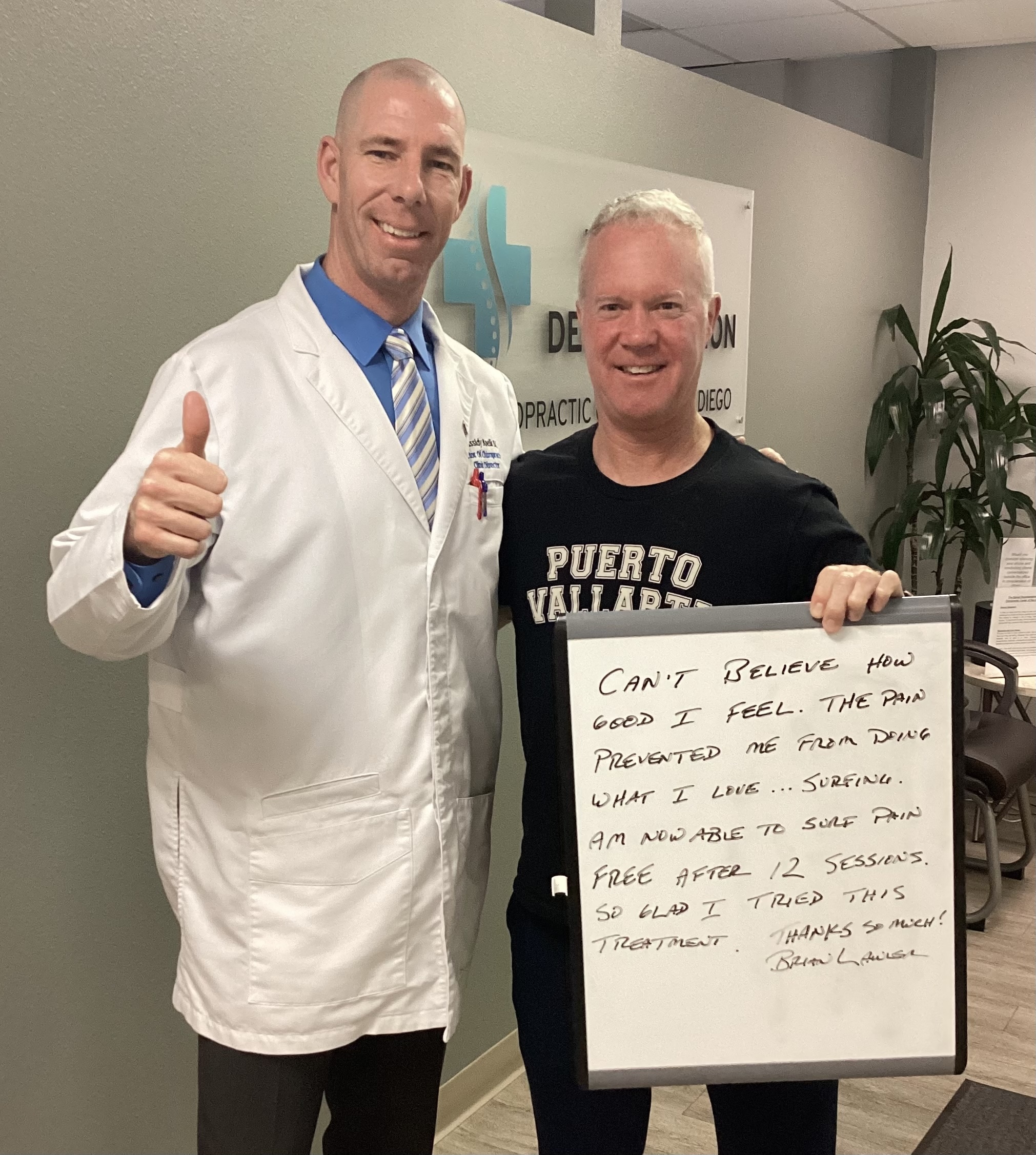
Brian Perrotta came to The Spinal Decompression & Chiropractic Center of San Diego with severe sciatica and a herniated disc.
⭐⭐⭐⭐⭐ Brian Perrotta — San Diego, CA
“I highly recommend Dr. Cassidy Boelk, DC and the team at The Spinal Decompression and Chiropractic Center. I came in with severe sciatica and a herniated disc, and his treatments have made a world of difference. He and his staff are both professional and genuinely caring, creating a welcoming and supportive environment. The treatments were not only highly effective but also tailored to my specific needs. I’m grateful for the care I received and the significant improvement in my quality of life.”
— Brian Perrotta, San Diego, CA
Brian's results are his individual experience and do not guarantee another patient's outcome. His experience does demonstrate why patients with a herniated disc and associated sciatica may want to investigate conservative treatment before assuming surgery is the only option.
Have a Herniated Disc and Unsure What to Do Next?
Patients can schedule a No-Charge, No-Obligation Consultation with Dr. Cassidy James Boelk, DC to discuss their symptoms, previous treatment, available imaging, and whether Non-Surgical Spinal Decompression may be appropriate.
Patients who already have an MRI are encouraged to bring their images and report. An MRI is not required to schedule a consultation.
Dr. Boelk personally evaluates new patients, and consultation appointments are scheduled based on availability.
Call 619-298-0800 to schedule an available consultation.
Live 24/7 Answering Service • Hablamos Español
What Actually Happens When a Disc Herniates?
The spinal discs sit between the vertebrae and help distribute loads while allowing the spine to move.
A healthy disc has a tougher outer portion surrounding softer material internally. When the outer portion becomes damaged or weakened, disc material can begin moving outward.
An MRI may describe this using terminology such as:
-
Bulging disc
-
Disc protrusion
-
Herniated disc
-
Extruded disc
-
Annular fissure or tear
-
Disc degeneration
-
Disc desiccation
-
Loss of disc height
These findings are related, but they are not identical.
More importantly, the terminology on the MRI does not determine by itself how much pain a patient should have or which treatment should be recommended.
The location of the disc injury matters. Whether a nerve is involved matters. The amount of available space around that nerve matters. Spinal stability and the patient's neurological findings also need to be considered.
This is why Dr. Boelk, DC personally reviews available MRI studies and compares the imaging with the patient's symptoms and examination findings rather than relying solely on the written radiology report.
Why Can a Herniated Disc Cause Pain Down the Leg?
A lumbar disc injury can cause pain directly in the lower back, but when a nerve root becomes involved, the symptoms can travel considerably farther.
Patients may experience:
-
Sciatica
-
Buttock pain
-
Burning down the thigh
-
Calf pain
-
Numbness or tingling
-
Pins and needles
-
Foot pain
-
Numbness in the toes
-
Leg weakness
-
Foot weakness
-
Difficulty sitting
-
Difficulty standing or walking
Some patients with a herniated disc have surprisingly little lower-back pain. Their primary complaint may be severe pain, burning, or numbness in the leg.
A nerve root can be affected by direct mechanical pressure, inflammation surrounding the injured disc, narrowing where the nerve exits the spine, or a combination of these factors.
This also helps explain why the size of a disc herniation on an MRI does not always correspond directly with the severity of a patient's symptoms.
From Lying Down for Hours to Living Normally Again
Kaitelyn H. described how significantly her back condition had affected her normal daily life before treatment.
⭐⭐⭐⭐⭐ Kaitelyn H. — San Diego, CA
“The care I received at Dr. Boelk’s office was so wonderful. I went from having to lay down for several hours a day, to being able to live my life normally, and even began working up my exercise capacity. I always felt cared about, and there was a lot of feedback. The exercise and information Dr. Boelk provides is so critical to maintaining positive results and pain reduction with increased mobility and freedom. All the staff are so caring, and it’s one of the best decisions I made for my back!”
— Kaitelyn H., San Diego, CA
Kaitelyn's results are her individual experience. Her testimonial also illustrates an important point about recovery from a disc injury: reducing pain is important, but restoring normal movement, strength, activity tolerance, and confidence in the spine matters as well.
How Is the DRX9000 Used for a Herniated Disc?
The Spinal Decompression & Chiropractic Center of San Diego uses DRX9000 spinal decompression systems exclusively.
The DRX9000 uses computer-controlled decompression and relaxation cycles to unload a targeted region of the lumbar spine.
For an appropriately selected patient with a herniated disc, the goal is to reduce mechanical stress affecting the injured disc and surrounding nerve structures and create a better environment for recovery.
Treatment is not identical for every patient.
Dr. Boelk, DC can modify treatment parameters based on factors including:
-
Disc level being treated
-
Treatment angle
-
Patient position
-
Starting force
-
Body size
-
Location of symptoms
-
Treatment cycles
-
Patient tolerance
-
Response to previous sessions
This is why Non-Surgical Spinal Decompression should not simply be viewed as putting someone on a machine and pressing start.
The equipment is important, but patient selection and treatment protocol are equally important.
Dr. Boelk, DC has performed more than 100,000 Non-Surgical Spinal Decompression treatments during more than two decades of clinical practice.
Does a Herniated Disc Have to “Go Back In” for a Patient to Improve?
No.
This is a common misconception about disc treatment.
Successful conservative treatment does not necessarily mean that a follow-up MRI has to show a perfectly normal disc.
From a clinical standpoint, more useful questions include:
-
Is the lower-back pain decreasing?
-
Is the leg pain decreasing?
-
Is numbness or tingling improving?
-
Is the patient sleeping better?
-
Can the patient sit longer?
-
Can the patient stand and walk more comfortably?
-
Is strength improving?
-
Is the patient returning to normal activities?
Disc recovery is a biological and mechanical process.
The objective is to reduce irritation around the injured disc and nerve, improve function, and progressively increase the patient's ability to tolerate normal daily and recreational activities.
What Does the No-Charge, No-Obligation Consultation Consist Of?
The consultation gives patients an opportunity to meet with Dr. Cassidy James Boelk, DC, discuss what has been happening, and get a better understanding of what the next step may be.
The consultation consists of:
-
Reviewing the patient's current symptoms
-
Discussing when and how the problem began
-
Reviewing previous treatments and how the patient responded
-
Discussing previous spinal injuries or surgeries
-
Reviewing existing MRI or X-ray imaging when available
-
Discussing what may be causing the patient's pain or neurological symptoms
-
Determining whether further examination or imaging may be necessary
-
Answering questions about Non-Surgical Spinal Decompression
-
Discussing whether the patient appears to be a potential candidate
-
Explaining the next step if Dr. Boelk, DC believes further evaluation or treatment is appropriate
There is no obligation to begin treatment.
If Dr. Boelk, DC does not believe Non-Surgical Spinal Decompression is appropriate, he will explain that as well.
Patients Travel Long Distances for Non-Surgical Spinal Decompression
Patients seeking Dr. Boelk's experience do not come only from San Diego.
Some travel hundreds or even thousands of miles for treatment.
Lynn traveled from Alaska after experiencing radiating leg pain severe enough to interfere with both walking and sleeping.
⭐⭐⭐⭐⭐ Lynn C. — Alaska
“My name is Lynn. I am from Alaska, and I just want to say it was totally worth taking a trip to go to the Spinal Decompression & Chiropractic Center of San Diego. I was having pain radiating down my legs, I couldn’t sleep, I could barely walk.
After treatment I am back to shoveling snow, teaching school, taking walks. So, I just want to thank Dr. Boelk and the clinic, you guys are wonderful, and you have created such a wonderful, friendly, kind and truly caring atmosphere. I highly encourage anybody that might be considering spinal decompression therapy, it really makes a difference.”
— Lynn C., Alaska
Lynn's testimonial reflects her individual experience and does not guarantee another patient's results.
Not Every Herniated Disc Is a Candidate for Spinal Decompression
A patient should not be accepted for Non-Surgical Spinal Decompression simply because an MRI contains the words “herniated disc.”
Depending on the individual circumstances, treatment may not be appropriate for patients with:
-
Unstable spondylolisthesis
-
Certain spinal fractures
-
Significant osteoporosis
-
Abdominal aortic aneurysm
-
Pregnancy for lumbar treatment
-
Certain malignancies
-
Certain surgical hardware at the treatment level
-
Progressive neurological weakness
-
Cauda equina syndrome
-
Other conditions that make decompression unsafe
There are also situations where another form of conservative care, additional diagnostic testing, or surgery may be the more appropriate recommendation.
Proper patient selection is an important part of providing Non-Surgical Spinal Decompression safely.
Sometimes the Safest Decision Is Not to Begin Treatment
Jan H. sought an evaluation from Dr. Boelk, DC after suffering a significant motocross neck injury.
Although Jan was hoping to avoid surgery, Dr. Boelk did not begin treatment because the fracture in his neck first needed to heal.
⭐⭐⭐⭐⭐ Jan H. — San Marcos, CA
“I decided to see Dr. Boelk after a pretty gnarly motocoss neck injury. At the Hospital I was at, I felt I was getting pressured into a surgery which I refused. A friend of a friend referred him after Dr. Boelk successfully treated his broken back.
Dr. Boelk is a compassionate individual who truly cares about his patients. He looked at my MRI images, explained what he saw and potential routes for recovery. He could not treat me as I have to wait until the fracture in my neck heals, but the level of professionalism, compassion, caring and knowledge displayed by him was exceptional.
He also recommended to seek an additional opinion form another neurosurgeon. My experience was that he really cares and he's not someone who would take advantage of the situation someone's in (unlike some other doctors). I will definitely be back and already recommended him to others as well! Thank you Dr. Boelk!”
— Jan H., San Marcos, CA
Jan's experience is a useful example of why candidacy screening matters.
Wanting to avoid surgery does not automatically make someone a candidate for Non-Surgical Spinal Decompression. Sometimes treatment needs to wait, and sometimes another type of care is the safer recommendation.
Why Patients Seek Out Dr. Cassidy James Boelk, DC
Dr. Boelk's practice has focused extensively on Non-Surgical Spinal Decompression and difficult disc-related spinal conditions for more than two decades.
His background includes:
-
Certified Spinal Decompression Doctor
-
Certified Pain-Free Performance Specialist (PPSC)
-
More than 22 years helping patients with disc-related spinal conditions
-
More than 100,000 Non-Surgical Spinal Decompression treatments performed
-
Founder of the Non-Surgical Spinal Decompression Training Academy
-
Founding Member of the American Spinal Decompression Society
-
Member of the International Disc Education Association
Dr. Boelk has also spent thousands of hours rehabilitating significant neck and lower-back injuries of his own, giving him personal as well as clinical experience with spinal injury, rehabilitation, and returning to an active lifestyle.
Seven DRX9000 Systems Dedicated to Non-Surgical Spinal Decompression
The Spinal Decompression & Chiropractic Center of San Diego has:
-
7 DRX9000 spinal decompression systems
-
4 lumbar DRX9000 systems
-
3 cervical DRX9000C systems
-
Individualized decompression protocols
-
MRI review when appropriate
-
Weight-bearing spinal evaluation
-
Rehabilitation and spinal stabilization when appropriate
-
Careful candidacy screening
Patients seek Dr. Boelk's expertise from throughout San Diego County and California, as well as from other states and countries.
When a Herniated Disc Requires Immediate Medical Attention
Most herniated discs do not represent neurological emergencies.
Certain symptoms require immediate medical evaluation, including:
-
New loss of bladder or bowel control
-
Difficulty beginning urination
-
Loss of sensation around the groin, genitals, buttocks, or inner thighs
-
Rapidly progressing leg weakness
-
Sudden difficulty controlling one or both legs
These symptoms can be associated with cauda equina syndrome or another serious neurological condition and require urgent evaluation.
Before Assuming Surgery Is the Only Option, Find Out What Options Are Available
For San Diego patients dealing with a herniated, bulging, protruding, or extruded disc, the next step does not have to be committing to surgery or committing to a decompression program.
It can simply be getting another opinion and understanding the condition better.
Schedule a No-Charge, No-Obligation Consultation
Dr. Boelk personally evaluates new patients, and consultation appointments are limited based on availability.
Patients who already have MRI images, X-rays, or reports are encouraged to bring them. Patients who do not have imaging can still schedule a consultation.
The purpose of the consultation is to better understand what may be causing the patient's symptoms and determine whether Non-Surgical Spinal Decompression may be an appropriate option.
There is no obligation to begin treatment.
The Spinal Decompression & Chiropractic Center of San Diego
5095 Murphy Canyon Road, Suite 300
San Diego, CA 92123
Office: 619-298-0800
Office Cell: 619-884-8298
Website: www.SanDiegoBackCare.com
Live 24/7 Answering Service
Hablamos Español
Call 619-298-0800 to schedule an available No-Charge, No-Obligation Consultation with Dr. Cassidy James Boelk, DC.