Can Spinal Decompression Help Sciatica Nerve Pain? – San Diego, CA
When Sciatica Starts Controlling Your Life
Sciatica can begin as an occasional pain in the buttock or leg. Then it becomes the reason you cannot sit comfortably, sleep through the night, drive to work, exercise, or stand long enough to make dinner.
Some people describe it as burning. Others feel an electric shock, deep aching, pins and needles, or numbness traveling from the lower back into the buttock, thigh, calf, foot, or toes.
When it keeps returning—or stops responding to medication, stretching, physical therapy, chiropractic adjustments, or injections—the natural question is:
Can spinal decompression actually help?
For the right patient, it may. But sciatica is a symptom, not a complete diagnosis. Before recommending treatment, Dr. Cassidy Boelk, DC must determine what is irritating the nerve and whether that condition can be treated safely with non-surgical spinal decompression.
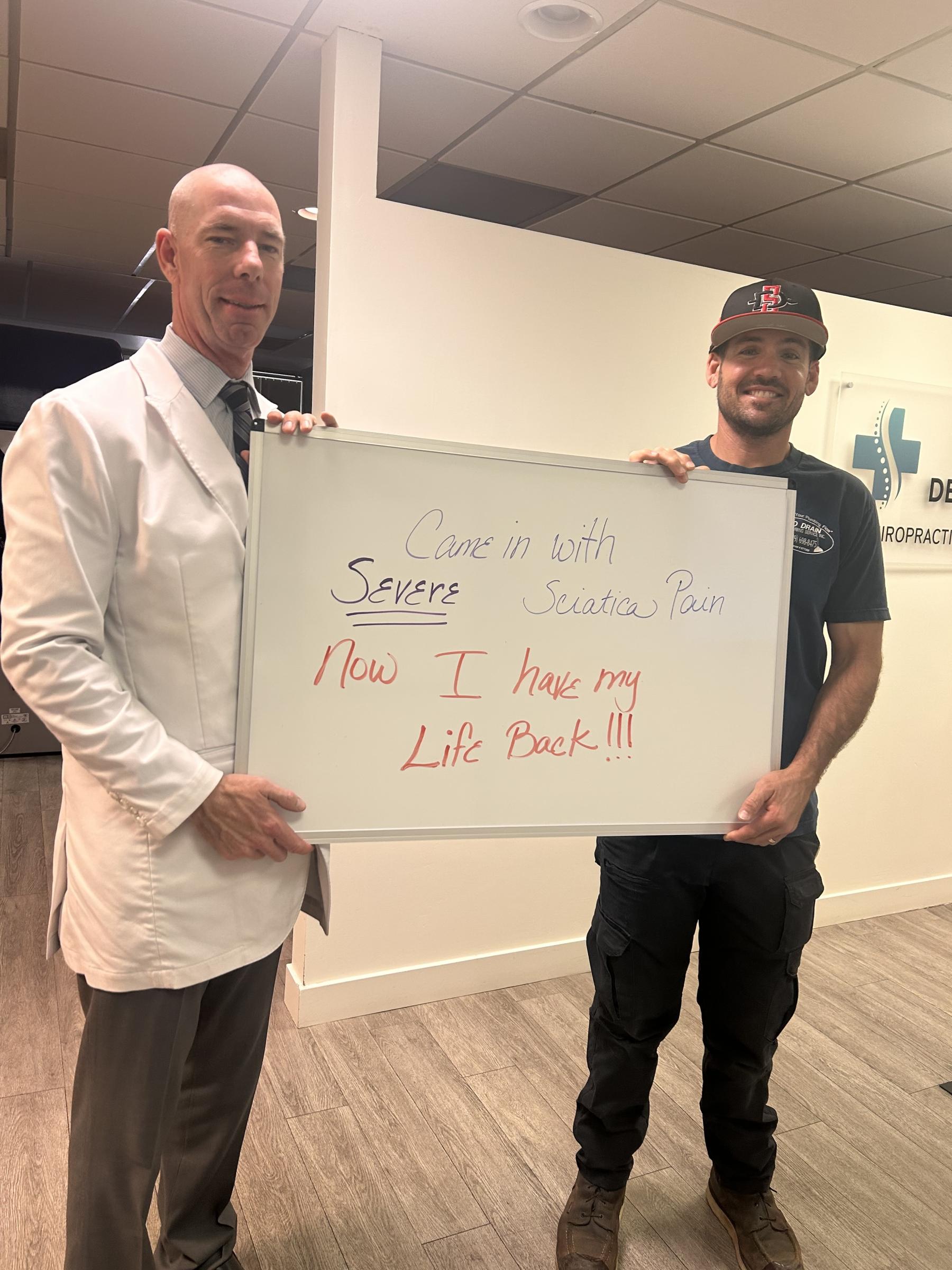
“For the First Time in 10 Years, I Am Completely Pain-Free”
⭐⭐⭐⭐⭐
“For the first time in 10 years, I am completely pain-free. My sciatica is gone, and I no longer have back pain.
Before finding Dr. Boelk, I tried chiropractic care, acupuncture, pain medications, and several other therapies that simply didn’t work. I was one step away from back surgery when I discovered spinal decompression treatment at The Spinal Decompression & Chiropractic Center of San Diego.
The results have been incredible. Every visit was comfortable, relaxing, and completely pain-free. Dr. Boelk and Patty always took the time to explain everything and made me feel genuinely cared for throughout the process.
They are warm, welcoming, and truly dedicated to helping their patients.
Thank you, Dr. Boelk and Patty!”
— Toni H., San Diego, CA
Toni’s experience is her own, and no treatment can guarantee the same result for another patient. Her story does show why persistent sciatica deserves a careful evaluation before someone assumes medication, injections, or surgery are the only remaining options.
Find Out What Is Causing Your Sciatica
If leg pain, numbness, or tingling is interfering with your sleep, work, exercise, or daily life, call 619-298-0800 for a no-charge, no-obligation consultation with Dr. Cassidy Boelk, DC.
Bring your MRI images if you have them—not only the written report. Dr. Boelk will review your symptoms, imaging, previous treatment, and examination findings and tell you honestly whether non-surgical spinal decompression may be appropriate.
A consultation does not commit you to treatment. Not everyone is a candidate, and if Dr. Boelk believes you need a different type of care, he will tell you.
Call 619-298-0800 to schedule. Our answering service is available 24 hours a day, seven days a week. Hablamos Español.
What Is Sciatica?
Sciatica describes pain or other nerve symptoms that follow the path of the sciatic nerve or one of the nerve roots that forms it.
The sciatic nerve is created by nerve roots originating in the lower spine. It travels through the buttock and down the leg. When one of those nerve roots becomes irritated or compressed, symptoms can appear anywhere along that pathway.
Common symptoms include:
-
Pain traveling from the lower back or buttock into one leg
-
Burning or electric pain in the thigh or calf
-
Numbness or tingling in the leg, foot, or toes
-
A feeling that the affected leg is heavy
-
Weakness in the leg or foot
-
Pain that increases with sitting, bending, coughing, or sneezing
A bulging or herniated lumbar disc is one of the most common causes of sciatica. However, other conditions can produce similar symptoms, which is why treatment should not be selected based on the word “sciatica” alone. The National Library of Medicine describes sciatica as pain, weakness, numbness, or tingling that can extend from the lower back into the calf, foot, or toes. National Library of Medicine: Sciatica
How Can a Herniated Disc Cause Sciatica?
The spinal discs sit between the vertebrae and help absorb force while allowing the spine to move.
A disc has a strong outer layer surrounding a softer center. When the outer portion becomes damaged, the disc may bulge, protrude, or herniate. If displaced disc material irritates a lumbar nerve root, pain can travel into the leg.
The problem is not always pressure alone. Chemical inflammation surrounding an injured disc can also irritate a nerve and contribute to sciatica.
This explains why two patients with similar-looking MRI findings can experience very different symptoms. One may have mild discomfort, while another has severe leg pain and can barely walk or sleep.
According to the National Institutes of Health’s clinical overview, sciatica can involve both inflammation and direct nerve compression. More pronounced weakness may suggest greater motor involvement and requires a prompt diagnostic evaluation. NIH/NCBI: Sciatica—clinical overview
How Non-Surgical Spinal Decompression May Help
Non-surgical spinal decompression uses computer-controlled pulling and releasing cycles intended to unload a targeted area of the lumbar spine.
At The Spinal Decompression & Chiropractic Center of San Diego, Dr. Boelk uses the DRX9000 exclusively for lumbar decompression. Treatment is not simply a forceful stretch of the entire back.
Variables may include:
-
The lumbar disc level being targeted
-
The angle of treatment
-
Patient positioning
-
Starting force
-
The duration and number of decompression cycles
-
How the treatment progresses
-
The patient’s response during and after each visit
The objective is to reduce mechanical stress around the injured disc and irritated nerve so the area has a better opportunity to settle.
Spinal decompression does not physically “push” a disc back into place, and the DRX9000 is not a magic machine. Patient selection, accurate diagnosis, appropriate treatment settings, frequency of care, activity modification, and rehabilitation all influence the outcome.
What Does the Research Say?
Research involving lumbar traction and non-surgical decompression has produced encouraging findings, but it is not accurate to claim that the evidence guarantees success.
A randomized controlled trial involving patients with lumbar disc herniation found significant improvements in pain and functional status among patients receiving DRX9000 non-surgical decompression. The study did not find the DRX9000 superior to conventional motorized traction, and it included a relatively small number of patients. Randomized DRX9000 clinical trial
A systematic review and meta-analysis of randomized trials found that lumbar traction may provide clinically meaningful short-term improvement in pain for patients with low-back pain and lumbar radiculopathy. The researchers also noted that the quality of the available evidence ranged from very low to low and that different traction methods did not consistently produce different outcomes. Systematic review of lumbar traction and radiculopathy
The responsible conclusion is not that decompression helps every person with sciatica. It is that the treatment may be a reasonable non-surgical option for carefully selected patients, particularly when symptoms and imaging point to a treatable disc-related problem.
Clinical experience and patient testimonials are valuable, but they do not replace proper diagnosis or guarantee a result.
“After About 12 Treatments, My Sciatica Was Gone”
⭐⭐⭐⭐⭐
“I have had an outstanding experience with Dr. Boelk and his staff at The Spinal Decompression & Chiropractic Center of San Diego.
They follow a very structured treatment protocol and utilize the best spinal decompression equipment available. I’ve been treated elsewhere using lower-quality decompression systems and never experienced meaningful improvement.
Dr. Boelk is attentive, professional, and genuinely cares about every patient. You can see it in the way he interacts with everyone who walks through the door.
After about 12 treatments, my sciatica was gone and I was nearly back to normal. Honestly, I wasn’t sure I would ever heal. What surprised me most was that after my very first treatment, I experienced significant relief and was able to sleep mostly pain-free for the first time in months.
The improvement has allowed me to get back to hiking, traveling, and enjoying life again.
This treatment was one of the best investments I’ve ever made.
Thank you, Dr. Boelk and your entire team.”
— Michael Langsdale, San Diego, CA
Some patients notice improvement early, while others require more time. Severe or longstanding disc conditions commonly need a structured course of care rather than one or two visits.
A rapid response like Michael’s should never be promised. Progress is evaluated throughout treatment, and recommendations are adjusted according to the patient’s clinical response.
How Dr. Boelk Determines Whether You Are a Candidate
A patient should not be placed on a decompression table simply because pain travels down the leg.
Dr. Boelk first needs to determine whether the symptoms are coming from the lumbar spine and whether decompression can be performed safely.
The evaluation may include:
-
Where the pain begins and where it travels
-
Whether symptoms extend below the knee
-
Areas of numbness or tingling
-
Muscle strength in the leg, ankle, foot, and toes
-
Reflex changes
-
Orthopedic and neurological findings
-
Positions that increase or reduce the pain
-
Previous treatment and its results
-
Previous spinal surgery
-
Review of the actual MRI images
-
Weight-bearing spinal alignment
-
Possible spinal instability
When appropriate, weight-bearing and flexion-extension X-rays may be used to evaluate how the spine behaves while standing and moving.
The MRI matters, but it is only one part of the decision. The disc findings must make sense when compared with the patient’s symptoms and examination.
Why the MRI Report Is Not Enough
MRI reports frequently list multiple abnormalities. A patient may have disc bulges at several levels, arthritis, degeneration, or areas of narrowing.
Not every abnormality is necessarily causing the current symptoms.
Dr. Boelk personally reviews the images to determine:
-
Which disc is most likely involved
-
Whether the disc is near or contacting a nerve
-
Whether the location matches the pain pattern
-
Whether a previous surgical level changes the treatment options
-
Whether there are findings that make decompression inappropriate
-
Whether another specialist should be involved
The goal is not simply to find something abnormal on an MRI. The goal is to identify the most likely source of the sciatica and decide what treatment direction makes sense.
When Spinal Decompression May Be Worth Considering
A patient may be considered for non-surgical spinal decompression when:
-
Sciatica appears to be related to a bulging or herniated lumbar disc
-
The symptoms and imaging findings match
-
The spine appears stable
-
Muscle weakness is not rapidly progressing
-
There is no neurological emergency
-
Previous conservative care has not produced sufficient improvement
-
The condition can be treated safely
Some patients seek decompression before having injections. Others come in after medication, physical therapy, chiropractic care, acupuncture, or injections have failed to provide lasting relief.
Not improving with another treatment does not prove that decompression will work. It does mean that a careful evaluation may be worthwhile before assuming the only remaining option is surgery.
When Sciatica Requires Urgent Medical Attention
Most cases of sciatica are not emergencies, but certain symptoms require immediate medical evaluation.
Seek urgent care if you develop:
-
New loss of bladder or bowel control
-
Difficulty beginning urination or an inability to feel a full bladder
-
Numbness around the groin, genitals, buttocks, or inner thighs
-
Rapidly progressing weakness in one or both legs
-
Sudden difficulty controlling the foot or leg
-
Severe symptoms following significant trauma
These can be signs of cauda equina syndrome or another serious neurological condition. The American Association of Neurological Surgeons advises that urinary retention, incontinence, saddle numbness, and significant leg weakness require immediate medical attention. American Association of Neurological Surgeons: Cauda Equina Syndrome
These symptoms should not be treated as a routine decompression case.
Not Every Patient Is Accepted for Treatment
⭐⭐⭐⭐⭐
“I found this terrific practice on social media. I followed up and did my own research, so I decided to pay them a visit.
The place is clean, well organized and run by a very efficient receptionist.
I met with the doctor and after an honest and forthright conversation, we both determined that surgery was my only option to correct my back issues.
I will return as a customer when the time is right.”
— Jeff J., Tucson, AZ
Jeff hoped to find a non-surgical solution, but after reviewing his condition, Dr. Boelk agreed that surgery was the appropriate direction.
He was not placed into a treatment program simply because he wanted to avoid an operation.
That honesty is an essential part of the consultation. The purpose is to determine what is best for the patient—not to make every patient fit the treatment.
Why Patients Seek Out Dr. Cassidy Boelk, DC
Dr. Boelk’s practice is focused on non-surgical spinal decompression, disc injuries, sciatica, radiating arm pain, and difficult neck and lower-back conditions.
His background includes:
-
Certified Spinal Decompression Doctor
-
Certified Pain-Free Performance Specialist
-
More than 22 years of clinical experience
-
More than 100,000 spinal decompression treatments performed
-
Founder of the Non-Surgical Spinal Decompression Training Academy
-
Trains other doctors in spinal decompression protocols and techniques
-
Founding Member of the American Spinal Decompression Society
-
Member of the International Disc Education Association
-
California-licensed doctor with X-ray radiography certification
-
Seven DRX9000 systems: four lumbar and three cervical
Dr. Boelk has also spent thousands of hours rehabilitating his own serious neck and lower-back injuries. That personal experience has influenced how he combines spinal decompression with rehabilitation, spinal-stability training, and realistic guidance about returning to activity.
Patients seek his expertise from throughout California, other states, Mexico, Canada, Spain, and the United Kingdom.
Stop Guessing About What Is Causing Your Leg Pain
If sciatica keeps returning—or if pain, tingling, or numbness is making it difficult to sleep, work, walk, drive, or exercise—the next step is finding out what is irritating the nerve.
You do not need to commit to treatment to get an experienced opinion.
Schedule a No-Charge, No-Obligation Consultation
The Spinal Decompression & Chiropractic Center of San Diego
5095 Murphy Canyon Road, Suite 300
San Diego, CA 92123
Call: 619-298-0800
Website: www.SanDiegoBackCare.com
24/7 Answering Service
Hablamos Español
Call 619-298-0800 to schedule a no-charge, no-obligation consultation with Dr. Cassidy Boelk, DC. Bring your MRI images if available, and find out whether non-surgical spinal decompression may be an appropriate option for your sciatica.