Can Spinal Decompression Help Sciatica Nerve Pain? Mira Mesa, CA
Sciatica has a way of taking ordinary parts of the day and making them difficult.
Sitting at your desk becomes uncomfortable. The drive to work starts bothering your leg. You stop going to the gym because you're afraid of setting it off. You wake up at night trying to find a position where your buttock, calf or foot doesn't hurt.
And after dealing with it long enough, most people aren't just asking how to make the pain feel better for a few hours.
They want to know what is irritating the nerve and whether anything can be done about it.
For some patients, Non-Surgical Spinal Decompression may be an option.
Dr. Cassidy James Boelk, DC has more than 22 years of experience with Non-Surgical Spinal Decompression and has performed more than 100,000 decompression treatments. He regularly evaluates patients whose sciatica may be associated with lumbar disc herniations, disc bulges, degenerative disc changes or narrowing around the spinal nerves.
But there is no automatic connection between “I have sciatica” and “I need spinal decompression.”
First, Dr. Boelk wants to figure out what is actually going on.
⭐⭐⭐⭐⭐ Kaitelyn H. — San Diego, CA
“The care I received at Dr. Boelk’s office was so wonderful. I went from having to lay down for several hours a day, to being able to live my life normally, and even began working up my exercise capacity. I always felt cared about, and there was a lot of feedback. The exercise and information Dr. Boelk provides is so critical to maintaining positive results and pain reduction with increased mobility and freedom. All the staff are so caring, and it’s one of the best decisions I made for my back!”
— Kaitelyn H., San Diego, CA
Start by Finding Out if You're Actually a Candidate
If you're in Mira Mesa and wondering whether spinal decompression could help your sciatica, Dr. Boelk offers a No-Charge, No-Obligation Consultation.
Already have a lumbar MRI? Bring the images and report.
No MRI yet? That's okay.
Dr. Boelk can discuss what's happening, where your symptoms travel, what makes them better or worse, what treatment you've already tried and whether further evaluation or Non-Surgical Spinal Decompression may make sense.
The Spinal Decompression & Chiropractic Center of San Diego
5095 Murphy Canyon Road, Suite 300
San Diego, CA 92123
Phone: 619-298-0800
www.SanDiegoBackCare.com
Live 24/7 Answering Service • Hablamos Español
What Does Your Sciatica Do During a Normal Day?
This is often more useful than simply asking how badly it hurts.
Suppose you wake up feeling relatively good.
You get into the car and 20 minutes later the tingling starts in your foot.
You arrive at work, sit at your desk, and by lunchtime the pain is running from your buttock into your calf.
Then you get up and walk around and it settles down.
That's useful information.
Another patient may have the opposite experience. Sitting feels fine, but standing or walking for a certain amount of time causes the leg symptoms to increase.
Dr. Boelk wants to hear these details.
He also wants to know exactly where the symptoms travel.
Pain in the buttock alone is different from pain that continues into the calf and foot. Numbness in the big toe may provide different information than numbness along the outside of the foot.
The pattern helps him understand which nerve may be involved and whether it corresponds with what appears on the MRI.
Why Would a Disc Cause Pain All the Way Down Your Leg?
The problem doesn't necessarily have to be located where you feel the pain.
A lumbar disc can bulge or herniate near a spinal nerve. If that nerve becomes irritated or compressed, symptoms may be felt farther along the nerve pathway.
That's why someone can have relatively mild lower-back pain but significant pain, burning, tingling or numbness in the leg.
L4-L5 and L5-S1 are two common areas Dr. Boelk evaluates in patients with sciatica.
But seeing one of those levels mentioned on an MRI report doesn't prove that it is responsible for the symptoms.
That's where the actual MRI images become helpful.
Bring the Images, Not Just the Report
Patients sometimes arrive with a report that sounds frightening.
Maybe it describes several disc bulges, degenerative disc disease, foraminal narrowing, facet changes and a herniation.
It's easy to read all of that and assume the entire spine is falling apart.
Dr. Boelk looks at it differently.
Which findings are likely relevant?
Where is the disc herniation?
Is there narrowing around a nerve?
Does it occur on the same side as the patient's symptoms?
Does the pattern of numbness or pain make sense with that level?
The written report is important, but Dr. Boelk prefers to review the actual images whenever possible.
And don't become overly focused on a single measurement.
A disc herniation isn't treated simply because it measures a certain number of millimeters. Location and the available space around the nerve can matter considerably.
How Does the DRX9000 Fit Into This?
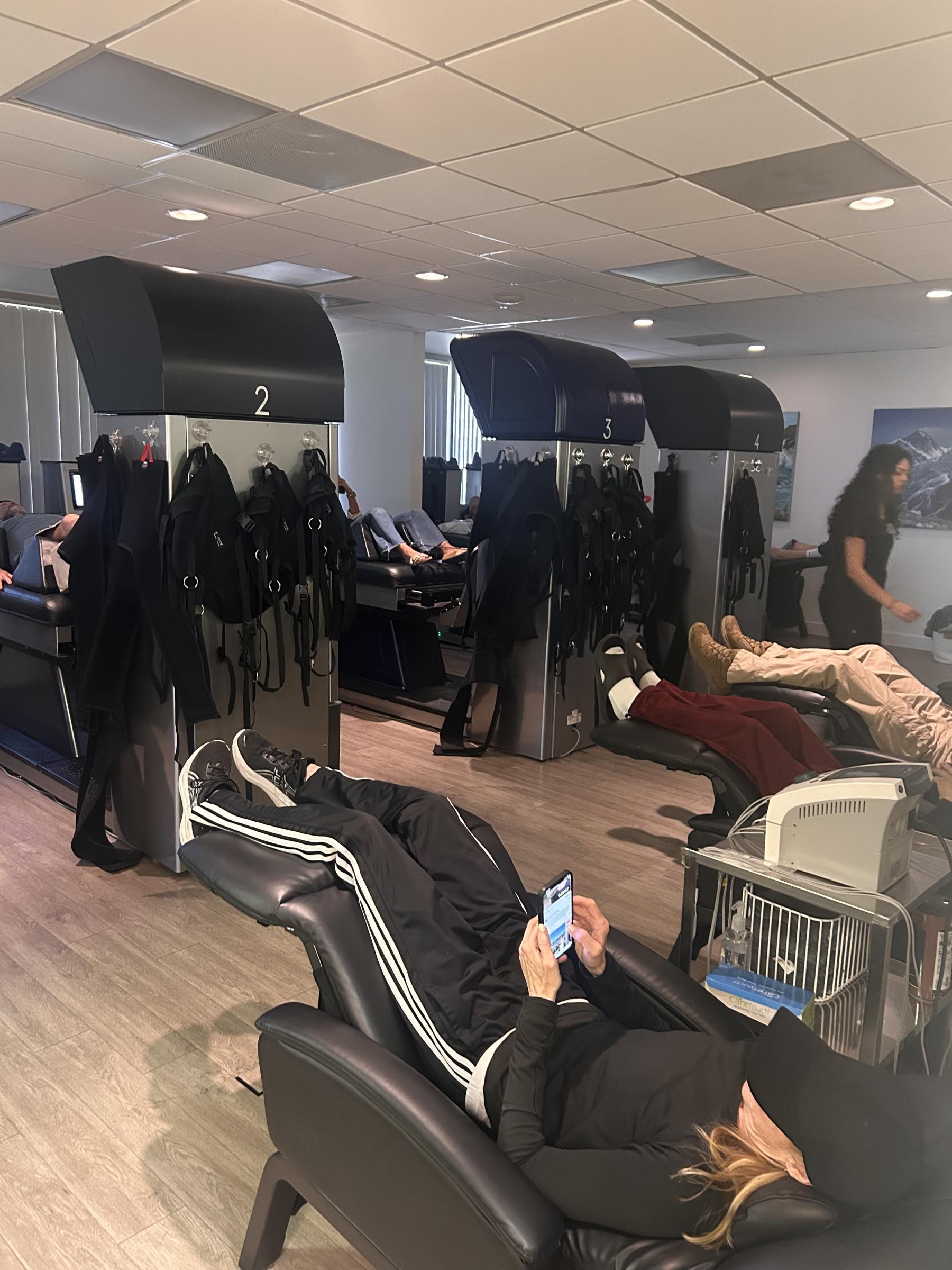
When Dr. Boelk believes a patient is an appropriate candidate for lumbar decompression, his office uses the DRX9000 exclusively.
The Spinal Decompression & Chiropractic Center of San Diego has seven DRX9000 systems—four lumbar and three cervical.
The patient lies on the table while the system applies controlled cycles of decompression and relaxation.
Most patients find treatment comfortable, and many find the sessions relaxing.
But the DRX9000 isn't a magic table, and Dr. Boelk doesn't treat every patient the same way.
He considers the spinal level being treated, treatment angle, positioning, starting force, the patient's body size, symptoms, tolerance and response.
A patient being treated for an L4-L5 disc problem may not have the same setup as someone being treated at L5-S1.
And the protocol may change depending on how the patient responds.
After more than 100,000 decompression treatments, Dr. Boelk's experience isn't simply in operating the equipment. It's in knowing how to apply decompression to the individual patient—and when not to use it.
You Don't Need to Stop Moving Just Because You Have Sciatica
Patients sometimes become understandably nervous about movement.
They bend over and feel the leg pain, so they stop bending.
They walk and feel something in the calf, so they stop walking.
Eventually they're doing very little because they're afraid of making the disc worse.
That's not usually the goal.
If walking is comfortable, short walks may be reasonable.
If sitting is clearly your biggest trigger, break up prolonged periods of sitting when you can. Someone working at a computer in Mira Mesa may do better getting up periodically rather than remaining in the same chair for hours.
If the drive is what sets you off, pay attention to your car-seat position.
You don't have to find a perfect posture and hold it all day.
Changing positions and moving within your tolerance can be helpful.
But Don't Force a Stretch That Sends Pain Down the Leg
This is different.
A lot of people with sciatica feel tight through the hamstring or calf.
The instinct is to stretch harder.
If you feel a normal muscular stretch, that's one thing.
If the stretch causes electrical pain, burning, tingling or numbness to travel farther down your leg, don't keep forcing it simply because someone told you stretching is good for sciatica.
The nerve itself may be irritated.
Pay attention to what your body is telling you.
How Do You Know Whether You're Improving?
Don't judge everything by what happens during one hour of one day.
Sciatica can fluctuate.
Instead, look at the things it has been preventing you from doing.
Can you sit longer than you could two weeks ago?
Can you sleep?
Are you walking farther?
Can you work without constantly changing positions?
Is the pain still reaching your foot?
Is the numbness changing?
Are you getting back to exercise?
These are practical ways of looking at progress.
A patient can still have some discomfort and be moving in a positive direction.
The opposite is also true. If weeks are going by and your ability to sit, walk or sleep is getting worse, that's worth discussing.
⭐⭐⭐⭐⭐ Rosa Algravez — Calexico, CA
“Hi my name is Rosa Algravez. I have suffered from leg numbness and low back pain for 4 years. I haven’t been able to do groceries or even take baths without pain. I looked for relief with various doctors with no luck. I have done treatments ranging from chiropractic to acupuncture. My husband found Dr. Boelk in the newspaper and we decided since we had tried everything else that we were going to give this a try. After my first few treatments, I feel as though I have returned to 100%. Life for me is completely different.
My husband and I have returned to enjoying life. We travel 300+ miles everyday from Calexico. I can do things now with little to no limitations. The staff makes you feel welcomed and it’s a very family environment. The payments are easy and I would recommend this to anyone suffering with low back pain. Thank You”
— Rosa Algravez, Age 58, Calexico, CA
What if Other Treatments Helped Only Temporarily?
Tell Dr. Boelk.
Patients sometimes dismiss a treatment as a failure because the symptoms eventually returned.
But suppose an injection dramatically reduced your leg pain for six weeks.
That's useful information.
Maybe physical therapy improved your mobility, but the numbness remained.
Maybe medication allows you to sit through work but the symptoms return when it wears off.
Maybe chiropractic treatment helps your lower back but hasn't changed what's happening in your foot.
The response can be part of understanding the problem.
You don't have to prove that everything else “failed” before discussing spinal decompression.
There Are Patients Dr. Boelk Will Not Treat With Decompression
Patient selection matters.
An unhealed fracture, significant osteoporosis, unstable spondylolisthesis, abdominal aortic aneurysm, pregnancy for lumbar treatment, certain malignancies and other medical conditions may make lumbar decompression inappropriate.
Previous spinal surgery requires careful review.
If there is fusion or metal hardware at the level Dr. Boelk would need to treat, that may rule out decompression at that level.
There are also cases where another specialist or surgical evaluation is the more appropriate next step.
⭐⭐⭐⭐⭐ Toni W. — Lake Elsinore, CA
“Very nice Dr. and Honest ! I would definitely recommend anyone who hasn't had metal put in there back in a surgery to go to him and give his program a shot. I believe it would definitely help. Just not in my personal case. As I have a lot of hardware in my back. But I'm glad I took the time to meet with him. It was very informative all around.”
— Toni W., Lake Elsinore, CA
Sometimes a useful consultation ends with Dr. Boelk telling someone that decompression isn't the right treatment.
That's part of the process too.
Tell Someone if Your Strength Is Changing
Pain is one thing.
Increasing neurological weakness is another.
If your foot is beginning to slap when you walk, you are having difficulty lifting the front of the foot, your leg repeatedly gives way or you've noticed a significant change in strength, get evaluated.
There are also symptoms that require prompt medical attention.
New loss of bowel or bladder control, difficulty urinating, numbness around the groin or saddle area, or rapidly progressing weakness should not wait for a routine spinal decompression consultation.
Why Dr. Boelk Has Spent More Than 22 Years Working With Spinal Decompression
Dr. Boelk's interest in spinal injuries began with his own.
He suffered an L5 compression fracture at age 16 and later experienced disc injuries and sciatica. Those experiences, along with thousands of hours spent on his own rehabilitation, eventually influenced the direction of his practice.
Dr. Boelk is a Certified Spinal Decompression Doctor and Certified Pain-Free Performance Specialist.
He is the Founder of the Non-Surgical Spinal Decompression Training Academy, where he trains other doctors in decompression protocols and techniques. He is also a Founding Member of the American Spinal Decompression Society, a member of the International Disc Education Association, and holds California X-ray radiography credentials.
His office now has seven DRX9000 systems and has provided more than 100,000 decompression treatments.
That experience doesn't mean every patient who comes in gets treated.
It means Dr. Boelk has spent a lot of time determining who is—and who isn't—a reasonable candidate.
Could Non-Surgical Spinal Decompression Help Your Sciatica?
If you live or work in Mira Mesa and sciatica is interfering with your commute, work, sleep, exercise or normal activities, find out what's causing it.
If you already have a lumbar MRI, bring the images and report.
If you don't, you can still schedule a consultation.
Dr. Boelk can discuss your symptoms and determine whether Non-Surgical Spinal Decompression may be an appropriate option.
Not every patient is a candidate. If Dr. Boelk doesn't believe decompression is appropriate for your condition, he'll tell you.
No-Charge, No-Obligation Consultation
The Spinal Decompression & Chiropractic Center of San Diego
5095 Murphy Canyon Road, Suite 300
San Diego, CA 92123
Phone: 619-298-0800
www.SanDiegoBackCare.com
Live 24/7 Answering Service • Hablamos Español
Call 619-298-0800 to schedule your No-Charge, No-Obligation Consultation.