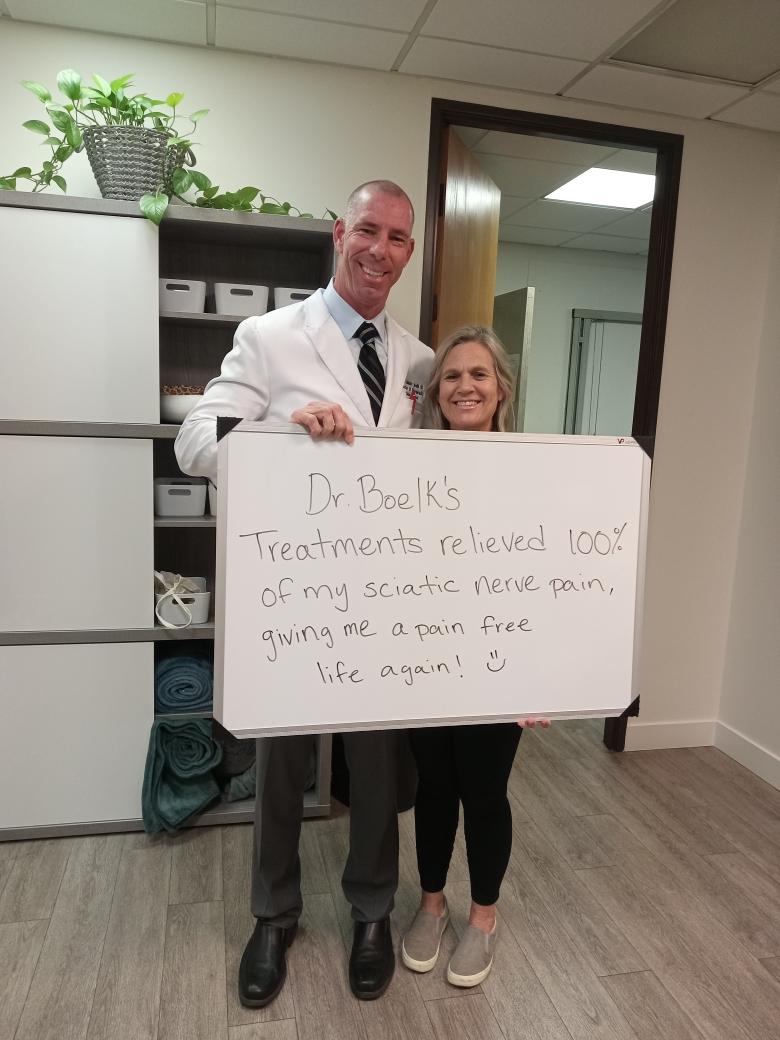
Can Spinal Decompression Help Sciatica Nerve Pain? – Kearny Mesa, CA
Why Does Sciatica Keep Coming Back?
Sciatica can be frustrating because it often seems to improve—only to return after sitting too long, lifting something, exercising, traveling, or performing an ordinary movement.
Medication may temporarily reduce the pain. Stretching might provide a few hours of relief. An injection may settle the inflammation for a while. But when the underlying nerve irritation remains, the burning, tingling, numbness, or shooting leg pain may return.
Non-surgical spinal decompression may help certain patients when their sciatica is connected to a bulging, herniated, or degenerative lumbar disc. The treatment is designed to reduce mechanical stress around the injured disc and irritated nerve without injections or surgery.
It does not help every cause of leg pain. The first step is determining what is producing the symptoms and whether decompression can be performed safely.
A Firefighter With Eight Months of Constant Sciatica
⭐⭐⭐⭐⭐
“Dr. Boelk has been a lifesaver.
I suffered from constant low back pain and sciatica for more than eight months. Pain medications didn’t help, and I was headed toward multiple injections in hopes of finding relief.
After beginning treatment with Dr. Boelk, everything changed.
Today, my pain is completely gone.
As a firefighter who depends on his body every day to help others, being pain-free has made a tremendous difference in both my career and quality of life.
The results I experienced were absolutely worth it, and I highly recommend looking into what Dr. Boelk and his team can do for you.”
— Joshua T., San Diego, CA
Joshua’s results are his own and cannot predict another patient’s outcome. His experience does show why persistent sciatica deserves more than repeatedly masking the symptoms without determining what is irritating the nerve.
You Do Not Need an MRI to Begin the Conversation
If sciatica is making it difficult to sleep, sit, walk, work, drive, or exercise, call 619-298-0800 for a no-charge, no-obligation consultation with Dr. Cassidy Boelk, DC.
An MRI can be valuable in certain cases, but you do not need to already have one to schedule a consultation. Dr. Boelk can begin by discussing your symptoms, history, previous treatment, and how the condition is affecting your life.
When appropriate, an examination and weight-bearing X-rays can provide additional information. If advanced imaging is clinically necessary, the office can explain the next step.
Whether you already have an MRI or have never had one, call 619-298-0800. Our answering service is available 24 hours a day, seven days a week. Hablamos Español.
Sciatica Is a Symptom, Not the Final Diagnosis
Sciatica describes pain or other nerve symptoms traveling along the pathway of the sciatic nerve. It does not explain why the nerve is irritated.
Symptoms may include:
-
Burning or shooting pain in the buttock or leg
-
Pain extending into the calf, ankle, foot, or toes
-
Tingling or pins and needles
-
Numbness
-
A heavy feeling in the leg
-
Weakness in the foot or leg
-
Pain that becomes worse while sitting, bending, coughing, or sneezing
The National Library of Medicine explains that sciatica can produce pain, weakness, numbness, or tingling extending from the lower back into the leg, calf, foot, or toes. National Library of Medicine: Sciatica
A bulging or herniated lumbar disc is a common cause, but not every case of leg pain comes from a disc. That distinction matters because the right treatment depends on the actual source of the symptoms.
Why Disc-Related Sciatica Can Become So Painful
The spinal discs sit between the vertebrae and help distribute force through the lower back.
When a disc becomes injured, its outer portion may weaken and allow the disc to bulge or herniate. If the displaced tissue affects a nearby lumbar nerve root, symptoms can travel far beyond the lower back.
The pain may be felt in the:
-
Buttock
-
Back or side of the thigh
-
Calf
-
Shin
-
Ankle
-
Heel
-
Top or bottom of the foot
-
Toes
Disc-related sciatica may involve both mechanical pressure and chemical inflammation surrounding the nerve. This helps explain why the intensity of the pain does not always match the apparent size of the disc injury.
A smaller disc problem in precisely the wrong location can cause severe symptoms. A larger-looking bulge may cause less pain if it is not affecting a sensitive nerve.
According to an NIH clinical review, bulging and herniated lumbar discs are among the most common causes of sciatica. The same review emphasizes the importance of distinguishing nerve irritation from direct compression accompanied by motor dysfunction. NIH/NCBI: Sciatica
What Makes Non-Surgical Spinal Decompression Different?
Non-surgical spinal decompression uses computer-controlled pulling and releasing cycles to unload a targeted part of the lumbar spine.
At The Spinal Decompression & Chiropractic Center of San Diego, Dr. Boelk uses DRX9000 systems exclusively for lumbar and cervical decompression. His Kearny Mesa office has four lumbar and three cervical DRX9000 machines.
Lumbar treatment may be adjusted according to:
-
The suspected disc level
-
The location of the leg symptoms
-
Patient positioning
-
The angle of treatment
-
Starting force
-
The number and duration of treatment cycles
-
The patient’s body type
-
Response during and following treatment
The objective is to create a better mechanical environment around the injured disc and irritated nerve.
This is not the same as pulling on someone’s legs or placing every patient on a generic traction setting. The machine is only one part of the process. Proper evaluation, patient selection, treatment frequency, progression, activity modification, and rehabilitation all matter.
What Does the Research Show?
Research on spinal decompression and lumbar traction is promising in certain areas, but it does not support guaranteed outcomes.
A randomized controlled trial involving patients with lumbar disc herniation found significant improvements in pain and functional status among those treated with DRX9000 non-surgical decompression. Conventional motorized traction also produced improvement, and the study did not establish that the DRX9000 was superior. Randomized DRX9000 clinical trial
A systematic review and meta-analysis of randomized trials concluded that lumbar traction may provide clinically meaningful short-term pain relief for patients with low-back pain and lumbar radiculopathy. The authors also noted limitations in the quality of the available evidence. Systematic review of lumbar traction and radiculopathy
These findings support decompression as a reasonable option to consider for properly selected patients—not as a treatment that works for every person with leg pain.
What If Other Treatments Have Not Worked?
Many patients arrive at Dr. Boelk’s office after trying several forms of care.
They may have used:
-
Anti-inflammatory or pain medication
-
Muscle relaxers
-
Chiropractic adjustments
-
Physical therapy
-
Massage
-
Acupuncture
-
Home stretching
-
Epidural injections
-
Rest and activity avoidance
Those treatments may have been reasonable. However, they do not all address an injured disc and irritated nerve in the same way.
Failure to improve with one treatment does not automatically mean surgery is the only option left. It also does not guarantee that decompression will be successful.
It means the condition should be reconsidered carefully: Does the pain pattern indicate a lumbar nerve problem? Is a disc likely involved? Is the spine stable? Is neurological function remaining intact? Can the patient be treated safely?
After an Accident, Sciatica Affected Every Part of His Life
⭐⭐⭐⭐⭐
“I was dealing with severe back pain that made it difficult to sleep, along with intense sciatica that radiated from my lower back down my leg following an accident.
When I met with Dr. Cassidy Boelk, he performed a thorough evaluation and determined that I was a good candidate for treatment.
The results were remarkable.
After just two spinal decompression sessions, my sciatic pain was gone, allowing us to focus on correcting the underlying cause of the problem. I completed 24 treatments and then progressed into rehabilitation exercises designed to strengthen my core and help prevent future flare-ups.
The office is beautiful, organized, and professional, and the customer service provided by the entire staff consistently exceeded my expectations.
Living with back and neck pain can affect every part of your life. In my case, I gained weight, relied on pain medications, struggled with depression, and dealt with significant anxiety because of my condition.
Today, I feel like a different person.
I’m sleeping better, walking comfortably, becoming active again, and enjoying life much more than before.
My experience has been excellent from start to finish.
Dr. Cassidy Boelk is truly outstanding, and I am extremely grateful I found his office.”
— Abel T., San Diego, CA
Abel experienced early improvement, but patients respond at different rates. Severe or longstanding disc conditions frequently require a structured treatment plan rather than one or two visits.
No responsible doctor should promise how quickly a specific patient will respond.
How Dr. Boelk Evaluates Sciatica Without Automatically Requiring an MRI
An MRI can be useful, especially when symptoms are severe, neurological deficits are present, previous treatment has failed, or surgery is being considered.
However, the evaluation does not have to begin with an MRI.
Dr. Boelk can learn a great deal by evaluating:
-
Where the pain starts and ends
-
Whether symptoms travel below the knee
-
Which part of the foot or leg feels numb
-
Muscle strength
-
Reflexes
-
The patient’s ability to walk
-
Movements or positions that reproduce symptoms
-
Previous injuries and treatment
-
History of spinal surgery
-
Weight-bearing alignment
-
Possible instability
When clinically appropriate, weight-bearing and flexion-extension X-rays may help determine how the spine behaves while standing and moving.
If an MRI is needed to clarify the diagnosis or confirm that treatment can be performed safely, Dr. Boelk can explain why. The goal is to use the information necessary for the individual patient—not to create an unnecessary barrier before the first conversation.
Why Rehabilitation Still Matters
Reducing sciatic pain is important, but pain relief does not automatically mean the spine is ready for unrestricted activity.
Once the irritated nerve begins settling and the patient can tolerate exercise, rehabilitation may be used to improve:
-
Core strength
-
Hip stability
-
Spinal control
-
Movement patterns
-
Lifting mechanics
-
Tolerance for sitting and standing
-
The ability to return to work, exercise, and recreation
Dr. Boelk is also a Certified Pain-Free Performance Specialist and has spent thousands of hours rehabilitating his own serious neck and lower-back injuries.
That experience has shaped his approach. The goal is not only to help reduce pain, but also to help patients rebuild the strength and confidence necessary to return to normal life.
When Sciatica Needs Immediate Medical Attention
Certain symptoms should not wait for an ordinary office appointment.
Seek urgent medical attention for:
-
New loss of bladder or bowel control
-
Difficulty urinating or an inability to feel a full bladder
-
Numbness around the groin, genitals, buttocks, or inner thighs
-
Rapidly progressing leg or foot weakness
-
Sudden difficulty controlling one or both legs
-
Severe symptoms following major trauma
These symptoms may indicate cauda equina syndrome or another serious neurological condition.
The American Association of Neurological Surgeons identifies urinary retention, incontinence, saddle numbness, and significant lower-extremity weakness as warning signs requiring immediate medical evaluation. American Association of Neurological Surgeons: Cauda Equina Syndrome
Not Every Person With Sciatica Is a Candidate
Spinal decompression may not be appropriate when a patient has:
-
An unstable spinal condition
-
An unhealed fracture
-
A neurological emergency
-
Certain serious vascular or bone conditions
-
Surgical hardware or fusion at the intended treatment level
-
Pregnancy when lumbar decompression is being considered
-
Another condition that is unlikely to respond to decompression
Previous spinal surgery does not automatically disqualify every patient. The type and location of the surgery, presence of hardware, intended treatment level, and spinal stability all need to be considered.
Honesty Matters More Than Starting Every Patient
⭐⭐⭐⭐⭐
“Very nice Dr. and honest! I would definitely recommend anyone who hasn’t had metal put in their back in a surgery to go to him and give his program a shot.
I believe it would definitely help—just not in my personal case, as I have a lot of hardware in my back.
But I’m glad I took the time to meet with him. It was very informative all around.”
— Toni W., Lake Elsinore, CA
Toni came to the office hoping decompression would be an option. After reviewing her surgical history and hardware, Dr. Boelk did not recommend treatment.
Not every patient who schedules a consultation will be accepted into a decompression program. If Dr. Boelk does not believe treatment is safe or appropriate, he will explain why.
Why Patients Seek Out Dr. Cassidy Boelk, DC
Dr. Boelk’s Kearny Mesa practice is focused on non-surgical spinal decompression, disc injuries, sciatica, radiating arm pain, and difficult neck and lower-back conditions.
His background includes:
-
Certified Spinal Decompression Doctor
-
Certified Pain-Free Performance Specialist
-
More than 22 years of clinical experience
-
More than 100,000 spinal decompression treatments performed
-
Founder of the Non-Surgical Spinal Decompression Training Academy
-
Trains other doctors in spinal decompression protocols and techniques
-
Founding Member of the American Spinal Decompression Society
-
Member of the International Disc Education Association
-
California-licensed doctor with X-ray radiography certification
-
Seven DRX9000 systems: four lumbar and three cervical
Patients seek Dr. Boelk’s expertise from throughout San Diego County, other parts of California, other states, Mexico, Canada, Spain, and the United Kingdom.
Find Out Why Your Sciatica Is Not Going Away
If you are tired of planning your day around leg pain—or wondering whether the next time you sit, bend, drive, or exercise will trigger another flare-up—the next step is finding out what is irritating the nerve.
You do not need to already have an MRI, and a consultation does not obligate you to begin treatment.
Schedule a No-Charge, No-Obligation Consultation
The Spinal Decompression & Chiropractic Center of San Diego
5095 Murphy Canyon Road, Suite 300
San Diego, CA 92123
Call: 619-298-0800
Website: www.SanDiegoBackCare.com
24/7 Answering Service
Hablamos Español
Call 619-298-0800 for a no-charge, no-obligation consultation with Dr. Cassidy Boelk, DC. Whether you already have imaging or have never had an MRI, Dr. Boelk will help you understand the most appropriate next step and whether non-surgical spinal decompression may be an option for your sciatica nerve pain.