Can Spinal Decompression Help Sciatica Nerve Pain? – Chula Vista, CA
When Sciatica Starts Making It Difficult to Stand or Walk
Sciatica can begin with something relatively minor—a nagging ache in the buttock, occasional tingling in the leg, or discomfort after sitting too long.
For some people, however, it progresses.
Walking becomes uncomfortable. Standing in one place becomes difficult. Pain begins traveling farther down the leg. The calf may burn, the foot may tingle, or parts of the leg may become numb.
Some patients eventually find themselves looking for somewhere to sit every few minutes or leaning over a shopping cart just to get through a store.
When sciatica reaches that point, simply treating the painful area is usually not enough. The more important issue is determining what is irritating the nerve in the first place.
Sciatica is not a diagnosis by itself. It describes symptoms associated with irritation of the nerves that eventually form the sciatic nerve.
Common spinal causes include:
-
Herniated discs
-
Bulging discs
-
Disc protrusions
-
Disc extrusions
-
Degenerative disc disease
-
Foraminal narrowing
-
Spinal stenosis
-
Other conditions affecting the lumbar nerve roots
For appropriately selected patients whose sciatica is related to a lumbar disc condition, Non-Surgical Spinal Decompression can be an effective treatment option without injections or surgery.
At The Spinal Decompression & Chiropractic Center of San Diego, Dr. Cassidy James Boelk, DC has focused much of his career on evaluating and treating these types of disc and nerve conditions.
Eight Months of Low Back Pain and Sciatica
Joshua T., a San Diego firefighter, had been dealing with constant low-back pain and sciatica for more than eight months.
Pain medications had not helped, and he was heading toward multiple injections in an attempt to find relief.
⭐⭐⭐⭐⭐ Joshua T. — San Diego, CA
“Dr. Boelk has been a lifesaver.
I suffered from constant low back pain and sciatica for more than eight months. Pain medications didn't help, and I was headed toward multiple injections in hopes of finding relief.
After beginning treatment with Dr. Boelk, everything changed.
Today, my pain is completely gone.
As a firefighter who depends on his body every day to help others, being pain-free has made a tremendous difference in both my career and quality of life.
The results I experienced were absolutely worth it, and I highly recommend looking into what Dr. Boelk and his team can do for you.”
— Joshua T., San Diego, CA
Individual results vary, and one patient's experience cannot predict another patient's response. Joshua's experience does demonstrate how dramatically persistent sciatica can affect someone's work and quality of life—and why identifying and treating the underlying problem matters.
Why Can a Problem in the Lower Back Cause Pain All the Way Into the Foot?
This is one of the first things many patients want explained.
The problem may be in the lumbar spine, but the worst pain can be in the buttock, thigh, calf, ankle, or foot.
The lumbar nerve roots leave the lower spine and eventually contribute to the sciatic nerve. When one of these nerve roots becomes irritated or compressed, symptoms can follow the nerve away from the spine.
Depending on the nerve involved, a patient may experience:
-
Deep buttock pain
-
Pain down the back or side of the thigh
-
Burning into the calf
-
Numbness or tingling
-
Pins and needles
-
Pain into the ankle or foot
-
Numbness in the toes
-
Leg or foot weakness
-
A heavy or fatigued feeling in the leg
-
Difficulty standing or walking
Some patients with significant sciatica have surprisingly little lower-back pain.
Their primary complaint is the leg.
This is one reason it is important to identify the source of the symptoms rather than simply treating the area where the patient feels pain.
A Disc Does Not Have to Look Enormous on an MRI to Cause Severe Sciatica
Patients are sometimes confused by this.
Their MRI may describe a disc protrusion as “small” or “mild,” yet the pain traveling down their leg is severe.
The amount of pain a patient experiences does not always correlate directly with the size of a disc abnormality on an MRI.
A lumbar nerve root can be affected by several factors, including:
-
Mechanical compression around the nerve
-
Inflammation associated with an injured disc
-
Reduced space where the nerve exits the spine
-
A combination of these factors
An irritated nerve can become extremely sensitive.
The opposite can also occur. Some people have significant degenerative changes or disc abnormalities on an MRI and relatively few symptoms.
For that reason, Dr. Boelk, DC evaluates the imaging along with the patient's clinical findings.
That evaluation may include:
-
Where the pain begins
-
How far down the leg it travels
-
Areas of numbness or tingling
-
Muscle strength
-
Reflexes
-
Walking tolerance
-
Sitting and standing tolerance
-
Positions that increase symptoms
-
Positions that relieve symptoms
-
Previous injuries
-
Previous treatments
-
Previous spinal surgery
-
Weight-bearing spinal alignment
-
Signs of spinal instability
An MRI can provide extremely useful information, but the written MRI report by itself does not determine whether a patient is a candidate for treatment.
How Non-Surgical Spinal Decompression Is Used for Sciatica
The Spinal Decompression & Chiropractic Center of San Diego uses DRX9000 spinal decompression systems exclusively.
The DRX9000 applies controlled decompression and relaxation cycles to a targeted region of the lumbar spine.
For disc-related sciatica, the objective is to reduce mechanical stress around the affected disc and irritated nerve root.
Treatment is not identical for every patient.
Dr. Boelk, DC can modify treatment parameters based on factors such as:
-
Disc level being treated
-
Treatment angle
-
Patient positioning
-
Starting force
-
Body size
-
Location of symptoms
-
Number of treatment cycles
-
Patient tolerance
-
Response to previous treatments
This is an important distinction when comparing spinal decompression offices.
The equipment matters, but so does the person determining how it is used.
Proper patient selection, treatment angle, force, frequency, progression, clinical monitoring, rehabilitation, and knowing when not to treat a patient are all important parts of a properly structured decompression program.
What If Standing and Walking Are the Biggest Problems?
Some patients with sciatica feel reasonably comfortable sitting or lying down but develop increasing symptoms once they are on their feet.
They may describe:
-
Burning after several minutes of walking
-
Increasing buttock or calf pain
-
Having to sit down frequently
-
Leaning over a shopping cart for relief
-
Favoring one leg
-
Shortening their stride
-
Avoiding exercise because walking increases the symptoms
Several different spinal conditions can produce this pattern, including disc problems, foraminal narrowing, and spinal stenosis.
This is also why every patient with sciatica should not automatically be given the same stretching or exercise program.
One common example is aggressive hamstring stretching.
A painful sciatic nerve is not necessarily a tight hamstring. Aggressively stretching an already irritated nerve can sometimes increase symptoms.
Patients can also pay attention to where their symptoms are traveling.
If a particular activity repeatedly causes pain, burning, numbness, or tingling to move progressively farther down the leg, repeatedly forcing that activity may continue irritating the nerve.
An Extruded Disc Was Pressing on Her L5 Nerve
Amanda's experience provides a good example of just how disabling disc-related sciatica can become.
Her symptoms had progressed to the point where getting out of bed was excruciating and walking or standing felt almost impossible.
An MRI eventually identified an extruded disc pressing on the L5 nerve.
⭐⭐⭐⭐⭐ Amanda — San Diego, CA
“Last year, I spent three months constantly going back and forth between doctor’s appointments and urgent care. The pain was unbearable—I was taking medication regularly just to get through the day. Getting out of bed was excruciating, and walking or standing felt like torture. Every step filled me with dread.
In December, my doctor finally ordered an MRI. That’s when I learned I had an extruded disc pressing on my L5 nerve, which affects the leg and foot. My doctor scheduled two follow-up appointments: one for pain management (spinal injections), and another to evaluate me for surgery.
Then I discovered spinal decompression therapy. I was thrilled to find a non-invasive alternative. I never ended up needing either of those appointments.
Now, I’m walking regularly, standing up straight—something I couldn’t do before. When I first sought help, I was so hunched over that I had to use a cane just to move forward. Because of the pain, I hadn’t exercised in months. But now, I’m doing a program called 75 hard which requires not one but 2 45-minute workouts per day, and I've even gotten back to lifting weights!
I’m so thankful I found this place. It’s conveniently located near my work, which makes it easy to fit sessions into my lunch break. Dr. Boelk and the staff are incredibly friendly and polite—it’s always a pleasure to come in.
The environment is so relaxing that I look forward to each visit. I truly thank God for leading me to this alternative. It’s made such a difference in my life.”
— Amanda, San Diego, CA
Amanda's experience is particularly relevant to patients whose sciatica has made standing and walking difficult. Her results are her own and cannot guarantee another patient's outcome.
Do Chula Vista Patients Need an MRI Before Scheduling?
No.
Patients do not need to already have an MRI to schedule a consultation with Dr. Boelk, DC.
If an MRI has already been performed, patients should bring the images and report with them.
Dr. Boelk personally reviews available MRI studies and correlates those findings with the patient's symptoms and examination.
MRI evaluation can become particularly useful when:
-
Symptoms are severe or persistent
-
Significant numbness is present
-
Muscle weakness is developing
-
Previous treatment has failed
-
Previous spinal surgery has been performed
-
The diagnosis remains unclear
-
Additional anatomical information is necessary before treatment
Weight-bearing X-rays and flexion-extension studies can also provide information that an MRI does not necessarily show, particularly when evaluating alignment and spinal stability.
Not Every Patient With Sciatica Is a Candidate for Spinal Decompression
This is an important part of the evaluation.
Non-Surgical Spinal Decompression is not appropriate for every patient with back or leg pain.
Depending upon the individual circumstances, treatment may not be appropriate for patients with conditions such as:
-
Unstable spondylolisthesis
-
Certain spinal fractures
-
Significant osteoporosis
-
Abdominal aortic aneurysm
-
Pregnancy for lumbar treatment
-
Certain malignancies
-
Certain surgical hardware at the treatment level
-
Progressive neurological weakness
-
Cauda equina syndrome
-
Other conditions that make decompression unsafe
There are also conditions outside the lumbar spine that can produce symptoms resembling sciatica.
Hip disorders, sacroiliac conditions, peripheral nerve problems, and vascular conditions are several examples.
A good candidacy evaluation therefore asks two questions:
Can Non-Surgical Spinal Decompression help this condition?
And equally important:
Can it be performed safely?
Sometimes Surgery Really Is the Appropriate Recommendation
The goal at The Spinal Decompression & Chiropractic Center of San Diego is not to place every patient who wants to avoid surgery into a decompression program.
Some patients are not candidates.
Jeff J. traveled from Tucson, Arizona seeking another opinion about his back condition.
⭐⭐⭐⭐⭐ Jeff J. — Tucson, AZ
“I found this terrific practice on social media. I followed up and did my own research so I decided to pay them a visit. The place is clean, well organized and run by a very efficient receptionist. I met with the doctor and after a honest and forthright conversation, we both determined that surgery was my only option to correct my back issues. I will return as a customer when the time is right.”
— Jeff J., Tucson, AZ
Jeff was not placed into treatment simply because he wanted a non-surgical option.
After evaluating his condition, surgery was determined to be the appropriate direction.
That type of candidacy screening is important. If Dr. Boelk, DC does not believe Non-Surgical Spinal Decompression is appropriate, he will explain why.
When Sciatica Requires Immediate Medical Attention
Most sciatica is painful but does not represent a neurological emergency.
Certain symptoms are different and require immediate medical evaluation.
These include:
-
New loss of bladder or bowel control
-
Difficulty beginning urination
-
Loss of sensation around the groin, genitals, buttocks, or inner thighs
-
Rapidly progressing leg weakness
-
Sudden difficulty controlling one or both legs
These symptoms can be associated with cauda equina syndrome or another serious neurological condition and should be evaluated urgently.
Why Patients Seek Out Dr. Cassidy James Boelk, DC
Patients travel from Chula Vista, throughout San Diego County, and considerably farther to seek Dr. Boelk's experience with Non-Surgical Spinal Decompression and difficult disc-related spinal conditions.
His background includes:
-
Certified Spinal Decompression Doctor
-
Certified Pain-Free Performance Specialist (PPSC)
-
More than 22 years helping patients with disc-related spinal conditions
-
More than 100,000 Non-Surgical Spinal Decompression treatments performed
-
Founder of the Non-Surgical Spinal Decompression Training Academy
-
Founding Member of the American Spinal Decompression Society
-
Member of the International Disc Education Association
Dr. Boelk has also spent thousands of hours rehabilitating significant neck and lower-back injuries of his own, giving him personal as well as clinical experience with the frustrations that can accompany a spinal injury.
His practice is highly focused on disc and nerve conditions including:
-
Herniated discs
-
Bulging discs
-
Disc protrusions and extrusions
-
Sciatica
-
Degenerative disc disease
-
Foraminal stenosis
-
Cervical radiculopathy
-
Chronic neck pain
-
Chronic lower-back pain
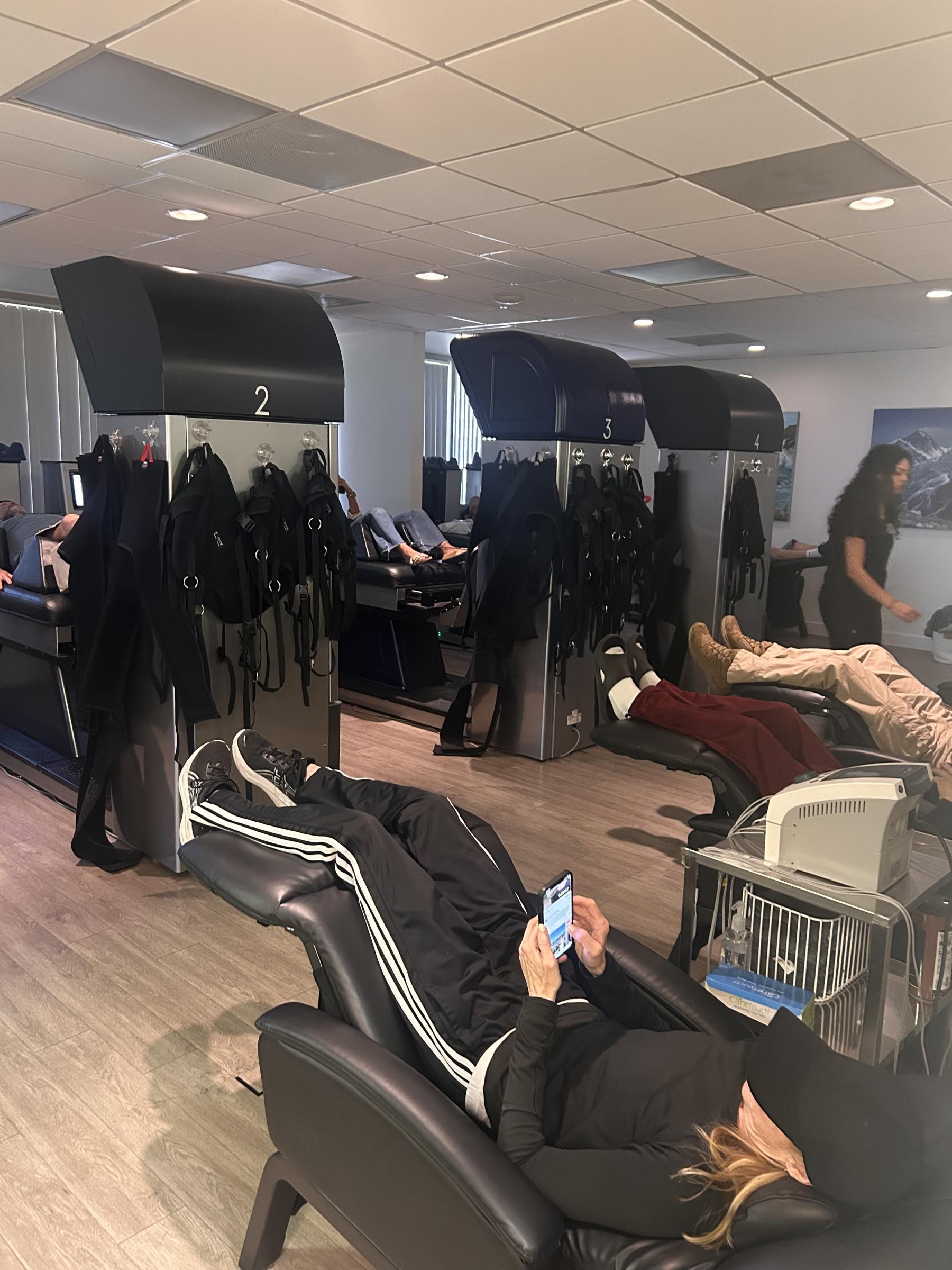
Seven DRX9000 Systems in One San Diego Facility
The Spinal Decompression & Chiropractic Center of San Diego has a dedicated Non-Surgical Spinal Decompression facility in Kearny Mesa with:
-
7 DRX9000 spinal decompression systems
-
4 lumbar DRX9000 systems
-
3 cervical DRX9000C systems
-
Individualized treatment protocols
-
MRI review when appropriate
-
Weight-bearing spinal evaluation
-
Rehabilitation and spinal stabilization when appropriate
-
Careful candidacy screening
Patients have traveled to the practice from throughout California and the United States as well as Mexico, Canada, Spain, and the United Kingdom seeking Dr. Boelk's experience with Non-Surgical Spinal Decompression.
Find Out What Is Causing the Sciatica
For patients in Chula Vista and the South Bay dealing with persistent sciatica, burning leg pain, numbness, tingling, or difficulty standing and walking, scheduling a consultation does not mean committing to treatment.
The purpose is to determine what is causing the symptoms and whether Non-Surgical Spinal Decompression is appropriate.
Patients do not need an MRI before calling.
If imaging has already been performed, patients are encouraged to bring it for review.
Schedule a Complimentary, No-Charge, No-Obligation Consultation
The Spinal Decompression & Chiropractic Center of San Diego
5095 Murphy Canyon Road, Suite 300
San Diego, CA 92123
Office: 619-298-0800
Office Cell: 619-884-8298
Website: www.SanDiegoBackCare.com
Live 24/7 Answering Service
Hablamos Español
Call 619-298-0800 to schedule a no-charge consultation with Dr. Cassidy James Boelk, DC.
The consultation is an opportunity to review the patient's symptoms, examination findings and available imaging, answer questions, and determine whether Non-Surgical Spinal Decompression is an appropriate option.