Can Spinal Decompression Help Degenerative Disc Disease? | Mira Mesa, CA
Being told you have degenerative disc disease can leave you with more questions than answers.
Maybe you've been dealing with lower back pain for several years. You finally had an MRI, and your doctor explained that the discs at L4-L5 or L5-S1 are wearing down. Perhaps there's also a disc bulge, arthritis, or narrowing around one of the spinal nerves.
You may have tried physical therapy, chiropractic adjustments, medications, or injections, but you're still having trouble sitting comfortably, bending forward, or getting through the day without pain.
So what happens next?
For some patients, Non-Surgical Spinal Decompression may be an option worth considering before moving toward more invasive treatment.
At The Spinal Decompression & Chiropractic Center of San Diego, Dr. Cassidy James Boelk, DC, has spent more than 22 years specializing in spinal decompression and evaluating patients with chronic lower back pain, neck pain, sciatica, and degenerative spinal conditions.
Patients from Mira Mesa, Sorrento Valley, Rancho Peñasquitos, and surrounding San Diego communities visit his Kearny Mesa clinic to find out whether the DRX9000 spinal decompression system may be appropriate for their condition.
The important thing to understand is that not every degenerative disc causes pain, and not every patient with degenerative disc disease is a candidate for spinal decompression.
A proper evaluation makes the difference.
When Back Pain Interferes With Everyday Life
For patients dealing with chronic disc problems, even ordinary activities can become difficult.
Patient Testimonial — Brian Perrotta, San Diego, CA
Herniated disc and severe sciatica
“I highly recommend Dr. Cassidy Boelk, DC and the team at The Spinal Decompression and Chiropractic Center. I came in with severe sciatica and a herniated disc, and his treatments have made a world of difference.
He and his staff are both professional and genuinely caring, creating a welcoming and supportive environment.
The treatments were not only highly effective but also tailored to my specific needs.
I’m grateful for the care I received and the significant improvement in my quality of life.”
Limited No-Charge Consultation for Mira Mesa Patients
If you've been diagnosed with degenerative disc disease and are wondering whether spinal decompression could help, Dr. Boelk offers a limited number of No-Charge, No-Obligation Consultations each week.
These appointments are an opportunity to discuss your condition, learn about the DRX9000 system, and find out whether further evaluation for spinal decompression may be appropriate.
What Is Included in the No-Charge Consultation?
1. Discussion of your symptoms
Dr. Boelk will ask where you're experiencing pain, how long you've had it, and which movements or positions make it better or worse.
2. Review of your medical and treatment history
You'll discuss previous physical therapy, chiropractic care, medications, injections, surgery, and other treatments you've tried.
3. Discussion of your MRI findings
If you have an MRI available, Dr. Boelk can discuss findings such as disc degeneration, disc space narrowing, bulging discs, herniations, or narrowing around the spinal nerves.
4. Explanation of DRX9000 spinal decompression
You'll learn how the system works, what treatment involves, and why some spinal conditions may be more appropriate for decompression than others.
5. Initial discussion of candidacy
Dr. Boelk will explain factors that may make treatment suitable or unsuitable, including previous surgery, spinal instability, and certain medical conditions.
6. Recommendations for your next step
Depending on your situation, this may involve a comprehensive examination, additional imaging, continued conservative care, or referral to another specialist.
You'll also have an opportunity to ask questions about treatment schedules, costs, and what to expect if you're accepted for care.
The consultation is not a comprehensive examination or a final determination of candidacy. If additional testing or imaging is recommended, the office will explain any associated fees before proceeding.
Because Dr. Boelk personally conducts these consultations, only a limited number are available each week. Appointments are scheduled on a first-come, first-served basis.
Call 619-298-0800 to request your No-Charge Consultation.
24/7 live answering service. Hablamos Español.
What Happens to Your Spinal Discs as You Get Older?
The discs between your vertebrae help absorb forces and allow your spine to move.
When we're younger, these discs generally contain more water and have greater flexibility.
Over time, they naturally begin to change.
They may lose water content, become less flexible, and gradually lose some of their height. The outer portion of the disc may develop small tears, and the nearby spinal joints can also undergo degenerative changes.
Doctors often refer to these findings as degenerative disc disease, or DDD.
On an MRI report, you may see terms such as disc desiccation, degenerative disc changes, or disc space narrowing.
The lower lumbar spine is particularly susceptible because it handles considerable mechanical loading throughout the day.
Two of the most commonly affected levels are L4-L5 and L5-S1.
Degenerative changes can also develop in the cervical spine, especially at C5-C6 and C6-C7.
But here's something many patients don't realize.
Having degenerative disc disease on an MRI doesn't automatically mean the disc is causing your pain.
Plenty of adults have significant degenerative changes and remain physically active without major symptoms.
That's why Dr. Boelk looks beyond the MRI report when evaluating a patient.
Why Can Degenerative Disc Disease Cause Lower Back Pain?
There are several possible reasons.
In some patients, changes within the disc and surrounding vertebral endplates can contribute to pain.
As a disc loses height, the way forces move through the spine can also change.
The nearby facet joints may experience additional stress, and arthritis may develop.
Another concern is the space available for the spinal nerves.
Each spinal nerve exits through an opening called a foramen. As the disc loses height, that opening may become narrower.
This is called foraminal stenosis.
If a nerve becomes irritated or compressed, pain may travel away from the spine.
For example, someone with degenerative changes at L5-S1 may experience lower back pain along with burning, tingling, or numbness traveling down one leg.
Someone with degeneration in the neck may experience pain extending into the shoulder, arm, or hand.
Other patients experience mainly localized back pain without nerve symptoms.
Understanding these differences helps determine which treatments are appropriate.
How Does the DRX9000 Spinal Decompression System Work?
The DRX9000 is a computerized spinal decompression system that applies controlled mechanical traction to the spine.
During treatment, the patient is positioned on the decompression table while the system delivers carefully regulated pulling forces.
The intention is to reduce mechanical loading on selected spinal structures and potentially relieve symptoms associated with certain disc-related conditions.
For some patients, traction-based treatment may help reduce discomfort and improve their ability to move, exercise, and participate in rehabilitation.
However, spinal decompression does not reverse the aging process.
It has not been proven to regenerate severely degenerated discs, permanently restore substantial disc height, or eliminate advanced spinal arthritis.
Research specifically supporting proprietary motorized spinal decompression systems for degenerative disc disease remains limited.
That is one reason patient selection matters.
Dr. Boelk evaluates the patient's symptoms, neurological findings, imaging, spinal stability, and treatment history before recommending a decompression program.
His clinic exclusively uses DRX9000 spinal decompression systems and has seven units for lumbar and cervical treatment.
Degenerative Disc Disease at L4-L5 and L5-S1
These are two of the most common spinal levels involved in chronic lower back problems.
L4-L5 Degenerative Disc Disease
At L4-L5, degeneration may occur alongside a disc bulge, herniation, facet arthritis, or degenerative spondylolisthesis.
Some patients develop lower back pain that becomes worse after sitting or bending.
Others experience nerve-related symptoms that extend into the leg.
When spondylolisthesis is present, determining whether the spinal segment is stable is particularly important.
L5-S1 Degenerative Disc Disease
L5-S1 is the lowest lumbar disc and experiences considerable mechanical loading.
Degeneration at this level can involve substantial disc height loss, endplate changes, facet arthritis, or narrowing around the exiting L5 nerve roots.
Patients may experience lower back pain, buttock discomfort, or symptoms traveling down one leg.
The severity of the MRI findings doesn't always correspond directly with the amount of pain.
A patient with advanced degeneration may have relatively mild symptoms, while someone with less obvious changes may experience significant nerve irritation.
Dr. Boelk considers how the symptoms correspond with the imaging and examination findings.
When appropriate, weight-bearing X-rays and flexion-extension views may help evaluate spinal alignment and stability.
What If Your MRI Shows a Collapsed Disc?
Patients sometimes arrive with MRI reports describing severe disc space narrowing or a nearly collapsed disc.
Naturally, they want to know whether spinal decompression can restore the disc.
The answer requires realistic expectations.
Spinal decompression has not been proven to permanently rebuild a collapsed disc or restore substantial lost disc height.
However, some patients with degenerative changes may still benefit from conservative treatment aimed at reducing pain and improving function.
Whether spinal decompression is appropriate depends on several factors, including the degree of degeneration, symptoms, neurological findings, and spinal stability.
A severely degenerated disc may also be associated with facet arthritis, foraminal stenosis, or other structural changes that influence the treatment recommendation.
The goal is to understand what's causing the symptoms rather than focusing exclusively on the appearance of the disc.
Can You Stay Active With Degenerative Disc Disease?
In many cases, yes.
Having degenerative disc disease doesn't mean you need to stop exercising, walking, or participating in activities you enjoy.
Appropriate movement and strengthening are often important parts of managing chronic spinal conditions.
Depending on the patient's symptoms, rehabilitation may include walking, trunk stabilization, hip strengthening, and gradual improvements in mobility and physical conditioning.
Some people need to temporarily modify activities that aggravate their symptoms, such as repeated bending, prolonged sitting, or heavy lifting.
Others benefit from improving their tolerance for these movements over time.
The goal is to help patients remain as active and functional as possible.
For selected patients, spinal decompression may be considered alongside an appropriate rehabilitation program.
When Previous Treatments Haven't Worked
Many patients who contact the clinic have already tried several approaches.
Some have completed physical therapy. Others have received chiropractic adjustments, medications, or spinal injections.
When symptoms continue despite appropriate care, the next step should be to reassess the condition.
Is the disc itself contributing to pain? Is there a herniation? Has disc height loss contributed to foraminal narrowing? Is there instability or another problem that needs attention?
The answers can change the treatment recommendation.
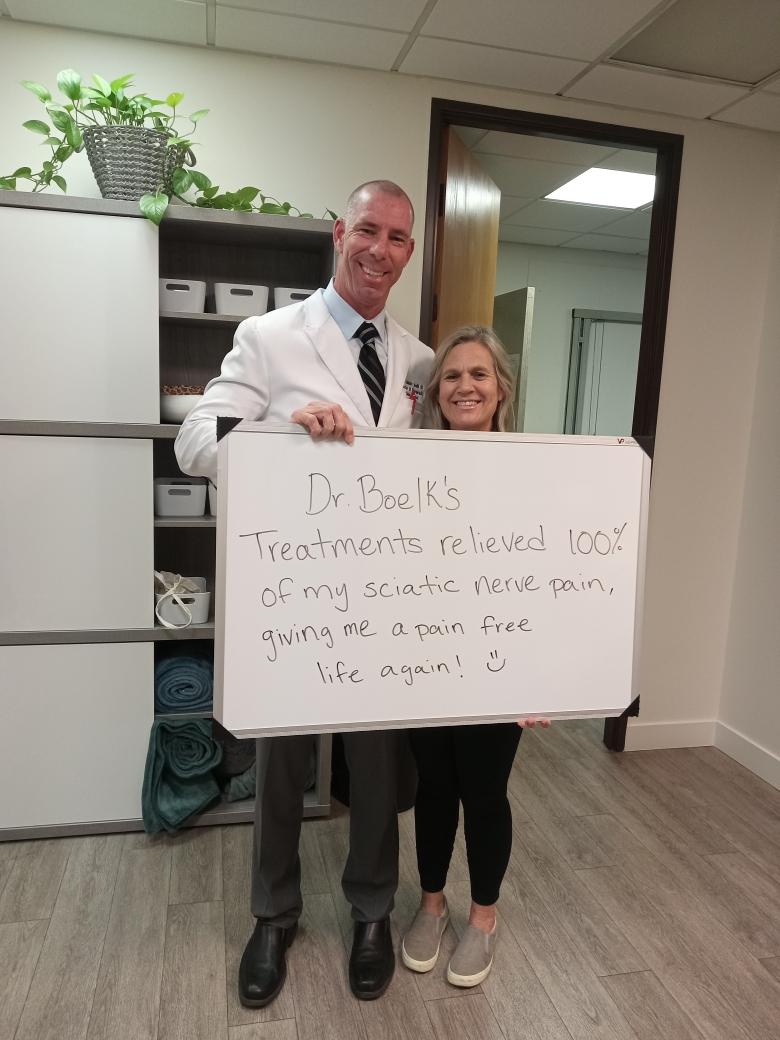
Patient Testimonial — Yuri Fresia, San Diego, CA
Persistent sciatica affecting work and physical activity
“When I first came here I was suffering from sciatica pain for several months non stop. I tried many different non invasive treatments, pain killers but relief was just temporary.
I heard about Dr. Boelk on social media and after reading other people testimonials about him I decided to try. It felt better since my first session. After 12 I felt I was improving a lot but still had room to get better so we decided trying 12 more.
After 36 sessions I felt I was back to normal. I could get back to surf, jiu jitsu and work after 6 months away.
Doctor helped me through the whole process, leaving me free to decide the next step and being honest about expectations.
I totally recommend for all my friends that suffer from sciatica pain. It’s worth 100%.”
Not Everyone Is a Candidate for Spinal Decompression
Dr. Boelk does not accept every patient who visits the clinic.
Certain fractures, significant spinal instability, unstable spondylolisthesis, fusion hardware at the intended treatment level, and other medical conditions may make spinal decompression inappropriate.
Patients with progressive neurological weakness may require prompt medical or surgical evaluation.
New bowel or bladder dysfunction, saddle anesthesia, or rapidly worsening leg weakness requires emergency medical attention.
In some situations, surgery or another treatment approach may be the most appropriate recommendation.
Determining when not to perform spinal decompression is an important part of patient selection.
About Dr. Cassidy James Boelk, DC
Dr. Boelk is the Founder and Clinic Director of The Spinal Decompression & Chiropractic Center of San Diego.
He has spent more than 22 years specializing in Non-Surgical Spinal Decompression and has experience with more than 100,000 spinal decompression sessions.
His credentials and professional affiliations include:
-
California Licensed Doctor of Chiropractic
-
Certified Spinal Decompression Doctor
-
Certified Pain-Free Performance Specialist (PPSC)
-
California X-ray Radiology Licensed Doctor
-
Founder, Non-Surgical Spinal Decompression Training Academy
-
Founding Member, American Spinal Decompression Society
-
Member, International Disc Education Association
In addition to treating patients, Dr. Boelk trains other healthcare professionals in spinal decompression protocols, patient selection, and rehabilitation principles.
His interest in spinal care is personal.
After fracturing his back when he was younger and experiencing additional spinal injuries later in life, he developed a strong interest in spinal biomechanics and non-surgical treatment options.
He continues to remain active through surfing, strength training, and hockey.
His Kearny Mesa clinic exclusively uses DRX9000 spinal decompression equipment, with seven systems dedicated to treating selected cervical and lumbar conditions.
Conveniently Located for Mira Mesa and Sorrento Valley Patients
The Spinal Decompression & Chiropractic Center of San Diego is located at 5095 Murphy Canyon Road, Suite 300, in Kearny Mesa.
Patients visit from Mira Mesa, Sorrento Valley, Scripps Ranch, Rancho Peñasquitos, Carmel Mountain Ranch, Poway, and surrounding communities.
The clinic also works with patients traveling from outside San Diego County and internationally.
For patients traveling longer distances, the office can explain the evaluation process, scheduling considerations, and which medical records may be useful before arranging travel.
Frequently Asked Questions About Degenerative Disc Disease
Can degenerative disc disease cause sciatica?
Yes. If disc degeneration is associated with a herniation or narrowing around a spinal nerve, it may contribute to sciatica, numbness, or tingling.
Does degenerative disc disease always get worse?
Not necessarily. Degenerative changes may progress with age, but symptoms don't always worsen. Many people remain active despite significant changes on MRI.
Can spinal decompression restore disc height?
Spinal decompression has not been proven to permanently restore substantial lost disc height or regenerate severely degenerated discs.
Is walking good for degenerative disc disease?
Walking is often beneficial when tolerated. It helps maintain mobility and general physical conditioning.
Can I lift weights with degenerative disc disease?
Many people can continue strength training with appropriate modifications. Exercise selection should depend on symptoms, neurological findings, and spinal stability.
Does degenerative disc disease always require surgery?
No. Many patients improve with conservative treatment. Surgery may be considered when symptoms remain disabling despite appropriate care or when significant neurological problems develop.
How do I know whether I'm a candidate for DRX9000 spinal decompression?
Candidacy depends on your symptoms, examination findings, imaging, spinal stability, previous surgery, and other medical considerations. Dr. Boelk begins with a consultation to discuss whether further evaluation is appropriate.
Degenerative Disc Disease Treatment Near Mira Mesa, CA
If you've been diagnosed with degenerative disc disease at L4-L5, L5-S1, C5-C6, or another spinal level and continue experiencing pain, understanding the cause of your symptoms is an important first step.
Dr. Cassidy James Boelk, DC, has spent more than 22 years specializing in Non-Surgical Spinal Decompression and evaluating patients with complicated cervical and lumbar conditions.
His approach begins with determining whether spinal decompression is appropriate rather than recommending the same treatment to everyone.
Request Your Limited No-Charge Consultation
Dr. Boelk offers a limited number of No-Charge, No-Obligation Consultations each week.
During your appointment, you'll have the opportunity to discuss your symptoms and previous treatments, discuss available MRI findings when appropriate, learn how the DRX9000 spinal decompression system works, and ask whether you may be a candidate.
Dr. Boelk will also explain whether a comprehensive examination, additional imaging, or another treatment approach may be the appropriate next step.
There is no obligation to begin treatment.
Because Dr. Boelk personally conducts these consultations, appointments are limited and scheduled on a first-come, first-served basis.
Call 619-298-0800 to request your No-Charge Consultation.
24/7 live answering service. Hablamos Español.
The Spinal Decompression & Chiropractic Center of San Diego
Dr. Cassidy James Boelk, DC
5095 Murphy Canyon Road, Suite 300
San Diego, CA 92123
Phone: 619-298-0800
Website: www.SanDiegoBackCare.com
Serving Mira Mesa, Sorrento Valley, Scripps Ranch, Rancho Peñasquitos, Poway, Carmel Mountain Ranch, and surrounding San Diego communities.