Can Spinal Decompression Help Degenerative Disc Disease? | Kearny Mesa, CA
If you've been diagnosed with degenerative disc disease in your lower back or neck, you may be wondering what your options are.
Maybe your MRI shows significant disc space narrowing at L4-L5 or L5-S1. Perhaps you've been dealing with chronic lower back pain for years, or you're beginning to experience pain traveling into your buttock or leg.
You may have already tried physical therapy, chiropractic adjustments, medications, or injections without getting the improvement you were hoping for.
Does that mean surgery is your only remaining option?
Not necessarily.
For certain patients, Non-Surgical Spinal Decompression may be another conservative treatment worth considering.
Dr. Cassidy James Boelk, DC, has spent more than 22 years specializing in spinal decompression, helping patients with complicated cervical and lumbar conditions understand their treatment options.
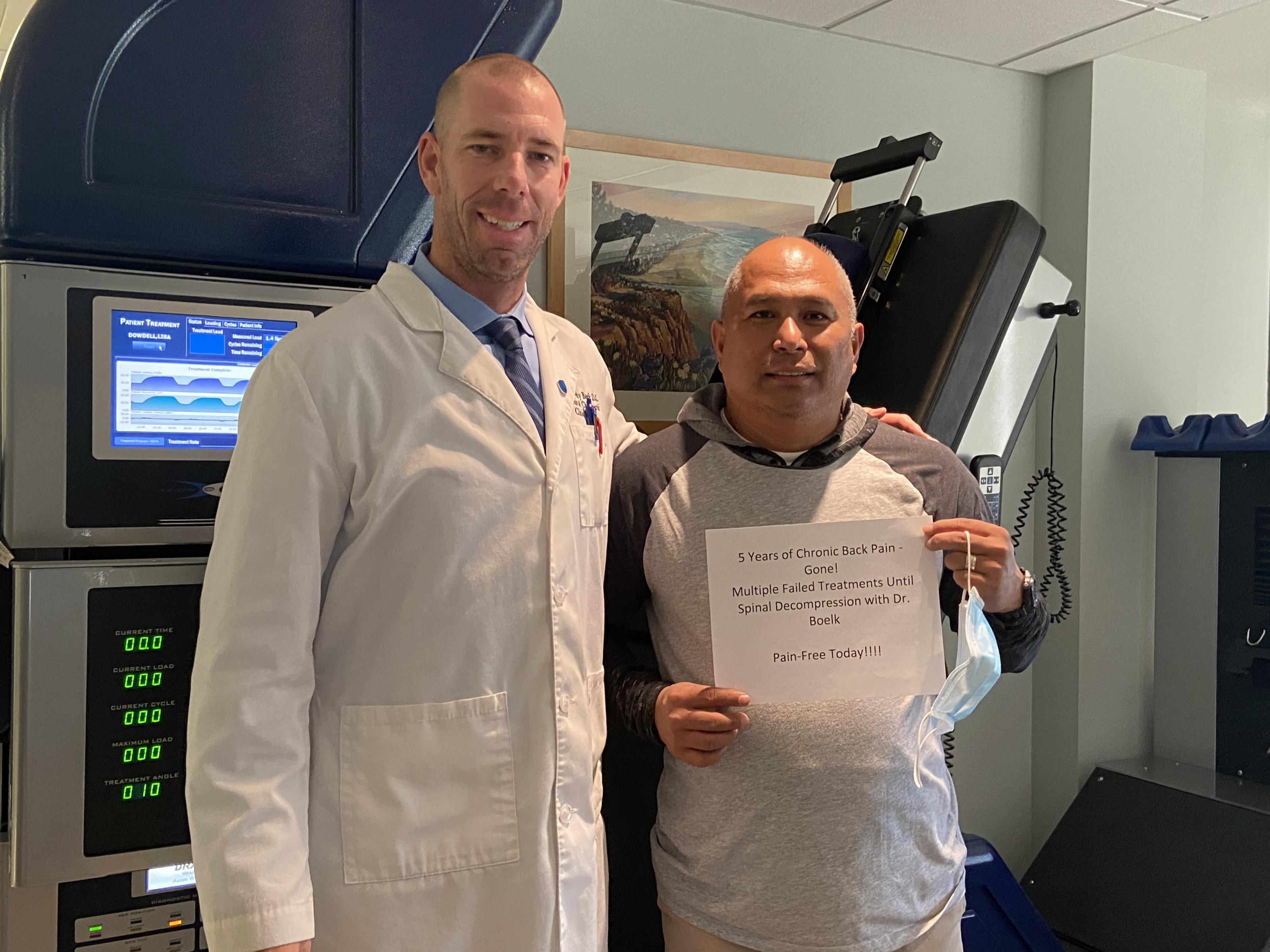
His clinic, The Spinal Decompression & Chiropractic Center of San Diego, is located in Kearny Mesa and exclusively uses the DRX9000 spinal decompression system.
The first step is determining whether the degenerative disc is contributing to your symptoms and whether spinal decompression is appropriate for your condition.
Real Patient Experience: Degenerative Disc Disease and Chronic Back Pain
Patient Testimonial — Steve Robinson
Chronic lower back pain and degenerative disc disease
“Dr. Boelk is professional, kind, and truly prioritizes his patients’ health.
The spinal decompression treatments, combined with the exercises and guidance he provided, have reduced my back pain to the point that I can sleep again.
Traditional chiropractic adjustments did not help my lower back—but spinal decompression did.
I highly recommend Dr. Boelk.”
Limited No-Charge Consultation — Find Out Whether You May Be a Candidate
If you've been diagnosed with degenerative disc disease and are wondering whether spinal decompression could be appropriate, Dr. Boelk offers a limited number of No-Charge, No-Obligation Consultations each week.
These appointments are designed to help patients understand their condition and learn about possible treatment options before committing to care.
What's Included in the No-Charge Consultation?
-
Discussion of your symptoms. Dr. Boelk will ask where you're experiencing pain, how long it's been present, and which movements or activities make it better or worse.
-
Review of your treatment history. You'll discuss previous physical therapy, chiropractic care, medications, injections, surgery, and other treatments you've tried.
-
Discussion of your MRI findings. If you have an MRI available, Dr. Boelk can discuss findings such as disc degeneration, disc height loss, bulging discs, herniations, or associated spinal narrowing.
-
Explanation of the DRX9000 system. You'll learn how Non-Surgical Spinal Decompression works, what treatment involves, and which conditions may be appropriate.
-
Initial discussion of candidacy. Dr. Boelk will explain factors that may make spinal decompression appropriate or unsuitable for your condition.
-
Recommendations for the next step. This may include a comprehensive examination, additional imaging, conservative treatment, or referral to another specialist.
You'll also have an opportunity to ask questions about the treatment process, scheduling, and program options.
The consultation is not a comprehensive examination or a final determination of candidacy. If further evaluation or imaging is recommended, the office will explain any associated fees before proceeding.
Because Dr. Boelk personally conducts these consultations, only a limited number are offered each week. Appointments are scheduled on a first-come, first-served basis.
Call 619-298-0800 to request your No-Charge Consultation.
The office has a 24/7 live answering service. Hablamos Español.
What Happens When a Spinal Disc Degenerates?
The discs between your vertebrae help absorb forces and allow your spine to move.
Over time, these discs naturally undergo changes.
They can lose water content, become less flexible, and gradually lose height. The outer layers may develop small tears, and the nearby vertebral endplates may also change.
On an MRI, these findings are often described as degenerative disc disease, disc desiccation, or disc space narrowing.
The lower lumbar spine is particularly susceptible because it carries much of the body's weight and is involved in bending, lifting, and twisting.
Two commonly affected levels are L4-L5 and L5-S1.
Degenerative changes can also develop in the neck, particularly at C5-C6 and C6-C7.
But here's something important: disc degeneration doesn't always cause pain.
Many adults have degenerative changes on MRI and remain physically active without significant symptoms.
That's why the diagnosis shouldn't be based on an MRI report alone.
Why Does Degenerative Disc Disease Cause Pain in Some People?
There are several possible reasons.
A degenerating disc may develop changes that contribute to local inflammation or pain arising from the disc itself.
As the disc loses height, the mechanics of the surrounding spinal joints can change. The facet joints may experience additional stress, and arthritis may develop.
Disc height loss can also reduce the size of the openings where spinal nerves exit.
This is called foraminal stenosis.
If the narrowing irritates a nerve, patients may experience pain traveling into the buttock, leg, shoulder, or arm.
A disc bulge or herniation can contribute to the problem as well.
For example, someone with advanced degeneration at L5-S1 may have both chronic lower back pain and symptoms traveling down one leg.
Another patient may have significant disc degeneration without any nerve compression.
Although both have degenerative disc disease, their symptoms and treatment needs may be quite different.
Can the DRX9000 Help Degenerative Disc Disease?
Non-Surgical Spinal Decompression uses controlled mechanical traction to apply carefully regulated forces to the spine.
The goal is to reduce mechanical loading on selected spinal structures and potentially relieve irritation associated with certain disc-related conditions.
For some patients, traction-based care may help reduce pain or improve their ability to participate in daily activities and rehabilitation.
However, spinal decompression does not reverse the aging process.
It has not been proven to regenerate severely degenerated discs, permanently restore lost disc height, or eliminate advanced arthritis.
Clinical evidence specifically supporting proprietary motorized spinal decompression systems for degenerative disc disease remains limited.
That's why careful patient selection is important.
At The Spinal Decompression & Chiropractic Center of San Diego, Dr. Boelk exclusively uses DRX9000 spinal decompression systems.
The clinic has seven tables, including equipment for cervical and lumbar treatment.
Dr. Boelk evaluates the patient's symptoms, imaging, neurological findings, spinal stability, and previous treatment history before recommending care.
Why L4-L5 and L5-S1 Degeneration Deserve a Closer Look
The L4-L5 and L5-S1 levels are two of the most common areas where degenerative changes develop.
At L4-L5, disc degeneration may occur alongside facet arthritis, disc bulging, or degenerative spondylolisthesis.
At L5-S1, patients may have substantial disc height loss, endplate changes, or narrowing around the exiting L5 nerve roots.
These findings can contribute to different symptoms.
Some patients experience primarily lower back pain. Others have sciatica, numbness, or tingling.
Dr. Boelk looks at whether the symptoms correspond with the affected spinal level.
He also evaluates spinal stability.
When indicated, standing X-rays, including flexion and extension views, may help identify abnormal movement between vertebrae.
This is particularly important when spondylolisthesis is present.
What If Physical Therapy or Chiropractic Adjustments Haven't Helped?
Many patients with degenerative disc disease improve with exercise, physical therapy, and appropriate activity modification.
Strengthening the muscles that support the spine, improving movement patterns, and gradually increasing activity can all be helpful.
But some patients continue experiencing pain despite a reasonable course of conservative care.
When that happens, it's worth reassessing the condition rather than simply repeating the same treatment indefinitely.
For selected patients, spinal decompression may be considered as an additional conservative option.
Others may benefit more from continued rehabilitation, medication management, injections, or consultation with a spine specialist.
The important question is whether the proposed treatment matches the source of the symptoms.
Not Everyone Is a Candidate for Spinal Decompression
Dr. Boelk does not accept every patient who visits his clinic.
Certain fractures, significant spinal instability, unstable spondylolisthesis, fusion hardware at the intended treatment level, and other medical conditions may make spinal decompression inappropriate.
Patients with progressive neurological weakness may require prompt medical or surgical evaluation.
New bladder or bowel dysfunction, saddle anesthesia, or rapidly worsening leg weakness requires emergency medical attention.
Sometimes surgery is the most appropriate recommendation.
Patient Testimonial — Jeff J., Tucson, Arizona
Patient who was advised to pursue surgery
“I found this terrific practice on social media.
I followed up and did my own research so I decided to pay them a visit.
The place is clean, well organized and run by a very efficient receptionist.
I met with the doctor and after a honest and forthright conversation, we both determined that surgery was my only option to correct my back issues.
I will return as a customer when the time is right.”
Can Degenerative Disc Disease Improve Without Surgery?
Yes. Many patients with degenerative disc changes improve with conservative treatment.
Even when the disc itself remains degenerated, symptoms may become more manageable.
Patients may experience less pain, better mobility, improved sleep, and greater tolerance for activities they previously avoided.
Exercise and rehabilitation are often important parts of long-term management.
For some patients, medications, injections, or other treatments may also be helpful.
Surgery is generally considered when symptoms remain disabling despite appropriate conservative treatment or when neurological problems require intervention.
The decision should be based on the patient's overall condition rather than the appearance of a single disc on MRI.
Meet Dr. Cassidy James Boelk, DC
Dr. Boelk is the Founder and Clinic Director of The Spinal Decompression & Chiropractic Center of San Diego.
He has spent more than 22 years specializing in Non-Surgical Spinal Decompression and has accumulated experience with more than 100,000 spinal decompression sessions.
His credentials and professional affiliations include:
-
California Licensed Doctor of Chiropractic
-
Certified Spinal Decompression Doctor
-
Certified Pain-Free Performance Specialist (PPSC)
-
California X-ray Radiology Licensed Doctor
-
Founder, Non-Surgical Spinal Decompression Training Academy
-
Founding Member, American Spinal Decompression Society
-
Member, International Disc Education Association
In addition to treating patients, Dr. Boelk has trained other healthcare professionals in spinal decompression techniques, protocols, and patient selection.
His interest in spinal rehabilitation is personal.
After fracturing his back when he was younger and experiencing additional spinal injuries later in life, he developed a particular interest in spinal mechanics, rehabilitation, and non-surgical treatment options.
Today, his Kearny Mesa clinic exclusively uses DRX9000 spinal decompression systems and focuses on individualized treatment for selected patients with cervical and lumbar conditions.
Patients Travel to Kearny Mesa for Spinal Decompression
Although the clinic is located in San Diego, patients travel from throughout California, other states, and internationally.
Some are looking for another opinion after years of persistent back or neck pain.
Others have already been told they may need surgery and want to understand whether conservative options remain.
Patient Testimonial — Lisa S., United Kingdom
Patient with bulging discs and nerve involvement
“I travel from the UK to see Dr Boelk and his wonderful team .
I have 3 bulging disc and one is touching the nerve.
I have the spinal decompression treatment and it really helps keep me in my active life .
I will not go to anyone else for back treatment, this place is number one and they genuinely care about their patients.”
Patients traveling from outside San Diego are encouraged to contact the office before arranging travel.
The team can explain the evaluation process, scheduling considerations, and which medical records may be helpful.
Not every patient will qualify for treatment.
Frequently Asked Questions About Degenerative Disc Disease
Can degenerative disc disease cause sciatica?
Yes. If disc degeneration is associated with a herniation, disc height loss, or foraminal narrowing that irritates a nerve, it may contribute to sciatica.
Is degenerative disc disease permanent?
The structural changes associated with disc degeneration generally do not completely reverse. However, pain and functional limitations can improve with appropriate care.
Can spinal decompression restore disc height?
There is no strong evidence that motorized spinal decompression permanently restores lost disc height in severely degenerated discs.
Is walking good for degenerative disc disease?
Walking is often helpful when tolerated. It supports general fitness and can be part of a rehabilitation program.
Can I lift weights with degenerative disc disease?
Many people with degenerative disc changes can continue strength training. Exercise selection and loading should be based on symptoms, neurological findings, and spinal stability.
Does degenerative disc disease always get worse with age?
Degenerative changes may progress over time, but symptoms don't necessarily worsen. Many people remain active despite significant changes on MRI.
How many spinal decompression treatments are needed?
There is no single treatment schedule appropriate for everyone. Dr. Boelk considers the patient's condition, severity of symptoms, neurological findings, and response to care before recommending a plan.
Degenerative Disc Disease Treatment in Kearny Mesa, CA
If you've been diagnosed with degenerative disc disease at L4-L5, L5-S1, or another spinal level and continue experiencing persistent back pain, neck pain, or sciatica, understanding the source of your symptoms is an important first step.
Dr. Cassidy James Boelk, DC, has spent more than 22 years specializing in Non-Surgical Spinal Decompression and evaluating complicated spinal conditions.
His approach begins with determining whether the patient's symptoms, imaging findings, and spinal stability make decompression appropriate.
Request Your No-Charge Consultation
Dr. Boelk offers a limited number of No-Charge, No-Obligation Consultations each week.
During the appointment, you'll have an opportunity to discuss your symptoms and previous treatments, review available MRI findings when appropriate, learn how the DRX9000 system works, and discuss whether you may be a candidate for further evaluation.
You'll also receive guidance on the next steps and have an opportunity to ask questions about the treatment process.
The consultation is not a comprehensive examination, and there is no obligation to begin treatment.
Because Dr. Boelk personally conducts these consultations, appointments are limited and scheduled on a first-come, first-served basis.
Call 619-298-0800 to request an appointment.
The office has a 24/7 live answering service. Hablamos Español.
The Spinal Decompression & Chiropractic Center of San Diego
Dr. Cassidy James Boelk, DC
5095 Murphy Canyon Road, Suite 300
San Diego, CA 92123
Phone: 619-298-0800
Website: www.SanDiegoBackCare.com
Serving Kearny Mesa, Serra Mesa, Mission Valley, Clairemont, Tierrasanta, Linda Vista, and surrounding San Diego communities.