Can Sciatica Cause Weakness? – San Diego, CA
If Your Leg Feels Weak, Don't Ignore It
Most people think of sciatica as pain.
They picture sharp pain shooting from the lower back into the buttock and down the leg.
But pain isn't the only symptom.
Many patients tell me things like:
- "My leg feels like it wants to give out."
- "I can't push off as well when I walk."
- "I'm tripping over my foot."
- "My foot feels weaker than the other one."
- "Climbing stairs has become surprisingly difficult."
If that sounds familiar, you're probably wondering:
"Can sciatica actually cause weakness?"
The answer is yes—it can.
While not every person with sciatica develops weakness, an irritated spinal nerve can affect more than just pain and sensation. It can also interfere with the signals your brain sends to the muscles.
Understanding why that happens—and when it deserves prompt medical attention—is extremely important.
Looking for Answers?
If you've noticed leg weakness, foot weakness, numbness, tingling, or persistent sciatica, Dr. Cassidy James Boelk, DC offers a Complimentary No-Charge Consultation to help determine the underlying cause.
Your Consultation Includes
✔ One-on-one consultation with Dr. Boelk
✔ Comprehensive neurological and spinal examination
✔ MRI review (if available)
✔ Honest discussion of your treatment options
✔ Answers to all of your questions
Not everyone is a candidate for treatment. If Dr. Boelk believes another option would better serve you, he'll tell you.
📞 619-298-0800
Patient Story
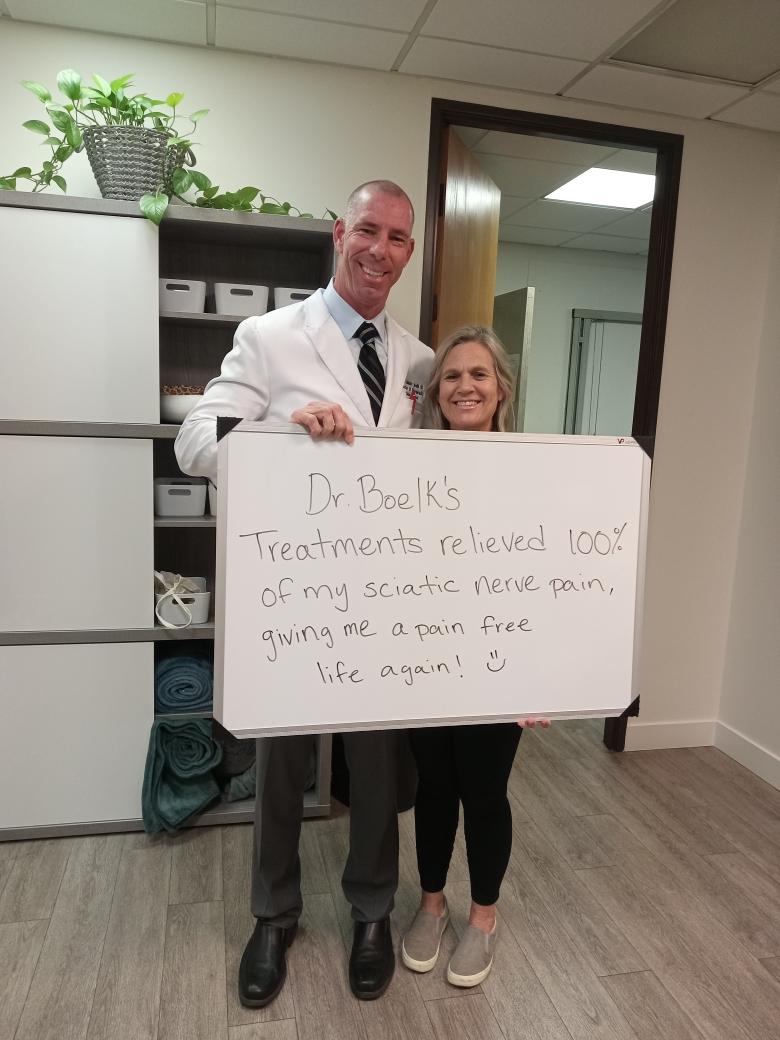
"There isn't enough room to fully explain the relief Dr. Boelk has brought to me and my family.
I found him after suffering from severe sciatica for more than a year. The pain shot from my hip all the way down to my left foot and became almost unbearable. I could no longer enjoy the activities I loved, including hockey, golf, and surfing.
Over the years, I had seen numerous chiropractors and experienced only temporary relief. Nothing seemed to provide lasting results.
Then I met Dr. Boelk... Through a structured treatment plan, my life completely changed.
What I respect most is his honesty. If he believes you are not a candidate or that another option would be better, he will tell you."
★★★★★ — Jayson Yavorsky, San Diego, CA
How Can Sciatica Cause Weakness?
Your sciatic nerve doesn't just carry pain signals.
It also carries the electrical signals that tell your muscles when to contract.
When one of the nerve roots in your lower back becomes irritated or compressed, those signals may not travel normally.
Depending on which nerve is affected, you may notice:
- Difficulty lifting your foot.
- Trouble standing on your toes.
- Reduced strength climbing stairs.
- A feeling that your leg wants to buckle.
- Weakness when pushing off while walking.
Some people first notice weakness while exercising.
Others discover it when they realize they can't perform movements that used to feel easy.
Pain and Weakness Don't Always Occur Together
One thing that surprises many patients is that severe pain doesn't always mean severe weakness, and severe weakness doesn't always cause severe pain.
Some people have intense leg pain but maintain excellent muscle strength.
Others experience relatively mild pain but noticeable weakness.
That's because pain fibers and motor fibers don't always respond the same way.
This is one reason a careful neurological examination is just as important as asking where it hurts.
One Thing Most Patients Don't Know
Not all weakness feels dramatic.
Sometimes it begins very subtly.
You might simply notice that one leg tires faster than the other.
Maybe you're catching your toe on the carpet.
Perhaps climbing stairs suddenly feels more difficult on one side.
These early changes are easy to dismiss, but they're worth paying attention to.
Recognizing weakness early can help your healthcare provider determine whether further evaluation is appropriate.
A Common Misconception
One of the biggest myths is:
"If my pain is improving, everything must be getting better."
Not necessarily.
Pain and strength don't always improve at the same rate.
That's why it's important to pay attention not only to how much something hurts, but also to how well your leg is functioning.
If you're developing new or worsening weakness—even if your pain is changing—that deserves prompt evaluation.
When Is Weakness a Reason to Seek Medical Attention?
Not every case of weakness is an emergency.
However, new or worsening weakness should never be ignored.
If you notice that one leg is becoming progressively weaker, you're having increasing difficulty walking, or your foot begins catching on the ground, it's important to be evaluated promptly.
Seek immediate medical attention if you experience:
- Sudden or rapidly worsening leg weakness.
- Difficulty lifting your foot (commonly called foot drop).
- Loss of bowel or bladder control.
- Numbness in the groin or saddle area.
- Severe weakness following a significant fall or other trauma.
Fortunately, these situations are uncommon.
More often, weakness develops gradually, providing an opportunity to identify the underlying cause and determine the most appropriate treatment plan.
The important message is simple:
Pain may get your attention, but weakness deserves your respect.
What Is Foot Drop?
One of the more serious forms of weakness is something called foot drop.
Foot drop occurs when the muscles responsible for lifting the front of the foot become too weak to function normally.
Instead of clearing the ground during walking, the toes may drag or catch.
Many people first notice that they begin tripping more often or feel like they have to lift their knee higher just to avoid catching their foot.
Although foot drop can have several causes, irritation or compression of certain nerves in the lower back is one possible explanation.
Because it may represent significant nerve involvement, foot drop should always be evaluated promptly.
Does Weakness Mean I'll Need Surgery?
Not necessarily.
This is another area where many patients become understandably anxious.
Weakness doesn't automatically mean surgery is required.
However, it does increase the importance of determining exactly what's causing the problem.
Some patients improve with carefully selected conservative treatment.
Others require additional testing, consultation with a spine specialist, or surgery.
The appropriate recommendation depends on many factors, including:
- The cause of the weakness.
- Whether the weakness is stable or worsening.
- MRI findings (when available).
- Your neurological examination.
- Your overall health.
- Your goals and daily activities.
The decision should never be based on one symptom alone.
Instead, it should be based on the complete clinical picture.
Where Does Non-Surgical Spinal Decompression Fit?
When weakness is associated with certain disc-related conditions, Non-Surgical Spinal Decompression may be considered as one conservative treatment option—but only after a careful evaluation.
The goal is to determine why the nerve is being irritated.
For appropriately selected patients, reducing mechanical stress on an injured spinal disc may help create a more favorable environment for recovery.
However, it's important to understand that Non-Surgical Spinal Decompression is not appropriate for everyone.
Patients with significant or rapidly progressive neurological deficits, certain spinal conditions, fractures, tumors, infections, severe instability, or other contraindications may require a different approach.
That's why every patient at our office begins with a thorough consultation and examination before treatment recommendations are made.
Sometimes the best recommendation is conservative care.
Sometimes additional imaging is appropriate.
Sometimes referral to another specialist is in the patient's best interest.
The recommendation should always fit the patient—not the other way around.
Why Patients Choose Dr. Cassidy James Boelk, DC
When patients begin experiencing weakness, they understandably want answers.
They want to know what's happening, whether it's serious, and what their options are.
For more than 22 years, Dr. Cassidy James Boelk, DC has specialized in evaluating and treating patients with herniated discs, bulging discs, sciatica, spinal stenosis, cervical radiculopathy, degenerative disc disease, and other complex spinal conditions.
During that time, he has personally performed more than 100,000 Non-Surgical Spinal Decompression treatments, making him one of the most experienced doctors in this highly specialized area of conservative spine care.
The Spinal Decompression & Chiropractic Center of San Diego exclusively utilizes seven DRX9000® spinal decompression systems, making it one of the largest DRX9000® spinal decompression practices in California.
Dr. Boelk is also:
- Board-Certified Doctor of Chiropractic
- Certified Spinal Decompression Doctor
- Certified Pain-Free Performance Specialist (PPSC)
- Founder of the Non-Surgical Spinal Decompression Training Academy
- Founding Member of the American Spinal Decompression Society
- California Licensed X-Ray Supervisor & Operator
Whenever imaging is available, he personally reviews each patient's MRI, correlating the findings with the patient's symptoms and neurological examination rather than relying solely on the written MRI report.
In addition to caring for patients, Dr. Boelk trains other physicians in the evaluation and treatment of disc-related spinal disorders, and patients travel from throughout California, across the United States, and internationally to seek his expertise.
Most importantly, patients know they'll receive an honest recommendation.
If conservative care appears appropriate, he'll explain why.
If he believes another treatment—or surgery—is the better option, he'll tell you that too.
Honest Advice Is Sometimes the Best Care
One of the reviews that best reflects our philosophy came from someone we ultimately did not treat.
"Very nice Dr. and honest! I would definitely recommend anyone who hasn't had metal put in their back from surgery to go to him and give his program a shot. I believe it would definitely help. Just not in my personal case because I have a lot of hardware in my back. But I'm glad I took the time to meet with him. It was very informative all around."
★★★★★ — Toni W., Lake Elsinore, CA
To us, that's one of the most meaningful reviews on our website.
Because our responsibility isn't to recommend treatment.
Our responsibility is to recommend the right treatment.
Sometimes that treatment isn't at our office.
A Personal Message From Dr. Cassidy James Boelk, DC
One of the things I've learned over the past 22 years is that patients often wait longer than they should when weakness begins. Many hope it will simply go away on its own because the pain has started improving.
My advice is simple: don't ignore changes in strength.
Pain tells us that something is irritated.
Weakness tells us that a nerve may not be communicating with a muscle as well as it should.
That doesn't automatically mean you'll need surgery, but it does mean you deserve an accurate diagnosis and a thoughtful treatment plan.
Whether you choose our office or another provider, I encourage you to ask questions, understand your diagnosis, review your MRI with someone who takes the time to explain it, and never feel rushed into making a decision before you're comfortable with your options.
If I believe I can help you, I'll explain why.
If I don't, I'll tell you that too.
I wish you the very best on your road to recovery.
— Dr. Cassidy James Boelk, DC
You Don't Have to Figure This Out Alone
If you've noticed leg weakness, foot weakness, numbness, tingling, or persistent sciatica, we'd be honored to help you understand what's causing your symptoms.
Your Complimentary No-Charge Consultation includes:
✔ One-on-one consultation with Dr. Cassidy James Boelk, DC
✔ Comprehensive examination
✔ MRI review (if available)
✔ Honest recommendations
✔ Answers to all of your questions
Whether you're a candidate for treatment at our office or another approach is more appropriate, our goal is to help you make an informed decision based on a thorough evaluation—not guesswork.
The Spinal Decompression & Chiropractic Center of San Diego
5095 Murphy Canyon Road, Suite 300
San Diego, CA 92123
📞 619-298-0800
✔ Complimentary No-Charge Consultation
✔ Live 24/7 Answering Service
✔ Hablamos Español