Can Sciatica Cause Permanent Nerve Damage? – La Jolla, CA
What Patients in La Jolla Should Know Before Ignoring Sciatica, Numbness, or Leg Weakness
One of the biggest fears people have after developing sciatica isn't actually the pain.
It's wondering whether they've waited too long.
Patients from La Jolla often tell us the same thing.
"I can deal with the pain...I'm just worried I'm permanently damaging the nerve."
It's an understandable concern.
Fortunately, most cases of sciatica do not result in permanent nerve damage.
The challenge is knowing the difference between sciatica that's painful...and sciatica that's telling you something more serious may be happening.
Every week, patients from La Jolla visit our office after trying medications, physical therapy, chiropractic care, spinal injections, massage therapy, or simply hoping the symptoms would improve with time.
Some have been told surgery may be their next step.
Others are simply looking for honest answers before making a decision.
The good news is that many people with sciatica recover without surgery and never develop permanent nerve damage.
The key is determining what's causing your sciatica and whether the affected nerve is simply irritated—or beginning to lose function.
Real Patient Story: "One of the Best Medical Decisions I've Ever Made"
Justine had been struggling with severe neck pain, dizziness, numbness, and tingling after trying multiple treatments. Eventually, surgery became the next recommendation.
"I was diagnosed with severe cervical disc bulges causing dizziness, neck pain, and numbness and tingling into my arm and hand. After trying multiple chiropractors, traction devices, and pain management, surgery became my last option.
Dr. Boelk explained how spinal decompression could help, and choosing treatment turned out to be one of the best medical decisions I've ever made. My pain dropped from a 7 to a 1–2, and my follow-up MRI showed my cervical spine had returned to a much more normal position.
Nearly four years later, I continue maintenance care and remain incredibly thankful I found this office. Dr. Boelk is practical, professional, and one of my favorite doctors."
— Justine Lai
Every patient is different, and no treatment can guarantee the same outcome.
What Justine's story demonstrates is the importance of understanding all appropriate treatment options before assuming surgery is the only answer.
Wondering If You're a Candidate?
If you're worried your sciatica is becoming permanent, the first step isn't deciding on treatment.
The first step is finding out why you're having sciatica in the first place.
Not everyone with sciatica has the same diagnosis.
Some patients have a herniated disc.
Others have spinal stenosis.
Some have degenerative disc disease.
Others have completely different causes.
That's why every recommendation should begin with an accurate diagnosis—not assumptions.
Can Sciatica Become Permanent?
This is probably the most important question.
For most people, the answer is no.
Sciatica usually develops because a spinal nerve becomes irritated or compressed. As the inflammation settles down or pressure on the nerve decreases, many patients gradually improve.
However, some patients begin developing neurological changes that deserve prompt evaluation.
That's why it's important not to focus only on your pain.
It's equally important to pay attention to what your nerve is doing.
What Symptoms Shouldn't Be Ignored?
If you notice any of the following, it's important to be evaluated rather than simply waiting to see what happens:
-
Increasing muscle weakness
-
Difficulty lifting your foot
-
Foot drop
-
Numbness that's spreading or becoming more noticeable
-
Difficulty walking normally
-
Loss of bowel or bladder control
-
Numbness around the groin or saddle region
These symptoms don't automatically mean permanent nerve damage has occurred.
However, they may indicate that the nerve is under increasing pressure and deserves prompt attention.
Pain Doesn't Always Tell the Whole Story
One of the biggest misconceptions is believing that the amount of pain determines how serious the problem is.
That's not always true.
We've evaluated patients with severe, disabling sciatica who recovered very well.
We've also seen patients with surprisingly little pain who were developing increasing weakness because the affected nerve wasn't functioning normally.
That's why a thorough orthopedic and neurological examination is just as important as reviewing your MRI.
The goal isn't simply to determine where your pain is.
The goal is determining what's causing it and whether the nerve is healing or beginning to lose function.
Can Permanent Nerve Damage Be Prevented?
In many cases, yes.
One of the biggest mistakes people make is waiting month after month, hoping the pain will eventually disappear.
Sometimes it does.
Sometimes it doesn't.
If your symptoms are improving, that's encouraging. But if your sciatica is becoming more frequent, the numbness is spreading, or you're noticing weakness that wasn't there before, those changes shouldn't be ignored.
They don't automatically mean permanent nerve damage has occurred.
They do mean it's time to find out what's causing your symptoms.
Does Sciatica Always Mean Surgery?
Fortunately, no.
Many patients with sciatica improve without surgery.
Others may eventually require surgery because of progressive neurological loss, significant muscle weakness, or symptoms that haven't responded to appropriate conservative treatment.
Every patient is different.
That's why treatment decisions shouldn't be based on pain alone—or on an MRI alone.
The best treatment plan comes from understanding your symptoms, performing a thorough examination, reviewing your imaging, and determining exactly what's causing the nerve irritation.
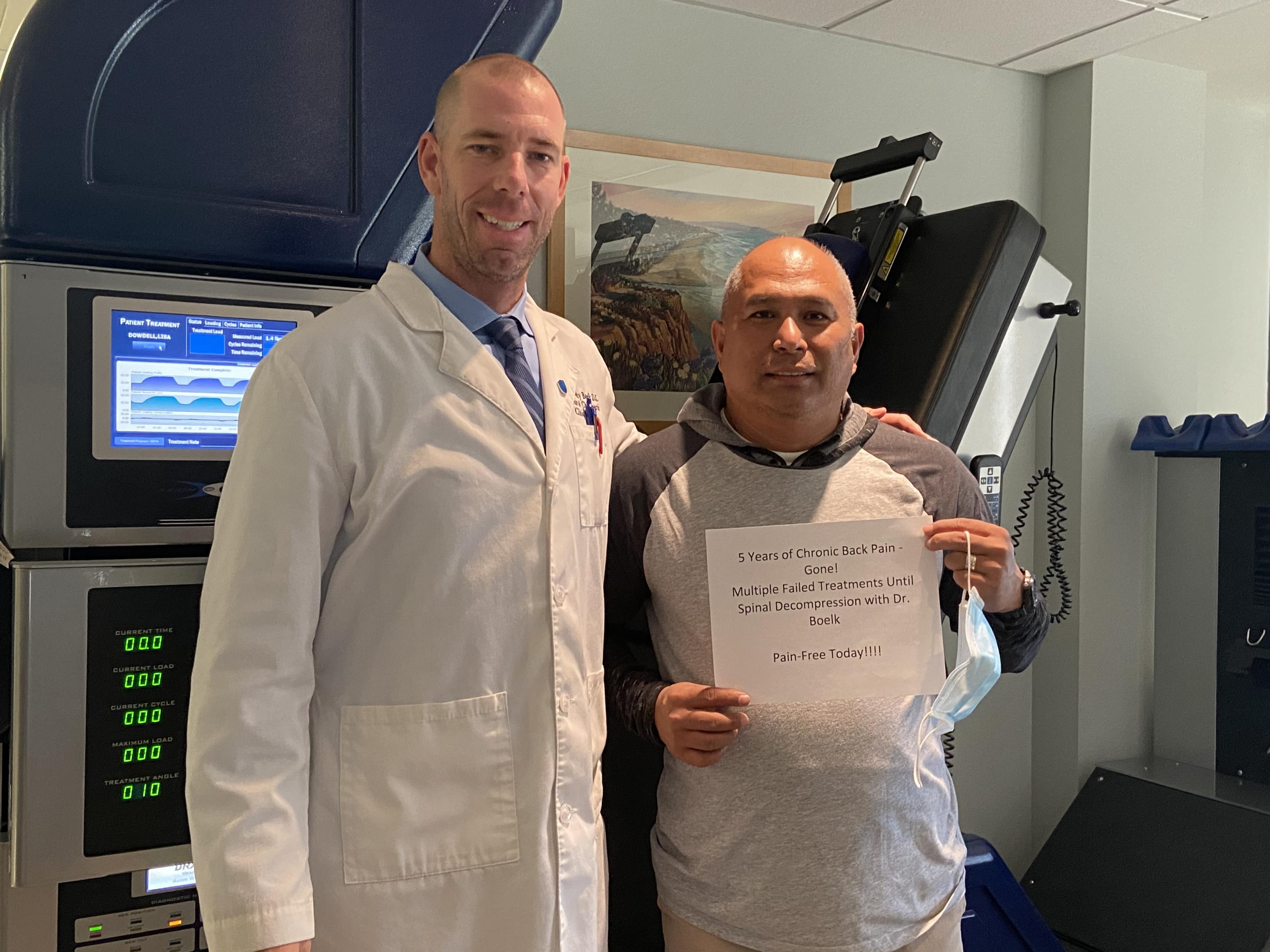
Real Patient Story: "Doctors Offered No Good Solutions"
James had been living with chronic back pain from deteriorating discs and felt like he had run out of options.
"My back has been a problem for a long time with deteriorating disks. Doctors offered no good solutions. Then a friend recommended Dr. Boelk and decompression therapy. I have now experienced weeks—even months—being pain-free. Relieving pressure on the discs allows the nerves to calm. It really works!"
— James Myers
Every patient's diagnosis and outcome are different.
James' experience is simply another reminder that before assuming surgery is your only option, it's worth taking the time to understand all of your treatment options.
Not Everyone With Sciatica Is The Same
One patient may have a herniated disc.
Another may have spinal stenosis.
Someone else may have degenerative disc disease, spondylolisthesis, or another condition altogether.
Even though their symptoms sound similar, the best treatment for each patient may be completely different.
That's why trying to diagnose yourself based on what you read online—or what worked for a friend—is rarely the best approach.
A proper diagnosis always comes first.
We Don't Believe Every Patient Is a Candidate
One of the things that makes our office different is that we don't believe spinal decompression is the right treatment for everyone.
Over the past 22 years, Dr. Cassidy James Boelk, DC has evaluated thousands of patients with sciatica, herniated discs, spinal stenosis, degenerative disc disease, and chronic neck and back pain.
Some have been excellent candidates for non-surgical spinal decompression.
Others have not.
If another conservative treatment is more appropriate, we'll tell you.
If we believe surgery offers the best opportunity for recovery, we'll tell you that too.
Our responsibility isn't to recommend treatment.
Our responsibility is to recommend the treatment we genuinely believe gives you the best opportunity for a successful outcome.
Why Patients From La Jolla Seek Out Dr. Cassidy James Boelk, DC
When you're trying to decide whether your sciatica is becoming more serious, experience matters.
WHY PATIENTS SEEK OUT DR. CASSIDY JAMES BOELK, DC
✔ Certified Spinal Decompression Doctor
✔ Certified Pain-Free Performance Specialist
✔ California X-Ray Radiology Licensed Doctor
✔ Founder, Non-Surgical Spinal Decompression Training Academy
✔ Founding Member, American Spinal Decompression Society
✔ More Than 22 Years Clinical Experience
✔ More Than 100,000 Spinal Decompression Treatments Performed
✔ 7 DRX9000 Spinal Decompression Systems
✔ Largest Provider of Non-Surgical Spinal Decompression in California
✔ Patients Travel From Throughout California, Across the United States, Mexico, Canada, Europe, and Internationally for Care
A Personal Message From Dr. Cassidy James Boelk, DC
If you've read this far, chances are you're not just looking for pain relief.
You're looking for answers.
You want to know whether the numbness is serious.
Whether the weakness is something to worry about.
Whether waiting is the right decision—or whether it's time to have your condition evaluated.
Those are important questions, and they're questions that deserve honest answers.
My recommendation is simple.
Don't ignore symptoms that are getting worse.
At the same time, don't assume surgery is your only option simply because someone told you that you have sciatica or a herniated disc.
Take the time to understand what's causing your symptoms first.
If I believe you're a good candidate for non-surgical spinal decompression, I'll explain why.
If I don't, I'll tell you that too.
My goal has always been to help patients make informed decisions based on honest recommendations—not pressure.
Find Out If You're a Candidate
Not everyone with sciatica is a candidate for non-surgical spinal decompression.
Likewise, not everyone with sciatica needs surgery.
The purpose of your evaluation is to determine what's causing your symptoms and whether non-surgical spinal decompression may be an appropriate treatment option.
During your evaluation, we'll:
-
Review your symptoms and health history
-
Perform a comprehensive orthopedic and neurological examination
-
Review your MRI and X-rays (if available)
-
Determine whether you're a candidate for non-surgical spinal decompression
-
Explain all appropriate treatment options
-
Answer your questions so you can make an informed decision
If you're not a candidate...
We'll tell you.
If another treatment is more appropriate, we'll explain why.
If we believe you should consult with a spine surgeon or another specialist, we'll recommend that as well.
Our goal is simple:
To help you understand your condition and make the right treatment decision.
The Spinal Decompression & Chiropractic Center of San Diego
Dr. Cassidy James Boelk, DC
5095 Murphy Canyon Road, Suite 300
San Diego, CA 92123
📞 (619) 298-0800
Why Patients Continue Choosing Our Office
✔ Complimentary No-Charge Consultation
✔ Live 24/7 Phone Answering
✔ Hablamos Español
✔ Conveniently Located Just Minutes From La Jolla
✔ Honest, Individualized Recommendations
✔ Every Patient Is Thoroughly Evaluated To Determine If They're Truly A Candidate For Care
✔ 7 DRX9000 Spinal Decompression Systems
✔ Largest Known Provider of Non-Surgical Spinal Decompression in California