Can I Exercise With a Herniated Disc? | Kearny Mesa, CA
Yes, in many cases you can exercise with a herniated disc. The harder question is what should you be doing right now?
Dr. Cassidy James Boelk, DC has this conversation with patients all the time. Someone gets an MRI, sees the words “herniated disc,” and suddenly they're afraid to bend over, pick something up or go back to the gym.
The opposite happens too. An active patient decides they're not going to let a disc injury slow them down, so they keep squatting, deadlifting, running or doing the same workout they've always done even though the symptoms are getting worse.
Neither extreme is particularly helpful.
Dr. Boelk has treated disc injuries and sciatica for more than 22 years, and one thing he has learned is that patients with herniated discs don't all respond to movement the same way.
One person may feel better walking. Another can only walk for ten minutes before the leg starts burning. One person tolerates a particular exercise without a problem. Another does the same exercise and feels pain travel from the lower back into the buttock and all the way to the foot.
That response is important.
The goal isn't to become afraid of exercise. It's to stop repeatedly doing the things that are clearly aggravating the problem while you figure out what's going on.
⭐⭐⭐⭐⭐ “I've Even Gotten Back to Lifting Weights!”
“Now, I’m walking regularly, standing up straight—something I couldn’t do before.”
“Last year, I spent three months constantly going back and forth between doctor’s appointments and urgent care. The pain was unbearable—I was taking medication regularly just to get through the day. Getting out of bed was excruciating, and walking or standing felt like torture. Every step filled me with dread.
In December, my doctor finally ordered an MRI. That’s when I learned I had an extruded disc pressing on my L5 nerve, which affects the leg and foot. My doctor scheduled two follow-up appointments: one for pain management (spinal injections), and another to evaluate me for surgery.
Then I discovered spinal decompression therapy. I was thrilled to find a non-invasive alternative. I never ended up needing either of those appointments.
Now, I’m walking regularly, standing up straight—something I couldn’t do before. When I first sought help, I was so hunched over that I had to use a cane just to move forward. Because of the pain, I hadn’t exercised in months. But now, I’m doing a program called 75 hard which requires not one but 2 45-minute workouts per day, and I've even gotten back to lifting weights!
I’m so thankful I found this place. It’s conveniently located near my work, which makes it easy to fit sessions into my lunch break. Dr. Boelk and the staff are incredibly friendly and polite—it’s always a pleasure to come in.
The environment is so relaxing that I look forward to each visit. I truly thank God for leading me to this alternative. It’s made such a difference in my life.”
— Amanda, San Diego, CA
Amanda had reached the point where she couldn't exercise at all. Her problem was affecting basic things like standing and walking.
Her eventual return to exercise didn't happen because someone told her to ignore the symptoms and push through them. There was a period where what she could safely tolerate was very different from what she could do later.
That's an important distinction.
What Happens While You're Exercising?
When Dr. Boelk talks with an active patient, he wants details.
If you say, “Working out bothers my back,” what does that actually mean?
Does the lower back feel tired after a workout but settle down quickly?
Does bending forward cause sharp pain?
Do you start a workout with discomfort in the lower back and finish with pain running down the leg?
Does the foot start tingling?
Do you feel fine while you're exercising but wake up significantly worse the following morning?
Does one leg feel weaker under load?
Those aren't all the same thing.
Normal muscular fatigue is one thing. Repeatedly producing burning, tingling, numbness or shooting leg pain is something else.
Dr. Boelk is especially interested when an activity causes symptoms to move farther down the leg.
If every time you perform a particular exercise the pain that was around your back or buttock starts traveling into your calf or foot, that's not something he wants you ignoring simply because somebody online said the exercise is good for herniated discs.
Do You Have to Stop Lifting Weights?
Not necessarily.
But sometimes you need to change what you're doing for a while.
This is where active patients can get frustrated because they want a list: these five exercises are safe, these five are dangerous.
Dr. Boelk doesn't think it's that simple.
Take a squat.
A squat isn't automatically a bad exercise because somebody has a disc herniation. But there's a big difference between an unloaded squat that produces no symptoms and putting a heavy bar on your back while you're already experiencing significant back pain and sciatica.
The same applies to deadlifts and leg presses.
These aren't inherently “bad” exercises. Dr. Boelk isn't telling someone who has recovered from a disc injury that they can never deadlift again.
But if you're in an irritated stage and every heavy set is followed by increasing leg symptoms, this probably isn't the time to prove you can train through it.
Sometimes backing off is part of getting back.
You Don't Have to Figure This Out From YouTube Videos
If you're in Kearny Mesa or the surrounding San Diego area and you've been diagnosed with a herniated disc, Dr. Boelk offers a No-Charge Consultation where you can sit down with him and go through what's actually happening.
Bring your MRI if you have one.
Tell him what you're doing in the gym. Tell him what you stopped doing. Show him where the symptoms go when something aggravates the disc.
Dr. Boelk will go through:
-
How the injury started.
-
What you're currently doing for exercise.
-
Which movements make you feel better or worse.
-
Whether symptoms stay around the back or travel into the leg.
-
Any numbness, tingling, burning or weakness.
-
Treatments and exercises you've already tried.
-
Your actual MRI images and report, if available.
-
Whether the MRI findings fit what you're experiencing.
-
Whether further examination or imaging may be appropriate.
-
Whether Non-Surgical Spinal Decompression may be an option.
-
What questions you have about returning to activity.
You don't need an MRI to schedule.
And scheduling doesn't mean you've decided to start spinal decompression.
Dr. Boelk still needs to determine whether you're a candidate.
There is no charge for the consultation and no obligation to begin treatment.
Dr. Boelk performs the consultations himself while continuing to treat the patients already under his care, so the office can only set aside a limited number during the clinic schedule.
Call 619-298-0800 and ask for the next available No-Charge Consultation with Dr. Cassidy James Boelk, DC.
Be Careful With the “I'll Just Stretch It Out” Approach
When lifting hurts, a lot of patients stop lifting and start stretching.
Sometimes that's useful.
Sometimes it isn't.
Dr. Boelk frequently sees patients who have been aggressively stretching the back of the leg because it feels tight. They'll do long hamstring stretches several times a day, but the “tightness” keeps returning.
Then they mention that the stretch also causes tingling into the foot.
That's different.
A nerve can create sensations that patients interpret as muscular tightness. If you're repeatedly stretching and the result is burning, tingling, numbness or pain traveling farther down the leg, Dr. Boelk wants to know about it.
The same goes for exercises you find online.
An exercise may be completely appropriate for one type of back problem and poorly tolerated by somebody else.
If your symptoms clearly worsen every time you perform it, don't assume you need to force your way through because the video called it a “herniated disc exercise.”
Walking Counts as Exercise Too
Patients sometimes ask whether they can exercise and really mean, “Can I go back to the gym?”
Exercise doesn't have to start there.
For some people with a disc injury, walking is one of the easiest ways to keep moving.
But even walking has to be judged by how the patient responds.
If you walk for 20 minutes and feel good, that's useful information.
If you can walk for five minutes and then the leg starts going numb, that's useful information too.
Dr. Boelk isn't looking for an arbitrary number of steps everyone with a herniated disc should hit. He wants to know what your body is tolerating right now and whether that's improving or declining.
⭐⭐⭐⭐⭐ “It Really Helps Keep Me in My Active Life”
“I will not go to anyone else for back treatment.”
“I travel from the UK to see Dr Boelk and his wonderful team . I have 3 bulging disc and one is touching the nerve. I have the spinal decompression treatment and it really helps keep me in my active life . I will not go to anyone else for back treatment, this place is number one and they genuinely care about their patients.”
— Lisa S., United Kingdom
“Active life” means something different for every patient.
Maybe you want to get back to lifting.
Maybe it's running.
Maybe you want to surf, play golf, hike or ride a bike.
Maybe you're not interested in any of that and simply want to walk a few miles without your leg hurting.
Dr. Boelk wants to know the goal because the goal helps determine where you're trying to get back to.
What Dr. Boelk Doesn't Want You to Ignore
Pain is only part of a disc injury.
Numbness and weakness matter too.
If you're exercising and notice that one leg isn't producing the same force as the other, don't automatically assume you just need to strengthen it.
Tell Dr. Boelk if your foot remains numb, the tingling is becoming more frequent, one leg is getting weaker, you have difficulty lifting the front of your foot, or your foot starts slapping the ground when you walk.
Those symptoms deserve attention.
Most herniated discs are not emergencies. Rapidly progressing weakness, new bowel or bladder dysfunction, difficulty urinating, or numbness around the groin or saddle area requires prompt medical evaluation rather than waiting for a routine spinal decompression consultation.
Does a Herniated Disc Mean You Need Spinal Decompression?
No.
Dr. Boelk needs to evaluate you first.
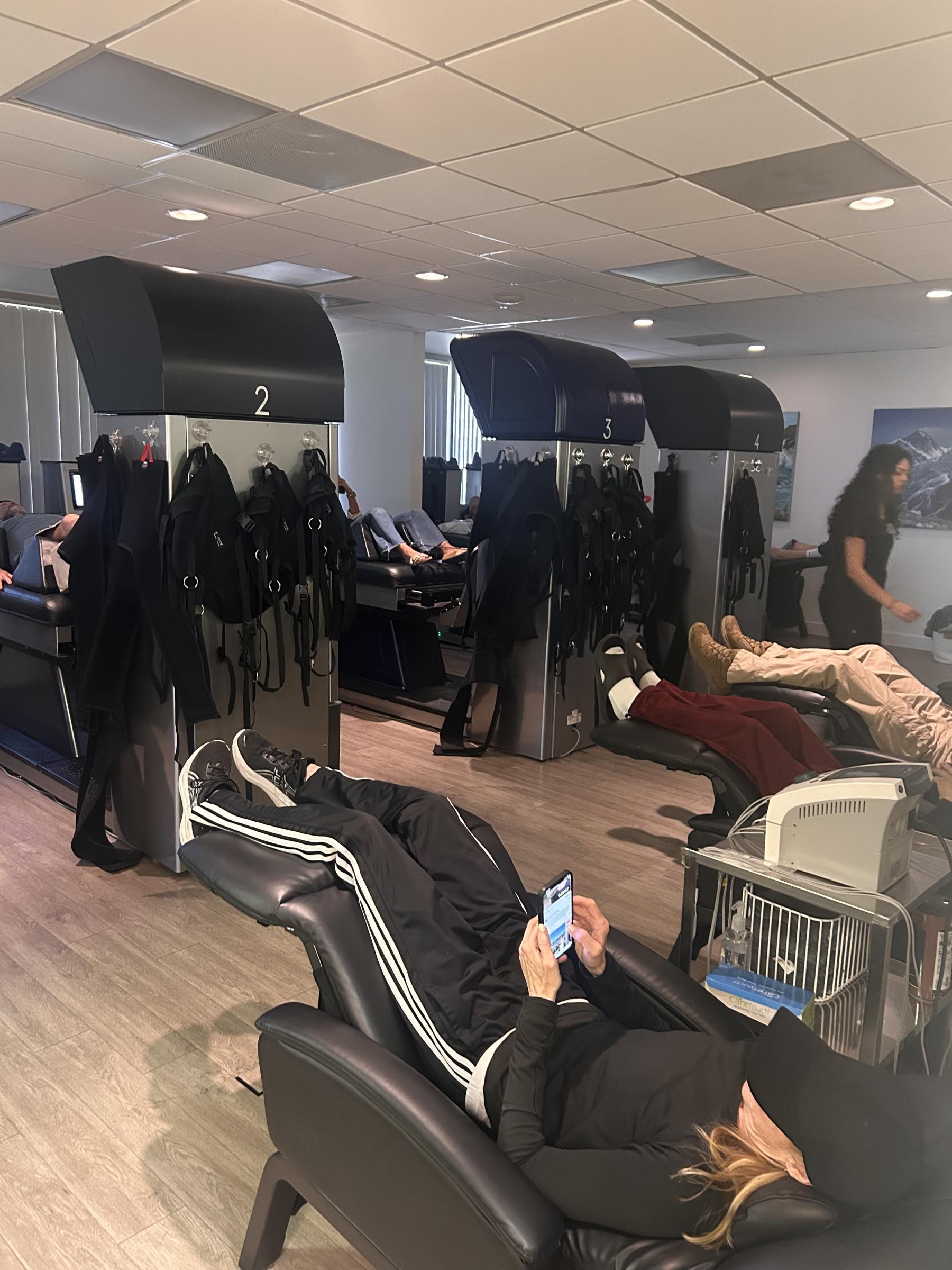
The Spinal Decompression & Chiropractic Center of San Diego uses the DRX9000, and Dr. Boelk evaluates patients with disc bulges, disc herniations, degenerative disc disease, disc-related sciatica, foraminal narrowing and selected cases of spinal stenosis.
But he doesn't put every patient with an abnormal MRI on a decompression table.
The MRI has to make sense with the symptoms. The patient has to be medically and structurally appropriate for treatment.
Things like significant osteoporosis, an unhealed fracture, unstable spondylolisthesis, abdominal aortic aneurysm, pregnancy for lumbar decompression, certain malignancies and other conditions may make decompression inappropriate.
Previous surgery needs to be evaluated carefully as well, particularly when there is fusion or metal hardware at the level that would need treatment.
★ Sometimes the Right Answer Is Something Else
Jeff J. traveled from Tucson to meet with Dr. Boelk.
He didn't become a spinal decompression patient.
“We both determined that surgery was my only option to correct my back issues.”
“I found this terrific practice on social media. I followed up and did my own research so I decided to pay them a visit. The place is clean, well organized and run by a very efficient receptionist. I met with the doctor and after a honest and forthright conversation, we both determined that surgery was my only option to correct my back issues. I will return as a customer when the time is right.”
— Jeff J., Tucson, AZ
That's why Dr. Boelk wants to evaluate someone before talking about a treatment plan.
Sometimes decompression makes sense.
Sometimes it doesn't.
Dr. Cassidy James Boelk, DC
Dr. Boelk has been working with spinal decompression and disc-related conditions for more than 22 years and has performed more than 100,000 spinal decompression treatments.
-
Doctor of Chiropractic
-
Certified Spinal Decompression Doctor
-
Certified Pain-Free Performance Specialist (PPSC)
-
Founder, Non-Surgical Spinal Decompression Training Academy
-
Trains other doctors in spinal decompression protocols and techniques
-
Founding Member, American Spinal Decompression Society
-
Member, International Disc Education Association
-
California X-Ray Radiation Supervisor & Operator
Dr. Boelk's interest in returning people to activity is also personal.
He suffered an L5 compression fracture when he was 16 and later dealt with disc injuries and sciatica. He continues to surf, play hockey and exercise.
He understands why an active patient doesn't want to hear, “Don't do anything anymore.”
But he also understands that there's a time to push and a time to back off.
The trick is knowing the difference.
So, Can You Exercise With a Herniated Disc?
For many people, yes.
You may need to modify what you're doing for a while. You may need to reduce load. Certain exercises may need to come out temporarily. Others may be perfectly comfortable and help you stay active while the problem is being addressed.
What Dr. Boelk doesn't recommend is guessing for months while the symptoms continue to get worse.
If exercise is repeatedly sending pain down your leg, your foot keeps going numb, or you're noticing weakness, come in and let him look at it.
You're not committing to treatment.
You're getting an opinion.
Your No-Charge Consultation includes:
-
One-on-one time with Dr. Cassidy James Boelk, DC
-
Review of your injury and symptoms
-
Discussion of your current exercise program
-
Review of movements that aggravate the problem
-
Discussion of sciatica, numbness, tingling or weakness
-
Review of treatments you've already tried
-
Review of your actual MRI images and report, if available
-
Comparison of the MRI with your symptoms
-
Discussion of whether further examination or imaging may be appropriate
-
An assessment of whether Non-Surgical Spinal Decompression may be an option
-
An honest answer if Dr. Boelk doesn't believe you're a candidate
-
Time to discuss your questions about getting active again
There is no charge and no obligation.
No MRI is required to schedule.
Dr. Boelk personally performs these consultations while continuing to treat his existing patients, so only a limited number are available during the clinic schedule.
If you've stopped doing things you enjoy because you're afraid of your disc—or you're still doing everything and wondering whether you're making the injury worse—it may be time to stop guessing.
Call 619-298-0800
Ask for the next available No-Charge Consultation with Dr. Cassidy James Boelk, DC.
Bring your MRI images and report if you have them. If you don't, that's okay.
The Spinal Decompression & Chiropractic Center of San Diego
5095 Murphy Canyon Road, Suite 300
San Diego, CA 92123
619-298-0800
SanDiegoBackCare.com
Live 24/7 Answering Service • Hablamos Español