Can Herniated Disc Heal Without Surgery? – La Jolla, CA
Yes, many herniated discs can improve without surgery. In some cases, the body can naturally shrink herniated disc material through a process called spontaneous resorption. In others, inflammation decreases, irritated nerves recover, and patients experience significant relief even when the disc remains visibly herniated on an MRI.
For people in La Jolla, CA, experiencing sciatica, chronic lower back pain, or an L4-L5 or L5-S1 disc herniation, one of the biggest concerns is whether surgery can be avoided.
The encouraging news is that many patients with symptomatic herniated discs improve with conservative treatment.
At The Spinal Decompression & Chiropractic Center of San Diego, Dr. Cassidy James Boelk, DC, has spent more than 22 years helping patients with herniated discs, sciatica, degenerative disc disease, and chronic spinal conditions explore non-surgical treatment options.
As a Certified Spinal Decompression Doctor, Certified Pain Free Performance Specialist, and Founder of the Non-Surgical Spinal Decompression Training Academy, Dr. Boelk has overseen more than 100,000 spinal decompression treatment sessions and also trains other doctors in non-surgical spinal decompression protocols and techniques.
Have a Herniated Disc? Request Your No-Charge Consultation
Before deciding on surgery, find out whether you may be a candidate for non-surgical spinal decompression.
Dr. Cassidy James Boelk, DC, offers a limited number of No-Charge Consultations each week.
During your consultation, you can:
-
Discuss your symptoms: Talk about your back pain, sciatica, numbness, weakness, or other concerns.
-
Review your history: Discuss your diagnosis, previous treatments, and available MRI findings.
-
Learn about the DRX9000: Understand how non-surgical spinal decompression works.
-
Explore your options: Find out whether a comprehensive spinal examination or additional imaging may be appropriate.
-
Receive honest recommendations: Not everyone is a candidate for spinal decompression. If it isn't appropriate, Dr. Boelk will explain why.
Call 619-298-0800 to request your No-Charge Consultation.
24/7 Answering Service | Hablamos Español
Real Patients Share Their Experiences
Anthony K. – Herniated Disc, Sciatica, and Previous Back Surgery
"I have been dealing with back pain for several years. It got so bad that I had surgery 5 years ago for a bulging disc. About 5 months ago the disc bulged again hitting my sciatic nerve creating pain in my legs that made me want to cry it hurt so bad. After trying so many other options I was fortunate enough to find the spinal decompression and chiropractic center of San Diego. After just a few sessions I noticed a difference. Now after being there for the past few months I'm able to go about my normal life again.
What a blessing it was to find a Dr that genuinely cares and knows how to help people in my situation. Thank you Dr Boelk!"
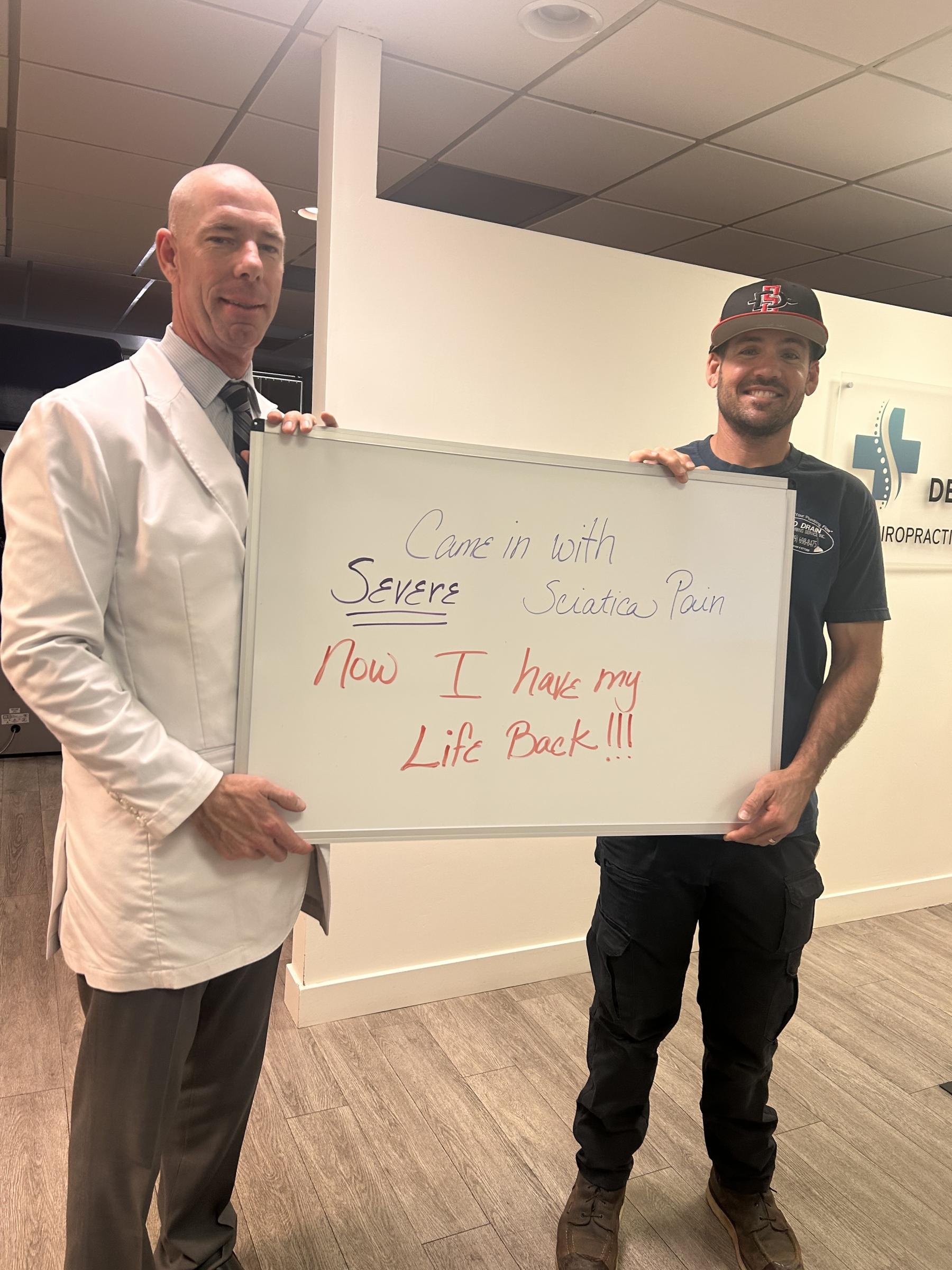
Brian Perrotta – Herniated Disc and Severe Sciatica
"I highly recommend Dr. Cassidy Boelk, DC and the team at The Spinal Decompression and Chiropractic Center. I came in with severe sciatica and a herniated disc, and his treatments have made a world of difference. He and his staff are both professional and genuinely caring, creating a welcoming and supportive environment. The treatments were not only highly effective but also tailored to my specific needs. I’m grateful for the care I received and the significant improvement in my quality of life."
Can a Herniated Disc Heal Naturally Without Surgery?
Yes. Some herniated discs can gradually shrink without surgical intervention.
A herniated disc occurs when material from inside a spinal disc extends beyond its normal boundaries. Depending on its location, the displaced material may irritate or compress a nearby spinal nerve.
However, the body has natural mechanisms that may help reduce inflammation and gradually break down certain types of herniated disc material.
This process is called spontaneous resorption.
Research suggests that extruded and sequestered disc herniations may be more likely to undergo spontaneous resorption than smaller, contained disc protrusions.
The process can take several months, and not every herniation will shrink.
Importantly, a patient may experience significant relief even if the disc does not completely return to its original shape.
The goal of conservative treatment is not simply to change what an MRI looks like. It's to help patients reduce pain, restore mobility, and return to normal activities.
How Long Does a Herniated Disc Take to Heal Without Surgery?
Many patients with symptomatic lumbar disc herniations begin improving within approximately six to twelve weeks.
However, recovery timelines vary considerably.
Some people improve within a few weeks, while others experience symptoms for several months or longer.
Several factors can influence recovery, including:
-
The location and size of the herniation
-
Whether a spinal nerve is irritated or compressed
-
How long symptoms have been present
-
The presence of additional spinal conditions
-
The patient's activity level and overall health
-
The response to conservative treatment
Dr. Boelk emphasizes evaluating each patient's symptoms, neurological findings, spinal mechanics, and available imaging rather than assuming every herniated disc requires the same treatment.
Can an L4-L5 or L5-S1 Herniated Disc Heal Without Surgery?
Yes. Many lumbar disc herniations at L4-L5 and L5-S1 improve with conservative care.
These are two of the most commonly affected levels in the lower back.
An L4-L5 herniation may irritate the L5 nerve root, potentially causing pain, tingling, numbness, or weakness extending into the outer leg or top of the foot.
An L5-S1 herniation may irritate the S1 nerve root, sometimes producing symptoms traveling through the buttock, down the back of the leg, and toward the outside of the foot.
However, the exact symptoms depend on which nerve is involved and where the herniation is located.
Some patients experience significant leg pain with relatively little lower back pain.
Others experience predominantly lower back discomfort.
An MRI finding alone does not determine whether surgery is necessary.
A comprehensive examination helps establish whether the herniation is responsible for the patient's symptoms and which treatment options may be appropriate.
What Is the Best Non-Surgical Treatment for a Herniated Disc?
There is no single treatment that works best for every herniated disc.
Depending on the patient's condition, conservative treatment may include activity modification, physical therapy, therapeutic exercise, medication, injections, and other approaches.
For selected patients with disc-related symptoms, non-surgical spinal decompression may also be considered.
At The Spinal Decompression & Chiropractic Center of San Diego, Dr. Boelk exclusively uses DRX9000 non-surgical spinal decompression equipment.
The practice has seven spinal decompression treatment units, including equipment for lumbar and cervical conditions.
The DRX9000 uses computer-controlled traction to apply adjustable forces to selected areas of the spine.
The goal is to reduce mechanical loading and potentially provide relief from certain disc-related symptoms.
Although some patients experience improvement with traction-based treatment, research findings remain mixed, and there is insufficient evidence that DRX9000 treatment reliably causes herniated discs to retract or regenerate.
Dr. Boelk determines whether decompression may be appropriate based on the patient's symptoms, physical examination, imaging findings, spinal stability, and overall clinical presentation.
Three Important Things to Understand About Herniated Disc Recovery
1. A Herniated Disc Doesn't Automatically Mean Surgery
Seeing words such as disc extrusion, nerve compression, or severe degeneration on an MRI report can be concerning.
However, many patients with these findings improve without surgery.
The decision to pursue surgery depends on neurological findings, symptom severity, functional limitations, and the response to appropriate conservative treatment.
2. Your Pain Can Improve Before the Disc Shrinks
Inflammation and nerve irritation may decrease before noticeable structural changes occur in the disc.
This is why improvements in walking tolerance, strength, mobility, sleep, and daily activities can be important signs of progress.
3. Rehabilitation Is an Important Part of Recovery
Reducing pain is only one goal.
Appropriate strengthening, movement retraining, and gradual activity progression may help patients return to work, exercise, golf, surfing, and other activities.
Dr. Boelk combines his experience in spinal decompression with his training as a Certified Pain Free Performance Specialist to help patients understand the importance of movement and rehabilitation.
Not Every Patient Is a Candidate for Spinal Decompression
One of the most important aspects of Dr. Boelk's approach is determining whether a patient is actually an appropriate candidate for treatment.
Not everyone who contacts the office is accepted for spinal decompression.
Certain conditions, including spinal instability, significant osteoporosis, some previous spinal fusion procedures, progressive neurological deficits, or other medical concerns, may make decompression inappropriate.
Patients with suspected cauda equina syndrome or significant spinal cord compression require urgent medical evaluation rather than routine decompression treatment.
Dr. Boelk reviews each patient's medical history, neurological findings, symptoms, and available imaging before determining whether spinal decompression may be appropriate.
The goal is not to treat everyone. It's to identify patients who may benefit and recommend other options when decompression isn't appropriate.
When Does a Herniated Disc Require Surgery?
Although many patients improve without surgery, certain situations require prompt medical or surgical evaluation.
These may include progressive muscle weakness, significant neurological deficits, or persistent disabling symptoms despite appropriate conservative treatment.
New loss of bowel or bladder control, saddle numbness, or rapidly progressing leg weakness requires emergency medical evaluation.
The goal should always be to choose the safest and most appropriate treatment for the patient's condition.
Why Patients From La Jolla Seek Out Dr. Cassidy James Boelk, DC
Dr. Boelk's interest in spinal rehabilitation began with his own experience suffering significant back injuries.
After fracturing his back when he was younger, he spent thousands of hours studying spinal biomechanics, rehabilitation, and non-surgical treatment approaches.
Today, he has more than 22 years of experience helping patients with disc-related spinal conditions and has overseen more than 100,000 spinal decompression treatment sessions.
Dr. Boelk's Professional Credentials and Experience
-
Doctor of Chiropractic (DC)
-
Certified Spinal Decompression Doctor
-
Certified Pain Free Performance Specialist (PPSC)
-
Founder of the Non-Surgical Spinal Decompression Training Academy
-
Founding Member of the American Spinal Decompression Society
-
Member of the International Disc Education Association
-
California Licensed X-Ray Radiology Doctor
-
More than 22 years of experience in non-surgical spinal decompression
-
More than 100,000 spinal decompression treatment sessions overseen
-
Clinical educator who trains other doctors in spinal decompression protocols and techniques
-
Extensive personal experience with spinal injury recovery and rehabilitation
Dr. Boelk also trains other doctors in non-surgical spinal decompression protocols and techniques.
His practice evaluates patients from throughout San Diego County, other states, and internationally, including Mexico, Canada, Spain, and the United Kingdom.
Can You Avoid Surgery for a Herniated Disc in La Jolla?
For many patients, the answer is yes.
However, understanding whether your particular herniation may respond to conservative treatment requires more than simply reading an MRI report.
A detailed history, comprehensive examination, neurological assessment, and review of available imaging can help determine which treatment options may be appropriate.
If you're experiencing chronic lower back pain, sciatica, numbness, or symptoms associated with an L4-L5 or L5-S1 disc herniation, Dr. Cassidy James Boelk, DC, and his team can help you explore your options.
A Limited Number of No-Charge Consultations Are Available Each Week.
The Spinal Decompression & Chiropractic Center of San Diego
Dr. Cassidy James Boelk, DC
Certified Spinal Decompression Doctor
Certified Pain Free Performance Specialist
5095 Murphy Canyon Road, Suite 300
San Diego, CA 92123
Phone: 619-298-0800
24/7 Answering Service
Hablamos Español
Website: www.SanDiegoBackCare.com