CAN A HERNIATED DISC HEAL NATURALLY? – SAN DIEGO, CA
Understanding Your Options Before Deciding on Surgery
When someone tells you that you have a herniated disc, your mind usually jumps to one place.
"Am I going to need surgery?"
It's a completely understandable question.
After all, you've probably been dealing with weeks or months of lower back pain, pain shooting into your leg, numbness, tingling, or weakness. Maybe you've stopped exercising, cancelled vacations, or started avoiding simple things like driving, golfing, surfing, playing with your kids, or even sleeping in your own bed because you're afraid of making your back worse.
Then you have an MRI.
Suddenly you're reading words like disc protrusion, disc extrusion, nerve compression, and degenerative disc disease.
It's enough to make anyone anxious.
One of the first things I tell patients is this:
An MRI is incredibly valuable—but it doesn't tell the whole story.
Over the past 22 years, I've reviewed thousands of MRI studies. Some have shown very large herniated discs in patients with surprisingly little pain. Others have shown relatively small disc injuries in people who could barely walk because of severe sciatica.
That's why I never make recommendations based solely on an MRI report.
Your symptoms, your physical examination, your neurological findings, your medical history, and your imaging all have to make sense together before deciding what the next step should be.
For some people, surgery is absolutely the correct recommendation.
For many others, it isn't.
The goal is figuring out which group you belong to.
"Last year, I spent three months constantly going back and forth between doctor's appointments and urgent care. The pain was unbearable. My doctor had already scheduled spinal injections and a surgical consultation because surgery seemed like my only option. Before moving forward, I found Dr. Boelk and learned about spinal decompression. Today I'm back to walking, lifting weights, sleeping through the night, and living my life again. I'm incredibly thankful I explored another option first."
★★★★★ Amanda – San Diego
What Does "Healing" Really Mean?
One of the biggest misconceptions patients have is believing that a herniated disc heals the same way a cut on your arm heals.
It doesn't.
A spinal disc is a unique structure. Unlike muscles, it has a very limited direct blood supply. Much of its nutrition comes through movement and the exchange of nutrients and fluids rather than rich circulation. That's one reason disc injuries often take longer to recover than many other orthopedic injuries.
Healing also doesn't necessarily mean the disc magically "pops back into place."
Sometimes symptoms improve because inflammation around the nerve decreases.
Sometimes the body gradually breaks down and absorbs part of the herniated material.
Sometimes the disc changes very little on MRI, but the patient feels dramatically better.
Pain and healing don't always move at the same pace.
That's important because many patients become discouraged if they still have occasional pain after a few weeks. Recovery from a disc injury is often measured in months—not days.
A Common Misconception About Herniated Discs
Many people believe that once a disc herniates, surgery is inevitable.
Fortunately, that's simply not true.
There are certainly situations where surgery is the safest and most appropriate recommendation. Progressive muscle weakness, certain neurological emergencies, or persistent symptoms despite appropriate conservative care may all warrant surgical evaluation.
But I've also met countless patients who assumed surgery was unavoidable simply because of what their MRI report said.
One thing experience has taught me is this:
We treat people—not MRI reports.
The size of a disc herniation is only one piece of the puzzle.
I've seen patients with large herniations who continued hiking, working, and living active lives with very little discomfort.
I've also seen relatively small disc injuries create debilitating sciatic pain.
That's why your examination matters just as much as your imaging.
Where Does Non-Surgical Spinal Decompression Fit?
Patients often ask me if spinal decompression "pushes the disc back in."
Not exactly.
Modern computer-controlled Non-Surgical Spinal Decompression is designed to gently reduce mechanical stress on injured discs and surrounding nerves while creating conditions that may support the body's natural healing response in appropriately selected patients.
Notice something important.
I said appropriately selected patients.
Not everyone qualifies.
Some patients are better served with physical therapy.
Some benefit from medications or injections.
Some genuinely need surgery.
That's why no treatment should ever be recommended until you've had a proper examination and your MRI has been carefully reviewed.
One of the reasons our office has become a destination for patients from throughout California and beyond is because we don't believe in one-size-fits-all treatment.
Every recommendation begins with understanding your diagnosis—not fitting you into a protocol.
Why Patients Travel to See Dr. Cassidy James Boelk, DC
If you've been researching herniated discs for any length of time, you've probably discovered that many offices offer spinal decompression.
That's a good thing.
More patients today have access to conservative treatment options than they did twenty years ago.
But one question I encourage patients to ask isn't simply:
"Does this office have a spinal decompression table?"
Instead, ask:
"How much experience does this doctor have evaluating and treating disc injuries?"
Those aren't the same question.
Over the past 22 years, I've dedicated my practice almost exclusively to helping patients with herniated discs, bulging discs, sciatica, cervical disc injuries, degenerative disc disease, foraminal stenosis, and other disc-related spinal conditions.
During that time, I've personally performed more than 100,000 Non-Surgical Spinal Decompression treatments.
I've reviewed thousands of MRI studies.
I've had the privilege of training doctors from around the country through the Non-Surgical Spinal Decompression Training Academy, and I'm a Founding Member of the American Spinal Decompression Society.
Our office has grown to include seven DRX9000® spinal decompression systems—four lumbar and three cervical—not because bigger is always better, but because we've chosen to make spinal decompression and disc-related conditions the primary focus of our practice.
Patients regularly drive from throughout California and often travel from Arizona, Nevada, Utah, Mexico, Canada, Spain, and the United Kingdom because they want an experienced opinion before making an important decision about their spine.
But if you asked me what I'm most proud of, it wouldn't be any of those things.
It's the trust our patients place in us.
Many arrive frightened after being told surgery is their only option. Others have tried months of treatment elsewhere without lasting improvement.
Regardless of where they're starting, my goal is always the same:
Help them understand exactly what's happening, answer every question honestly, and guide them toward the treatment option I truly believe is best for them—even if that treatment isn't offered in my office.
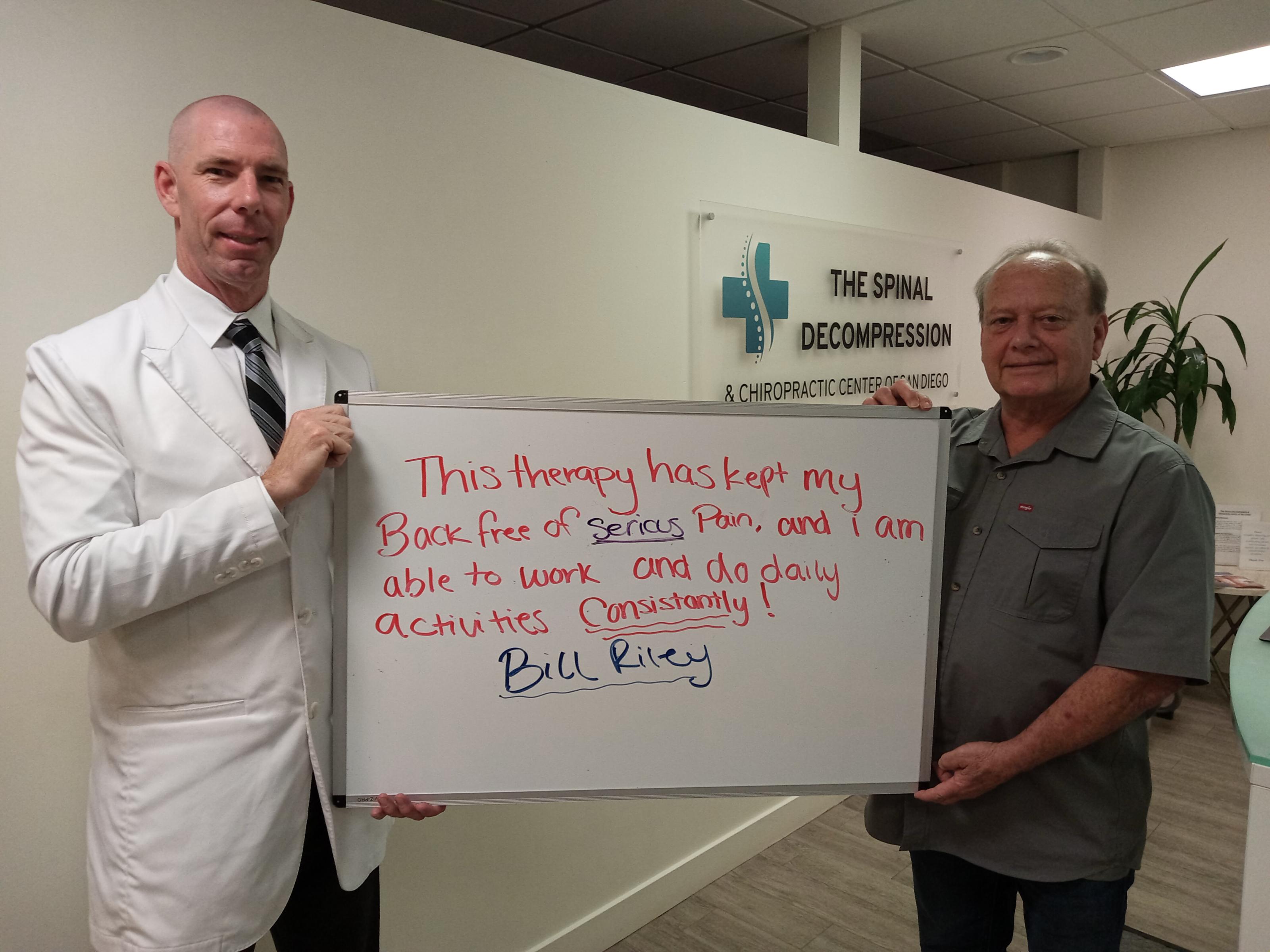
"I have had an outstanding experience with Dr. Boelk and his staff at The Spinal Decompression & Chiropractic Center of San Diego. They follow a very structured treatment protocol and utilize the best spinal decompression equipment available. I've been treated elsewhere using lower-quality decompression systems and never experienced meaningful improvement. Dr. Boelk is attentive, professional, and genuinely cares about every patient. After about 12 treatments, my sciatica was gone and I was nearly back to normal. Honestly, I wasn't sure I would ever heal. What surprised me most was that after my very first treatment, I experienced significant relief and was able to sleep mostly pain-free for the first time in months. The improvement has allowed me to get back to hiking, traveling, and enjoying life again. This treatment was one of the best investments I've ever made. Thank you, Dr. Boelk and your entire team."
★★★★★ — Michael Langsdale, San Diego, CA
Choosing the Right Doctor for a Herniated Disc
If you've never had a herniated disc before, it's easy to assume every office offering spinal decompression provides the same level of care.
In my experience, that's one of the biggest mistakes patients can make.
Rather than asking how much treatment costs or how quickly you can get started, I encourage people to ask a few different questions.
How long has the doctor been treating patients with herniated discs?
Experience matters because every disc injury is different. A treatment plan that works well for one patient may not be appropriate for another.
Will the doctor personally review my MRI?
Your MRI should never be looked at in isolation. It needs to be compared with your symptoms, neurological examination, and physical findings to determine whether it actually explains your pain.
Is treatment individualized?
No two patients are exactly alike. Treatment recommendations should be based on your diagnosis, your goals, and how your body responds—not simply on a standard protocol.
Does the office include rehabilitation?
Helping you feel better is only part of the process. Helping reduce the chances of future flare-ups through spinal stabilization, posture education, and appropriate rehabilitation is equally important.
Will they tell you if you're not a candidate?
This may be the most important question of all.
An ethical office should never recommend the same treatment for everyone.
Some patients truly need surgery.
Others are better served by physical therapy or another specialist.
One of the things I tell every patient is this:
The right treatment is the one that's right for you—not necessarily the one we provide.
My Philosophy
People sometimes ask me why I've devoted so much of my career to treating disc injuries.
The answer is simple.
I've lived through serious neck and back injuries myself.
I know what it's like to wonder whether you'll ever feel normal again.
I know what it's like to miss the activities you love because you're afraid of making your condition worse.
That's why I spend so much time educating patients.
I don't want anyone making decisions out of fear.
I want them making decisions because they understand their diagnosis, understand their options, and feel confident in the path they're choosing.
Whether that path leads them to our office or somewhere else, they've accomplished something important:
They've become an informed patient.
And informed patients almost always make better healthcare decisions.
Ready to Learn More About Your Herniated Disc?
If you've been diagnosed with a herniated disc, have persistent back pain or sciatica, or have already had an MRI and would like an experienced opinion, I'd be happy to meet with you.
During your Complimentary No-Charge Consultation, we'll take the time to:
- Listen to your story and understand your symptoms.
- Personally review your MRI or imaging, if available.
- Perform a thorough examination.
- Explain your diagnosis in plain English.
- Discuss all appropriate treatment options—not just the ones we provide.
- Honestly tell you whether I believe you're a candidate for conservative care.
If I believe another treatment—or another specialist—is the better choice, I'll tell you that too.
My goal isn't simply to recommend treatment.
My goal is to help you make the best decision for your health.
Dr. Cassidy James Boelk, DC
Board-Certified Doctor of Chiropractic
Certified Spinal Decompression Doctor
Certified Pain-Free Performance Specialist (PPSC)
Founder, Non-Surgical Spinal Decompression Training Academy
Founding Member, American Spinal Decompression Society
The Spinal Decompression & Chiropractic Center of San Diego
5095 Murphy Canyon Road, Suite 300
San Diego, CA 92123
📞 619-298-0800
✔ Complimentary No-Charge Consultation
✔ Live 24/7 Answering Service
✔ Hablamos Español