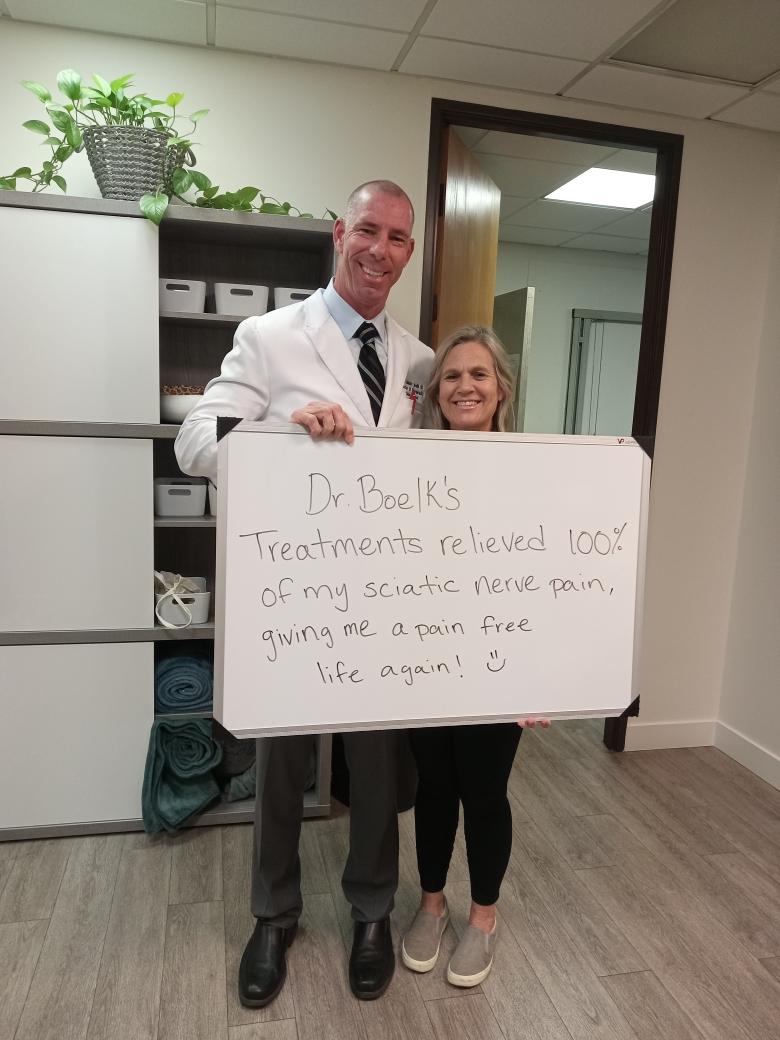
Burning Leg Pains From a Pinched Nerve – San Diego, CA
Burning pain down the leg can be one of the most frustrating and debilitating conditions a person experiences.
For some people, it feels like:
- Sharp electrical pain shooting into the calf or foot
- Burning or stabbing sensations down the leg
- Numbness or tingling
- Weakness while walking
- Pain sitting in the car
- Difficulty sleeping
- Severe low back pain combined with sciatica
- Pain that worsens bending forward, coughing, or prolonged sitting
Many patients are told it is “just sciatica.”
But what many people do not fully understand is that sciatica is often a symptom — not the root cause.
At The Spinal Decompression & Chiropractic Center of San Diego, Dr. Cassidy Boelk, DC specializes in evaluating and treating disc-related nerve compression conditions using advanced Non-Surgical Spinal Decompression (NSSD), movement-based rehabilitation, and customized spinal stabilization programs.
Dr. Boelk is a Certified Spinal Decompression Doctor, Certified Pain-Free Performance Specialist, founder of the Spinal Decompression Training Academy, and has performed over 100,000 spinal decompression treatments using the DRX9000 system.
Many patients travel from throughout California and even outside the United States to seek his expertise after trying multiple other treatments without lasting relief.
What Causes Burning Pain Down The Leg?
One of the most common causes is irritation or compression of a spinal nerve.
This frequently occurs from:
- Disc herniations
- Disc bulges
- Disc degeneration
- Annular tears
- Spinal instability
- Severe disc compression
- Inflammation surrounding spinal nerves
When the disc becomes injured or compressed, it may place pressure on nearby nerves exiting the spine.
This can create symptoms radiating far away from the actual spinal injury itself.
For example:
- A low back disc injury may create burning pain into the buttock, thigh, calf, or foot
- A neck disc injury may create symptoms into the shoulder, arm, or hand
This is why many people continue chasing the area where they feel pain instead of identifying the source of the nerve irritation.
Why Many Treatments Fail To Create Lasting Relief
Many patients who arrive at our office have already tried:
- Traditional chiropractic
- Massage therapy
- General physical therapy
- Stretching programs
- Pain medications
- Injections
- Other decompression clinics
- General traction devices
Yet they continue struggling.
One major reason is because many approaches focus heavily on muscles while failing to adequately address the underlying disc and nerve compression component.
Muscles absolutely matter.
However, when a nerve remains irritated from ongoing disc pressure, symptoms often continue returning.
This is one reason why Dr. Boelk’s office places heavy emphasis on identifying:
- The exact spinal level involved
- Whether symptoms appear disc-related
- Whether nerve compression may be present
- Which movements aggravate symptoms
- Whether the patient may qualify for Non-Surgical Spinal Decompression
What Is Non-Surgical Spinal Decompression?
Non-Surgical Spinal Decompression (NSSD) is designed to help reduce pressure within injured spinal discs and surrounding nerves.
At our office, we exclusively use the DRX9000 system because of its advanced customization capabilities and ability to deliver highly specific decompression treatments.
Not all spinal decompression systems are the same.
Treatment variables matter tremendously, including:
- Angle of pull
- Force applied
- Patient positioning
- Disc level targeted
- Severity of injury
- Muscle guarding
- Tolerance levels
- Stability considerations
This is why generalized traction often produces inconsistent results.
Dr. Boelk customizes treatment protocols based on the patient’s examination findings, movement patterns, MRI findings when available, symptom presentation, and overall spinal mechanics.
Why Active Rehabilitation Is Critical
One of the biggest mistakes people make is relying entirely on passive treatments.
Even when spinal decompression helps reduce pressure and calm symptoms, long-term improvement often requires correcting the underlying instability and movement dysfunctions that contributed to the problem.
This is why our office frequently combines treatment with:
- Core stabilization
- Hip mobility training
- Postural correction
- Spinal stability exercises
- Progressive rehabilitation
- Movement retraining
The goal is not simply temporary relief.
The goal is helping patients regain stability, reduce irritation, improve movement quality, and avoid repeated flare-ups.
Real Patient Experiences
Michael Langsdale
“After only 12 sessions with Dr. Boelk and the DRX9000, I experienced major improvements in my sciatica and low back pain after struggling for a long time. I had tried decompression elsewhere before and it was nowhere near the same quality or effectiveness.”
Summary: Michael experienced significant relief after previously trying lower-quality decompression elsewhere without success.
Calder Pearce
“I came in with severe low back pain and sciatica that was affecting my daily life tremendously. The treatment plan Dr. Boelk put together made a huge difference and helped me get back to functioning normally again.”
Summary: Calder experienced major improvements in severe sciatica symptoms and daily function after customized decompression and rehabilitation.
Marlo Surovsky
“I was in terrible pain and worried surgery was becoming my only option. After treatment with Dr. Boelk and his team, my pain improved dramatically and I was finally able to start moving normally again.”
Summary: Marlo avoided progressing further toward surgical intervention after significant improvement with conservative treatment.
Why Patients Travel To See Dr. Boelk
Patients regularly drive and fly in from:
- Arizona
- Nevada
- Utah
- Oregon
- Alaska
- Mexico
- Spain
- The United Kingdom
- Canada
because they are searching for highly specialized experience with severe disc and nerve compression cases.
Dr. Boelk has spent nearly 20 years focusing heavily on spinal decompression protocols and disc-related injuries.
He also trains doctors nationwide through the Spinal Decompression Training Academy on advanced decompression procedures, patient evaluation, and rehabilitation integration.
Severe Sciatica & Disc Evaluation – San Diego, CA
For qualifying new patients, we are currently offering a limited number of Severe Sciatica & Disc Pain Relief Evaluations at a reduced rate.
This evaluation may include:
- Detailed consultation
- Spinal and movement evaluation
- Review of prior MRI imaging
- Digital motion X-rays if clinically necessary
- Customized treatment recommendations
- Determination of whether you may qualify for our Non-Surgical Disc & Sciatica Pain Relief Program
Because Dr. Boelk personally reviews and evaluates these cases, availability is limited each week.
Many patients contacting our office have already been struggling for months or even years before finally discovering that their symptoms may actually be coming from an injured spinal disc or irritated nerve.
Looking For Help With Burning Leg Pain In San Diego?
If you are struggling with burning pain down the leg, sciatica, numbness, tingling, disc injuries, or chronic low back pain and are trying to avoid injections or surgery, the first step is determining what is truly causing the problem.
The sooner significant nerve irritation and disc compression are properly evaluated, the greater the likelihood of preventing the condition from worsening further.
Contact Our Office
Dr. Cassidy Boelk, DC
Certified Spinal Decompression Doctor
Certified Pain-Free Performance Specialist
Founder – Spinal Decompression Training Academy
Over 100,000 Spinal Decompression Treatments Performed
The Spinal Decompression & Chiropractic Center of San Diego
📍 5095 Murphy Canyon Road, Suite 300
San Diego, CA 92123
📞 Office: (619) 298-0800
📱 Text Line: (619) 884-8298
Our office also has a live 24/7 answering service available to help schedule consultations and answer questions.
Hablamos Español.
Because of the complexity of these cases, all patients are accepted on a first-come, first-served basis after determining whether they are an appropriate candidate for care.