Bulging Disc vs. Herniated Disc – San Diego
Bulging Disc vs. Herniated Disc: What's the Difference?
If you've been told you have a bulging disc or a herniated disc, you may have wondered:
"Are they the same thing?"
It's one of the most common questions we hear from new patients.
The short answer is:
No.
While both conditions involve the spinal discs, they are not identical, and understanding the difference can help explain why some people experience severe pain while others have little or no symptoms.
At The Spinal Decompression & Chiropractic Center of San Diego, Dr. Cassidy James Boelk, DC has spent more than 22 years diagnosing and treating patients with bulging discs, herniated discs, sciatica, degenerative disc disease, and chronic neck and back pain.
One of the first things we do during every consultation is help patients understand exactly what their MRI means—and, just as importantly, what it doesn't mean.
Quick Answer
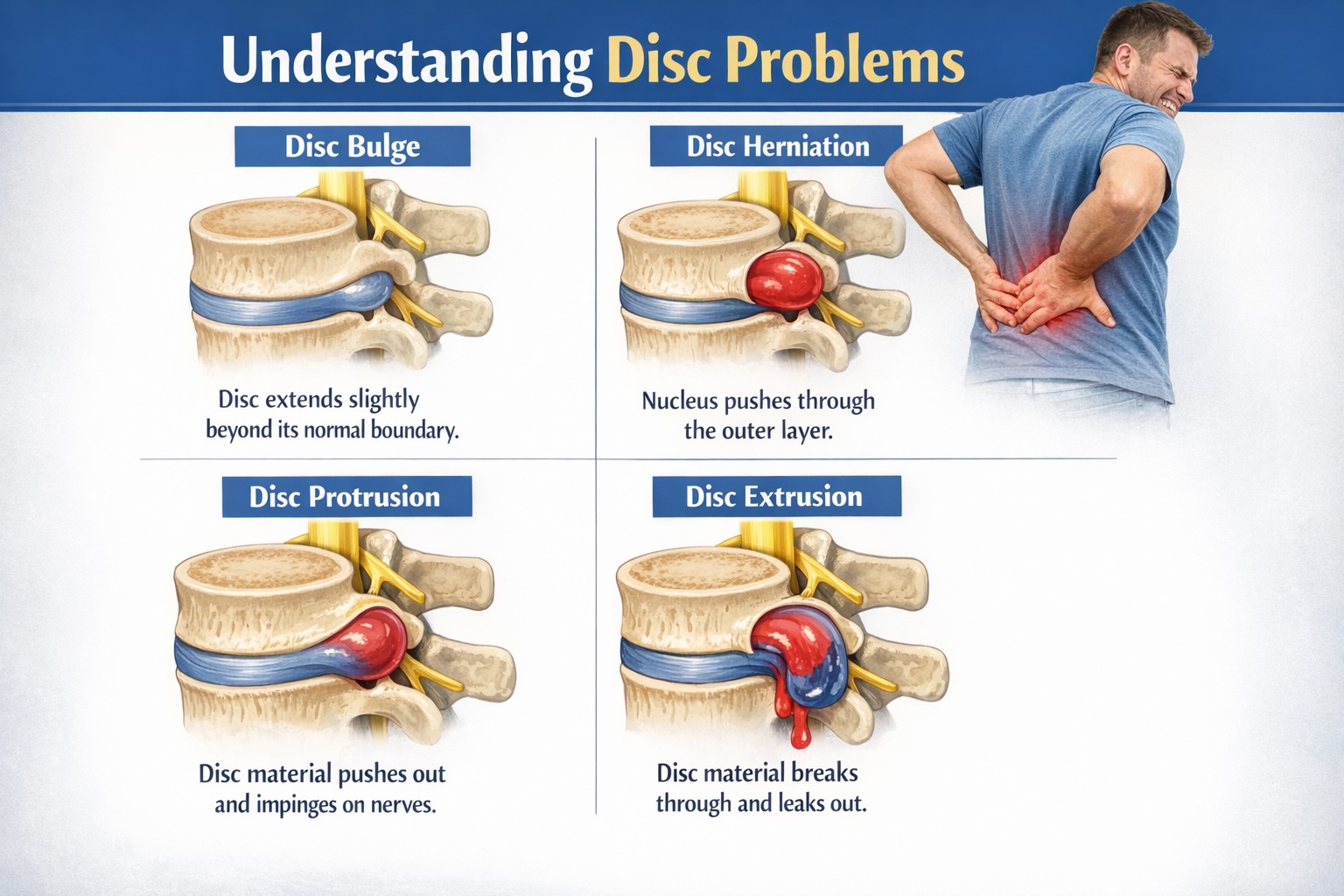
A bulging disc occurs when the outer portion of the disc extends beyond its normal boundaries but remains intact.
A herniated disc occurs when the tough outer layer of the disc develops a tear, allowing some of the soft inner material to push outward.
Both conditions can cause pain.
Both can irritate nearby spinal nerves.
And surprisingly, either condition may produce no symptoms at all.
The most important factor isn't simply what the MRI report says—it's whether the disc is actually responsible for your symptoms.
Schedule Your No-Charge Consultation
If you've been diagnosed with a bulging disc or herniated disc—or you're experiencing persistent neck pain, back pain, sciatica, arm pain, numbness, or tingling—we'd be honored to help.
Your Consultation Includes
✔ Comprehensive Examination
✔ Review of Any MRI or X-rays You Already Have
✔ Honest Diagnosis
✔ Discussion of Conservative Treatment Options
✔ Time to Answer Your Questions
✔ No Obligation
The Spinal Decompression & Chiropractic Center of San Diego
5095 Murphy Canyon Road, Suite 300
San Diego, CA 92123
☎ (619) 298-0800
✔ 24-Hour Live Answering Service
✔ Hablamos Español
"I Finally Understood What Was Actually Causing My Pain."
Many patients arrive with MRI reports filled with unfamiliar medical terms.
They've been told they have bulging discs, herniated discs, degenerative changes, arthritis, stenosis, or multiple abnormalities—but no one has clearly explained which finding is actually causing their symptoms.
One patient shared:
"Dr. Boelk explained my MRI in a way that finally made sense. For the first time, I understood what was causing my sciatica and what my treatment options actually were. I never felt pressured, and every question I had was answered."
One of our goals during every consultation is to help patients understand their diagnosis—not simply read an MRI report.
Understanding Your Spinal Discs
Think of each spinal disc as a shock absorber between the bones of your spine.
Every disc has two main parts:
- A strong outer ring called the annulus fibrosus
- A soft, gel-like center called the nucleus pulposus
These discs allow your spine to move while absorbing the tremendous forces created by walking, lifting, running, sitting, and bending.
As we age, spinal discs naturally begin losing water content and elasticity.
This makes them more susceptible to injury over time.
What Is a Bulging Disc?
A bulging disc occurs when the outer portion of the disc extends beyond its normal boundaries.
Importantly, the outer fibers of the disc remain intact.
You can think of it like a tire that's beginning to bulge outward but hasn't ruptured.
Bulging discs are actually very common.
Many adults have bulging discs without experiencing any pain whatsoever.
In many cases, a bulging disc is simply part of the normal aging process.
However, if the bulge becomes large enough to irritate a nearby spinal nerve, symptoms such as back pain, neck pain, sciatica, arm pain, numbness, or tingling can develop.
What Is a Herniated Disc?
A herniated disc is different.
Instead of simply bulging outward, the tough outer fibers of the disc develop a tear.
Through that tear, some of the soft inner material pushes outward.
Depending on its size and location, this displaced material may place pressure on a nearby spinal nerve or trigger inflammation around the nerve.
This is why herniated discs are often associated with:
- Sciatica
- Arm pain
- Numbness
- Tingling
- Muscle weakness
- Shooting pain into the extremities
Not every herniated disc is painful, but when symptoms occur, they often involve irritation of a spinal nerve.
Which One Is More Serious?
This surprises many people.
A herniated disc is not automatically worse than a bulging disc.
Likewise, a bulging disc isn't automatically a minor problem.
What matters most is:
✔ Is the disc compressing a spinal nerve?
✔ Does it match your symptoms?
✔ Are you developing muscle weakness?
✔ Is the condition improving or worsening?
We've seen patients with large herniated discs who have relatively little pain.
We've also seen patients with seemingly small bulging discs who experience significant sciatica because of where the disc is located.
This is why MRI findings should never be interpreted in isolation.
Your symptoms, physical examination, neurological findings, and imaging all need to be considered together.
Can Both Cause Sciatica?
Absolutely.
Both bulging discs and herniated discs can cause sciatica if they irritate or compress one of the spinal nerves that eventually forms the sciatic nerve.
Sciatica is not a diagnosis itself.
Rather, it's a description of symptoms caused by irritation of the sciatic nerve.
Common symptoms include:
- Pain radiating into the buttock
- Pain traveling down the back or side of the leg
- Numbness or tingling
- Burning sensations
- Muscle weakness
- Difficulty standing or walking
Some patients experience occasional discomfort.
Others find that sitting, driving, coughing, or bending forward significantly worsens their symptoms.
The important question isn't simply whether you have sciatica—it's what's causing it.
Can Either Heal Without Surgery?
In many cases, yes.
One of the biggest misconceptions is that a disc injury automatically leads to surgery.
Fortunately, that's often not true.
Many patients improve with conservative care.
For herniated discs, research has shown that the body may gradually reabsorb portions of the displaced disc material over time while inflammation around the affected nerve decreases.
Bulging discs may also become less symptomatic as inflammation settles and pressure on nearby nerves improves.
Not every patient heals the same way.
Recovery depends on factors including:
✔ The severity of the injury
✔ Whether nerve compression is present
✔ Overall health
✔ Activity level
✔ Following an appropriate treatment plan
This is why every patient deserves an individualized evaluation rather than a one-size-fits-all recommendation.
Where Does Non-Surgical Spinal Decompression Fit In?
For appropriately selected patients with certain disc-related conditions, non-surgical spinal decompression may be one conservative treatment option.
The goal is to gently reduce pressure affecting the injured spinal disc while helping relieve irritation involving nearby spinal nerves.
As symptoms improve, treatment often progresses to strengthening and stabilization exercises designed to help support the spine and improve long-term function.
Just as importantly, patients receive education regarding posture, lifting mechanics, sleeping positions, sitting, and activity modification to help protect the spine during recovery.
It's important to remember that spinal decompression is not appropriate for everyone.
That's why a comprehensive examination always comes first.
My Philosophy After More Than 22 Years
One of the most common mistakes I see is patients becoming overly focused on the wording of their MRI report.
They'll ask:
"Is a bulging disc better than a herniated disc?"
The truth is, that's often the wrong question.
The more important questions are:
- Is this finding actually causing your pain?
- Does it match your examination?
- Is a spinal nerve involved?
- What treatment gives you the best opportunity to improve?
I've treated patients with multiple herniated discs who had very little pain.
I've also treated patients with relatively small bulging discs who were experiencing severe sciatica because of where the disc was located.
This is why I don't treat MRI reports.
I treat people.
Every recommendation I make is based on your symptoms, your examination, your imaging, your goals, and what I believe offers you the greatest opportunity for recovery.
Another Patient's Experience
Calder Pearce spent years searching for answers before finding our office.
"Dr. Boelk and his team are the best in the business! I have had lower back problems for over 5 years and been to 6 other doctors seeking options other than surgery. I came in early January not able to bend and walking with a limp. By February I was able to bend again with minimal pain and by March I am now able to bend without any pain and am able to walk normally.
I am EXTREMELY happy I did not have surgery and found Dr. Boelk. Trust him and the process and he will get you feeling better. He also said from the beginning that if at any stage in the process he felt like progress wasn't happening he would let me know..."
— Calder Pearce, San Diego, CA
Every patient's diagnosis and recovery are different, but Calder's story highlights why understanding all of your treatment options before considering surgery can be so valuable.
Why Patients Throughout San Diego Choose Our Office
Patients travel to our office from neighborhoods throughout San Diego because they're looking for a clinic that focuses specifically on spinal disc injuries rather than treating every type of musculoskeletal complaint.
Patients appreciate that our office offers:
✔ Board-Certified Doctor of Chiropractic
✔ Certified Spinal Decompression Doctor
✔ Certified Pain-Free Performance Specialist (PPSC)
✔ Founder, Spinal Decompression Training Academy
✔ Founding Member, American Spinal Decompression Society
✔ More Than 22 Years Treating Disc Injuries
✔ More Than 100,000 Spinal Decompression Treatments Performed
✔ Seven DRX9000® Systems (4 Lumbar • 3 Cervical)
✔ Honest Candidate Selection
Whether you're coming from Downtown, Mission Valley, Clairemont, La Jolla, Mira Mesa, Kearny Mesa, Chula Vista, or elsewhere in San Diego County, our goal is to help you understand your diagnosis and make an informed decision about your care.
Not Everyone Is a Candidate
One of the things we're most proud of is that we don't recommend spinal decompression for everyone.
If we don't believe it's the right treatment for your condition, we'll tell you.
One patient shared this after visiting our office:
"Very nice Dr. and Honest! I would definitely recommend anyone who hasn't had metal put in their back in a surgery to go to him and give his program a shot. I believe it would definitely help. Just not in my personal case, as I have a lot of hardware in my back. But I'm glad I took the time to meet with him. It was very informative all around."
— Toni W., Lake Elsinore, CA
Honest recommendations have always been one of the foundations of our practice.
Frequently Asked Questions
Is a bulging disc the same as a herniated disc?
No. A bulging disc extends beyond its normal boundaries while the outer fibers remain intact. A herniated disc involves a tear in the outer layer, allowing inner disc material to protrude outward.
Which causes more pain?
Either one can cause significant pain—or no pain at all. Symptoms depend more on whether a spinal nerve is irritated or compressed than on the terminology used in the MRI report.
Can both conditions cause sciatica?
Yes. Both bulging discs and herniated discs can compress or irritate spinal nerves that contribute to the sciatic nerve, resulting in pain, numbness, tingling, or weakness traveling into the leg.
Do all bulging or herniated discs require surgery?
No. Many patients improve with conservative treatment. Surgery is generally reserved for specific situations, such as significant neurological deficits, progressive weakness, or when appropriate conservative care has not been successful.
Do I need an MRI before scheduling?
No. Many patients are evaluated before having an MRI. If you've already had imaging, we'll review it with you. If additional imaging is necessary, we'll explain why.
Due to Patient Demand
For more than 22 years, Dr. Cassidy James Boelk, DC has had the privilege of helping patients throughout San Diego better understand their spinal conditions and explore conservative treatment options.
Every new patient consultation includes time to review your history, perform a comprehensive examination, discuss your diagnosis, and answer your questions.
Because of the time dedicated to each visit, new patient appointments are scheduled on a first-come, first-served basis.
Schedule Your No-Charge Consultation
If you've been told you have a bulging disc, a herniated disc, or you're experiencing persistent neck pain, back pain, or sciatica, we'd be honored to help you understand what's causing your symptoms.
During your consultation, Dr. Cassidy James Boelk, DC will:
✔ Perform a comprehensive examination
✔ Review any MRI or X-rays you've already had
✔ Explain the difference between your MRI findings and your actual diagnosis
✔ Discuss all appropriate treatment options
✔ Answer your questions honestly
If conservative treatment is appropriate, we'll explain why.
If another approach would better serve your condition, we'll tell you that as well.
Our goal is simple:
To provide an accurate diagnosis, honest recommendations, and help you make the most informed decision possible about your spinal health.
The Spinal Decompression & Chiropractic Center of San Diego
📍 5095 Murphy Canyon Road, Suite 300
San Diego, CA 92123
☎ (619) 298-0800
24-Hour Live Answering Service • Hablamos Español