Bulging Disc vs. Herniated Disc – Kearny Mesa
Bulging Disc vs. Herniated Disc: What's the Difference?
If you've recently had an MRI and were told you have either a bulging disc or a herniated disc, you may be wondering:
"What's the difference?"
Many patients assume they're simply two different names for the same condition.
They're not.
Although both involve the spinal discs and can cause neck pain, back pain, sciatica, numbness, or tingling, they describe different types of disc injuries.
Understanding the difference can help you better understand your MRI, your symptoms, and the treatment options available to you.
At The Spinal Decompression & Chiropractic Center of San Diego, located just minutes from Kearny Mesa, Dr. Cassidy James Boelk, DC has spent more than 22 years evaluating patients with bulging discs, herniated discs, degenerative disc disease, spinal stenosis, and sciatica.
Rather than treating MRI reports, our goal is to identify whether your imaging findings actually explain your symptoms and determine the most appropriate treatment plan.
Quick Answer
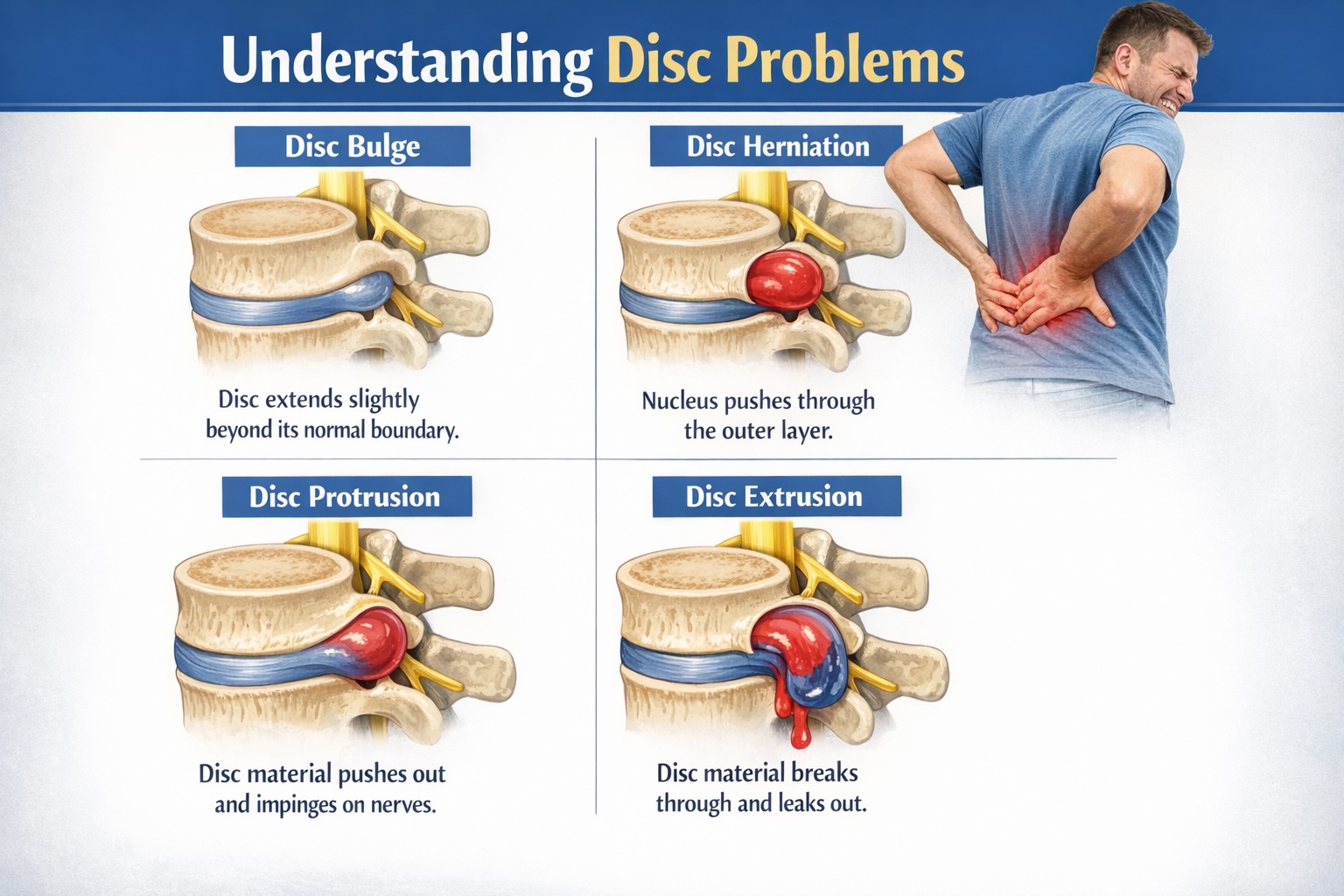
A bulging disc occurs when the disc extends beyond its normal boundaries, but the tough outer fibers remain intact.
A herniated disc occurs when the outer layer develops a tear, allowing part of the soft inner material to push outward.
Both conditions can:
✔ Cause pain
✔ Compress spinal nerves
✔ Produce sciatica
✔ Cause numbness or tingling
✔ Cause muscle weakness
Or...
Neither may produce symptoms at all.
The MRI finding alone doesn't determine how serious your condition is.
Schedule Your No-Charge Consultation
If you've recently been diagnosed with a bulging disc or herniated disc—or you're experiencing persistent back pain, neck pain, or sciatica—we'd be honored to help.
Your Consultation Includes
✔ Comprehensive Examination
✔ Review of Any MRI or X-rays You Already Have
✔ Honest Diagnosis
✔ Discussion of Conservative Treatment Options
✔ Time to Answer Your Questions
✔ No Obligation
The Spinal Decompression & Chiropractic Center of San Diego
5095 Murphy Canyon Road, Suite 300
San Diego, CA 92123
Conveniently located just minutes from Kearny Mesa.
☎ (619) 298-0800
✔ 24-Hour Live Answering Service
✔ Hablamos Español
"Finally Someone Explained My MRI."
One of the biggest frustrations patients express is that they've been handed an MRI report filled with unfamiliar medical terminology but never had anyone explain what it actually means.
One patient shared:
"Dr. Boelk explained everything in plain English. I finally understood the difference between what my MRI showed and what was actually causing my pain. It made me feel much more confident about moving forward."
Helping patients understand their diagnosis is one of the most important parts of every consultation.
Understanding the Anatomy of a Spinal Disc
Think of each spinal disc as a shock absorber positioned between the bones of your spine.
Every disc consists of two primary parts:
- A strong outer ring called the annulus fibrosus
- A soft, gel-like center called the nucleus pulposus
Together, these structures absorb the forces created by walking, lifting, bending, twisting, sitting, and other daily activities.
As discs naturally age, they gradually lose water content and flexibility, making them more susceptible to injury.
What Is a Bulging Disc?
A bulging disc occurs when the outer portion of the disc begins extending beyond its normal borders.
Importantly, the outer fibers remain intact.
Imagine squeezing a jelly-filled donut without breaking the outer dough.
The shape changes, but nothing leaks out.
That's similar to a bulging disc.
Bulging discs are actually extremely common and often appear on MRI scans in people who have no pain whatsoever.
However, if the bulge narrows the space around a spinal nerve, symptoms may develop.
What Is a Herniated Disc?
A herniated disc occurs when the outer fibers develop a tear.
Through that opening, some of the soft inner disc material pushes outward.
If this material irritates or compresses a nearby spinal nerve, patients may experience symptoms such as:
- Sciatica
- Arm pain
- Numbness
- Tingling
- Muscle weakness
- Shooting pain
Again, not every herniated disc causes symptoms.
Some large herniations are surprisingly painless, while some relatively small herniations can produce severe nerve pain depending on their location.
Which One Is Worse?
This is probably the question we hear most often.
The honest answer is:
Neither is automatically worse.
What matters most is:
✔ Is a nerve involved?
✔ Does the MRI match your symptoms?
✔ Are neurological deficits present?
✔ Is the condition improving?
We've evaluated patients from Kearny Mesa whose MRI reports sounded alarming but whose symptoms improved with conservative care.
We've also seen relatively minor-looking MRI findings produce significant pain because of where the disc was located.
That's why MRI findings should always be interpreted together with your history and physical examination.
Can Both Cause Sciatica?
Yes.
Both a bulging disc and a herniated disc can cause sciatica if they place pressure on or irritate one of the spinal nerves that eventually forms the sciatic nerve.
Sciatica isn't a diagnosis itself—it's a symptom caused by irritation of the sciatic nerve.
Patients commonly experience:
- Pain radiating into the buttock
- Pain traveling down the leg
- Burning pain
- Numbness
- Tingling
- Muscle weakness
- Difficulty standing or walking
Many of our patients from Kearny Mesa first notice symptoms after long days sitting at a desk, driving between job sites, working in healthcare, or performing repetitive lifting in warehouses and industrial settings. These activities don't necessarily cause the disc injury, but they often aggravate an already irritated spinal nerve.
The important question isn't simply whether you have sciatica.
It's what's causing it.
Can Both Conditions Heal Without Surgery?
In many cases, yes.
Being diagnosed with a bulging disc or herniated disc does not automatically mean you'll need surgery.
Many patients improve through conservative treatment.
For herniated discs, research has shown that the body can gradually reabsorb portions of the displaced disc material while inflammation decreases around the affected nerve.
Bulging discs may also become much less symptomatic as inflammation settles and pressure on nearby nerves improves.
Recovery depends on numerous factors, including:
✔ The size and location of the disc injury
✔ Whether a nerve is compressed
✔ Your overall health
✔ Your activity level
✔ Following an appropriate treatment plan
Every patient heals differently, which is why individualized care is so important.
Where Does Non-Surgical Spinal Decompression Fit In?
For appropriately selected patients, non-surgical spinal decompression may be an effective conservative treatment option.
The goal is to gently reduce pressure affecting the injured spinal disc while decreasing irritation involving nearby spinal nerves.
As symptoms improve, treatment generally progresses to spinal stabilization and strengthening exercises designed to improve long-term function.
Patients also receive education regarding:
- Sitting posture
- Ergonomic workstations
- Safe lifting techniques
- Sleeping positions
- Activity modification
For many Kearny Mesa professionals who spend long hours sitting at computers or commuting throughout San Diego, these lifestyle modifications become just as important as the treatment itself.
Spinal decompression is not appropriate for every patient, which is why a thorough examination always comes first.
My Philosophy After More Than 22 Years
One of the biggest misconceptions I encounter is that patients become overly concerned about the wording of their MRI report.
Many ask:
"Doctor, which is worse—a bulging disc or a herniated disc?"
The reality is that the MRI terminology often matters far less than the clinical findings.
I've treated patients with multiple herniated discs who had relatively little pain.
I've also cared for patients with small bulging discs who experienced severe sciatica because the disc happened to be pressing on a nerve in exactly the wrong location.
That's why I never recommend treatment based solely on MRI findings.
Instead, I evaluate:
- Your symptoms
- Your neurological examination
- Your orthopedic examination
- Your imaging
- Your activity goals
- Your overall health
Only then do I recommend what I believe offers the greatest opportunity for improvement.
My goal isn't to sell a treatment.
It's to help you understand your condition and make the most informed decision possible.
Another Patient's Experience
Calder Pearce came to our office after years of lower back pain and multiple consultations while trying to avoid surgery.
"Dr. Boelk and his team are the best in the business! I have had lower back problems for over 5 years and been to 6 other doctors seeking options other than surgery. I came in early January not able to bend and walking with a limp. By February I was able to bend again with minimal pain and by March I am now able to bend without any pain and am able to walk normally.
I am EXTREMELY happy I did not have surgery and found Dr. Boelk. Trust him and the process and he will get you feeling better. He also said from the beginning that if at any stage in the process he felt like progress wasn't happening he would let me know..."
— Calder Pearce, San Diego, CA
Every patient's condition is unique, but Calder's experience highlights why many people choose to fully explore conservative treatment options before considering spine surgery.
Why Patients from Kearny Mesa Choose Our Office
Because our office is located just minutes from Kearny Mesa, we regularly care for patients who live and work throughout the area.
Many are:
- Healthcare professionals
- Engineers
- Office workers
- Mechanics
- Tradespeople
- Business owners
- Warehouse and logistics employees
These occupations often involve prolonged sitting, repetitive lifting, bending, standing, or long commutes—all of which can aggravate disc-related pain.
Patients appreciate that our office offers:
✔ Board-Certified Doctor of Chiropractic
✔ Certified Spinal Decompression Doctor
✔ Certified Pain-Free Performance Specialist (PPSC)
✔ Founder, Spinal Decompression Training Academy
✔ Founding Member, American Spinal Decompression Society
✔ More Than 22 Years Treating Disc Injuries
✔ More Than 100,000 Spinal Decompression Treatments Performed
✔ Seven DRX9000® Systems (4 Lumbar • 3 Cervical)
✔ Honest Candidate Selection
Our mission is to help patients return to work, recreation, and everyday life with confidence.
Not Everyone Is a Candidate
One of the things that distinguishes our practice is that we don't recommend spinal decompression simply because someone has a bulging or herniated disc.
If we don't believe it's the right treatment for your condition, we'll tell you.
One patient shared this after visiting our office:
"Very nice Dr. and Honest! I would definitely recommend anyone who hasn't had metal put in their back in a surgery to go to him and give his program a shot. I believe it would definitely help. Just not in my personal case, as I have a lot of hardware in my back. But I'm glad I took the time to meet with him. It was very informative all around."
— Toni W., Lake Elsinore, CA
We believe patients deserve honest recommendations based on their diagnosis—not a one-size-fits-all treatment plan.
Frequently Asked Questions
Is a bulging disc less serious than a herniated disc?
Not necessarily. Either condition can be mild or severe depending on whether it compresses a spinal nerve and whether it matches your symptoms.
Can both conditions cause sciatica?
Yes. Both bulging discs and herniated discs can irritate or compress the spinal nerves that contribute to the sciatic nerve.
Can both heal without surgery?
Many patients improve without surgery, although recovery depends on the severity of the injury, your symptoms, and your overall health.
Will my MRI tell me exactly what's causing my pain?
Not always. MRI findings must always be interpreted alongside your history and physical examination. Many people have abnormal MRI findings without experiencing pain.
Do I need an MRI before scheduling?
No. If you've already had one, we'll review it. If additional imaging is needed after your examination, we'll explain why.
Due to Patient Demand
For more than 22 years, Dr. Cassidy James Boelk, DC has helped patients from Kearny Mesa and throughout San Diego better understand spinal disc injuries and explore conservative treatment options.
Each consultation includes ample time for a detailed history, comprehensive examination, imaging review, and discussion of your treatment options.
Because of this individualized approach, new patient appointments are scheduled on a first-come, first-served basis.
Schedule Your No-Charge Consultation
If you've been diagnosed with a bulging disc, a herniated disc, or you're experiencing persistent neck pain, back pain, or sciatica, we'd be honored to help.
During your consultation, Dr. Cassidy James Boelk, DC will:
✔ Perform a comprehensive examination
✔ Review your MRI or X-rays, if available
✔ Explain your diagnosis in plain English
✔ Discuss all appropriate treatment options
✔ Answer every question you have
If we believe conservative care is appropriate, we'll explain why.
If another treatment—or a referral to another specialist—is in your best interest, we'll tell you that too.
Our goal is simple:
To help you understand your condition, make an informed decision, and return to the activities that matter most to you.
The Spinal Decompression & Chiropractic Center of San Diego
📍 5095 Murphy Canyon Road, Suite 300
San Diego, CA 92123
☎ (619) 298-0800
24-Hour Live Answering Service • Hablamos Español